


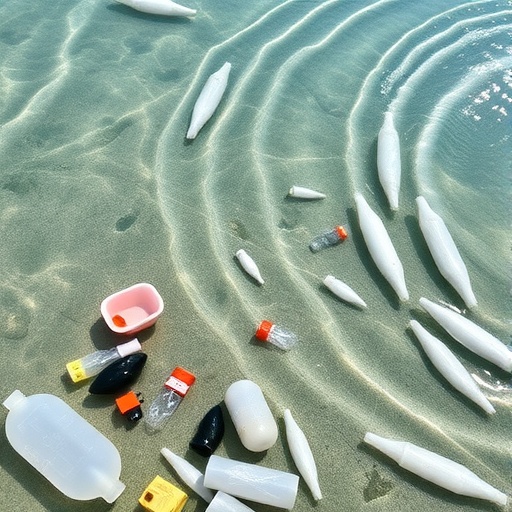
Scientists have long grappled with the perplexing mystery of plastic pollution in the world’s oceans, where the sheer volume of buoyant plastic waste on the surface does not tally with the amounts observed. A groundbreaking new study from Queen Mary University of London, published in Philosophical Transactions of the Royal Society A, now offers compelling insight into this conundrum through a sophisticated computational model that simulates the long-term degradation and transport of buoyant plastics across the ocean’s vertical water column. The research reveals a sobering reality: even if humanity ceased all plastic inputs into the ocean today, microplastics and fragmented debris would persist on the surface and continue polluting marine ecosystems for over a century.
At the heart of this investigation is the simulation of the slow fragmentation processes of large plastic debris exposed to surface ocean conditions such as sunlight, mechanical abrasion by waves, and complex interactions with organic material. These large plastics gradually break down into microscopic fragments that then adhere to marine snow—a sticky, organic particulate matter that plays an integral role in transporting particles to deeper waters. By coupling fragmentation kinetics with a size-selective sedimentation paradigm, the model meticulously tracks how these buoyant plastics transition from surface pollutants to components embedded within deep-sea sediments. This fusion of biological and physical oceanographic processes offers the most comprehensive quantification yet of the temporal fate of surface plastics.
Lead author Dr. Nan Wu of Queen Mary University of London underscores the magnitude and persistence of this issue: “Our model demonstrates that the fragmentation of buoyant plastics is a protracted process, spanning decades. Even after 100 years, roughly 10% of plastic material initially at the surface remains afloat, continuing to generate microplastic pollution.” This slow and persistent degradation challenges previous assumptions that plastics simply sink rapidly or disappear entirely, painting a more intricate picture of oceanic plastic lifespan that reconciles observed surface plastic shortfalls—often coined the ‘missing plastic’ problem—with the enduring pollution footprint.
The model extends beyond plastic fragmentation to reveal critical interactions with the ocean’s biological pump—an essential conveyor system responsible for carbon sequestration and nutrient cycling. As microplastic concentrations escalate due to unmitigated plastic production and pollution, there is growing concern that these foreign particles may overwhelm the biological pump’s capacity. This saturation could disrupt fundamental biogeochemical cycles, altering carbon fluxes and potentially triggering adverse feedback mechanisms in ocean ecosystems, which are foundational to global climate regulation.
This paradigm-shifting study also highlights the role of suspended fine particulates, including marine snow, as essential vectors in microplastic sedimentation. Co-author Professor Kate Spencer emphasizes that “fine and sticky suspended sediments are critical to understanding microplastic fate and transport.” Such sediments effectively catalyze the sinking of microplastics that would otherwise remain buoyant, implying that sediment dynamics must be factored into future assessments of plastic pollution impacts and mitigation strategies at oceanic scales.
Moreover, the research calls for a shift in environmental management and public policy perspectives. Professor Andrew Manning, a co-author with dual expertise in marine science and environmental engineering, explains, “Tackling ocean plastic pollution requires long-term, systemic thinking that goes beyond simply cleaning plastics off the surface.” This study advocates for strategies that incorporate the slow fragmentation timeline and complex sedimentation processes, aligning remediation efforts with the protracted natural degradation mechanisms inherent to marine plastics.
The study was a collaborative effort integrating multi-disciplinary expertise, including marine geochemistry, environmental fluid dynamics, and computational modeling. Such a holistic approach has enabled the creation of a dynamic framework capable of simulating quantitative plastic mass transfer from the ocean surface down to the bathyal and abyssal depths. This framework not only enhances predictive capabilities but also serves as a valuable tool for assessing future scenarios of plastic pollution under varying environmental and mitigation pathways.
The findings elucidate why vast quantities of buoyant plastics remain elusive during ocean surface surveys, contributing significantly to our understanding of the plastic lifecycle in marine environments. The persistent presence of plastics, even decades after input cessation, further underlines the intergenerational nature of marine plastic contamination. These insights stress the urgency for global policy frameworks to prioritize plastic reduction and improve waste management practices internationally, given that removal and degradation are inherently slow natural processes.
Funding for the research was provided by the Lloyd’s Register Foundation, with additional support from Queen Mary University of London, HR Wallingford Ltd, and the EU INTERREG Preventing Plastic Pollution project. Access to computational resources, coupled with field data from prior studies published in Nature Water and Limnology & Oceanography, strengthened the model’s reliability and integration with empirical evidence.
As plastic production continues to surge globally, this study presents a cautionary outlook on the long-term environmental consequences of current consumption and disposal patterns. By shedding light on the detailed mechanisms governing plastic fragmentation and vertical transport, this research paves the way for improved risk assessments and highlights the critical need for sustained international cooperation to address marine plastic pollution comprehensively and effectively.
The comprehensive model developed by Dr. Wu and colleagues represents a significant step forward in unraveling the complexities of plastic pollution dynamics in the world’s oceans. As the global community confronts the escalating marine pollution crisis, insights such as these will be crucial to designing sustainable interventions capable of preserving oceanic health for generations to come.
News Publication Date:
23-Oct-2025
Web References:
http://dx.doi.org/10.1098/rsta.2024.0445
References:
Wu N, Grieve S, Manning A, Spencer K. 2025 Coupling fragmentation to a size-selective sedimentation model can quantify the long-term fate of buoyant plastics in the ocean. Phil. Trans. R. Soc. A 383: 20240445.
Cite Scienmag News
Violet Maxwell. (October 23, 2025). New Study Reveals Plastic Pollution Can Persist on Ocean Surfaces for Over a Century. Scienmag. https://scienmag.com/new-study-reveals-plastic-pollution-can-persist-on-ocean-surfaces-for-over-a-century/
Violet Maxwell. "New Study Reveals Plastic Pollution Can Persist on Ocean Surfaces for Over a Century." Scienmag, 23 October 2025, https://scienmag.com/new-study-reveals-plastic-pollution-can-persist-on-ocean-surfaces-for-over-a-century/. Accessed 3 September 2026.
Violet Maxwell. "New Study Reveals Plastic Pollution Can Persist on Ocean Surfaces for Over a Century." Scienmag. October 23, 2025. https://scienmag.com/new-study-reveals-plastic-pollution-can-persist-on-ocean-surfaces-for-over-a-century/


