


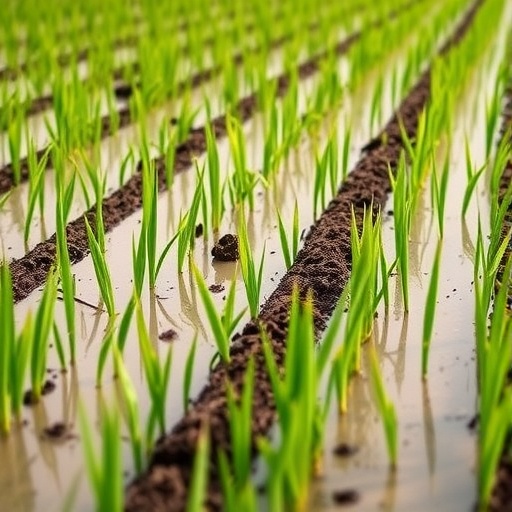
In a groundbreaking study published in the prestigious Proceedings of the National Academy of Sciences (PNAS), researchers led by Professor YAN Xiaoyuan from the Institute of Soil Science at the Chinese Academy of Sciences have fundamentally revised our understanding of nitrogen cycling in flooded rice ecosystems. For decades, the scientific consensus held that the majority of nitrogen gas losses in rice paddies, particularly the emission of dinitrogen (N₂), originated directly from the nitrogen fertilizers applied to these crops. However, this new research reveals a paradigm-shifting insight: the dominant source of dinitrogen emissions is actually soil organic nitrogen (SON), not the applied fertilizers.
The significance of nitrogen to global rice production, especially in China where fertilizer application rates frequently reach two to three times the global average, has long placed the spotlight on agricultural management practices aimed at curbing nitrogen loss. Until now, efforts to mitigate gaseous nitrogen emissions have centered on optimizing fertilizer use. However, one fundamental challenge has been accurately distinguishing soil-emitted N₂ from the atmospheric background, which has obscured precise source attribution. By addressing this challenge, the research team has uncovered that a substantial fraction—approximately 72% to 75%—of N₂ emissions stems from the mineralization of soil organic nitrogen rather than the applied synthetic fertilizers themselves.
To unlock these revelations, the team deployed an innovative in situ methodology that combined ^15N isotope tracing with membrane inlet mass spectrometry (MIMS). This sophisticated approach allowed for continuous, simultaneous monitoring of multiple nitrogen gases—dinitrogen (N₂), ammonia (NH₃), and nitrous oxide (N₂O)—across the entire rice growing season. More importantly, it enabled researchers to partition the gaseous emissions according to their nitrogen sources precisely. This methodological breakthrough overcame long-standing analytical limitations and provided unprecedented resolution in field-scale nitrogen transformation measurements.
These detailed observations revealed a complex temporal pattern in nitrogen losses associated with rice cultivation. Early in the growing season, volatile ammonia emissions were closely tied to the application of synthetic fertilizers, mainly urea, which rapidly hydrolyzes to produce ammonium (NH₄⁺). However, as the season progressed, the dominant pathway shifted toward dinitrogen emissions primarily originating from nitrogen released through the microbial breakdown of soil organic matter. Nitrous oxide emissions, another potent greenhouse gas, were found to be produced by both fertilizer-derived and soil-derived nitrogen, indicating a more complicated interplay between soil microbiota and fertilizer inputs.
The researchers propose a novel conceptual framework termed the “microbial nitrogen pump” to explain these dynamics. This mechanism suggests that, following fertilizer application, soil microbes swiftly assimilate ammonium to fulfill their growth demands, inducing a stoichiometric imbalance between carbon and nitrogen within the microbial biomass. To restore this equilibrium, the microbes accelerate the decomposition of native soil organic matter, leading to the mobilization and mineralization of soil organic nitrogen. The mineralized ammonium, derived from this “old nitrogen,” subsequently undergoes nitrification and denitrification processes, culminating in the release of dinitrogen gas into the atmosphere. This challenges the conventional notion that fertilizer nitrogen directly transforms into gaseous losses.
Intrinsically, the microbial nitrogen pump thus acts as an indirect driver of substantial nitrogen losses, with fertilizer serving as an activator of soil nitrogen pools rather than the primary nitrogen source lost as gas. This insight has profound implications for nitrogen management in flooded rice systems because it shifts the focus from fertilizer input alone to the soil microbial and organic matter interactions that govern nitrogen cycling at a more fundamental level.
Beyond merely advancing scientific understanding, the study also identifies promising practical applications. Notably, hybrid rice cultivars demonstrated enhanced efficiency in nitrogen uptake and microbial nitrogen utilization. These varieties reduced yield-scaled nitrogen gas emissions by approximately 43% without sacrificing grain productivity, highlighting a viable pathway to achieve both environmental sustainability and food security. This synergy underscores the importance of integrating crop breeding strategies with soil microbiome management to optimize nitrogen use efficiency.
The implications of this research extend far beyond rice paddies in China. By establishing soil organic nitrogen as the dominant source of dinitrogen emissions, the study calls for a reassessment of global nitrogen budgets and the models that predict greenhouse gas emissions from agricultural systems. Current models may underestimate the contribution of soil organic nitrogen mineralization to nitrogen gas fluxes, which could lead to errors in shaping climate policies and agricultural guidelines worldwide.
Furthermore, this work offers a new theoretical and methodological foundation for future research focused on sustainable agricultural practices. The combination of isotope tracing and real-time gas measurement tools presents an opportunity to explore nitrogen cycling intricacies in various agroecosystems, potentially leading to innovations that curb nitrogen losses while maintaining or even enhancing crop yields.
Importantly, understanding the microbial nitrogen pump also opens avenues to manipulate soil microbial communities and organic matter dynamics to mitigate nitrogen loss. For example, adjusted fertilization regimes that minimize microbial disruption or practices that maintain the soil organic nitrogen reservoir could reduce N₂ emissions. Additionally, breeding or engineering crop varieties capable of more efficient nitrogen uptake could further diminish the indirect losses triggered by microbial mineralization.
In conclusion, this pioneering study by Prof. YAN Xiaoyuan and colleagues heralds a new era in agricultural nitrogen research. By demonstrating that soil organic nitrogen, rather than fertilizer nitrogen, predominantly drives dinitrogen emissions in flooded rice systems, they challenge longstanding assumptions and highlight the central role of microbial processes in agricultural nitrogen cycling. Their findings not only provide theoretical insights but also practical strategies to enhance nitrogen use efficiency and reduce environmental impacts, offering hope for more sustainable food production systems globally.
[Subject of Research]: Not applicable
[Article Title]: Soil organic nitrogen rather than fertilizer drives dinitrogen losses in flooded rice systems
[References]: YAN Xiaoyuan et al., Proceedings of the National Academy of Sciences, 2026.
[Image Credits]: YAN Xiaoyuan
[Keywords]: Soil science, Environmental sciences, Soils, Pedology, Soil chemistry, Fertilizers, Nitrogen cycle
Cite Scienmag News
Alan Morgan. (April 28, 2026). New Study Finds Soil, Rather Than Fertilizer, Drives Nitrogen Gas Emissions in Rice Paddies. Scienmag. https://scienmag.com/new-study-finds-soil-rather-than-fertilizer-drives-nitrogen-gas-emissions-in-rice-paddies/
Alan Morgan. "New Study Finds Soil, Rather Than Fertilizer, Drives Nitrogen Gas Emissions in Rice Paddies." Scienmag, 28 April 2026, https://scienmag.com/new-study-finds-soil-rather-than-fertilizer-drives-nitrogen-gas-emissions-in-rice-paddies/. Accessed 3 September 2026.
Alan Morgan. "New Study Finds Soil, Rather Than Fertilizer, Drives Nitrogen Gas Emissions in Rice Paddies." Scienmag. April 28, 2026. https://scienmag.com/new-study-finds-soil-rather-than-fertilizer-drives-nitrogen-gas-emissions-in-rice-paddies/


