


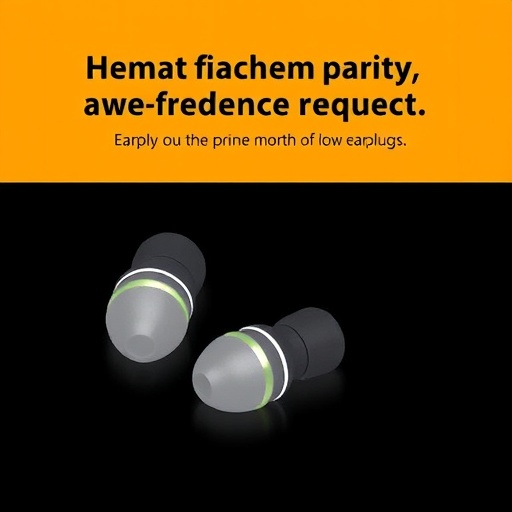
In the modern workplace, hearing loss remains a widespread and insidious occupational hazard. Despite the availability of earplugs, many workers avoid wearing them due to discomfort and undesirable acoustic effects. A new breakthrough in earplug technology now promises to revolutionize hearing protection by addressing these issues with unprecedented precision. Researchers specializing in acoustics from institutions in Canada and France have engineered advanced passive earplugs utilizing Helmholtz resonators—micro-architectural components that can selectively attenuate low-frequency noise while preserving comfort and communication clarity. This innovation, as recently reported in the Journal of the Acoustical Society of America, paves the way toward safer work environments without sacrificing auditory comfort.
Traditional earplugs effectively reduce many high-frequency noises but struggle with low-frequency vibrations and hums, common in industrial settings such as warehouses and transport hubs. Such sounds, including the rumbling of traffic or the subtle yet persistent vibrations of machinery, penetrate conventional earplugs due to individual anatomical variations in ear canal shape and size, causing significant sound leakage. Moreover, the ubiquitous occlusion effect—where the user’s own voice becomes exaggerated and hollow inside the ear—poses a serious barrier to consistent earplug use, often leading to their premature removal during work shifts. The newly developed meta-earplugs combat these difficulties by carefully tailoring the acoustic environment within the ear canal.
At the heart of this innovation is the deployment of Helmholtz resonators—precisely engineered, bulb-shaped cavities with narrow necks—embedded inside the earplug’s structure. These resonators are designed to finely tune the reflection patterns of sound waves inside the ear canal. When the earplug seals the ear, it effectively creates a small acoustic chamber where sound waves bounce back and forth between the eardrum and the earplug itself. By adjusting the dimensions and configurations of the resonators, researchers can engineer constructive or destructive interference patterns, selectively canceling out unwanted low-frequency noise while maintaining natural auditory feedback.
Leading acoustician Kévin Carillo, one of the principal investigators from the Institut de recherche Robert-Sauvé en santé et en sécurité du travail, explains that this design simultaneously enhances comfort and protection—two qualities historically at odds in earplug development. The precise tuning of multiple Helmholtz resonators in series allows the earplug to target a broad spectrum of low frequencies without relying on active electronics or bulky components. This passive attenuation method represents a leap forward in ergonomic auditory protection technology, directly addressing problems that have long plagued conventional hearing protection devices.
The fabrication of these meta-earplugs involves cutting-edge 3D printing techniques, which are critical for achieving the intricate, small-scale geometries necessary for the Helmholtz resonators to function effectively. The cavities inside the resonators measure just a few cubic centimeters, and their necks are precisely engineered to sub-millimeter accuracy. This level of manufacturing precision ensures the earplugs perform exactly as designed, tuning out low-frequency noise and dissipating acoustic pressure within the confined space of the ear canal.
Previously established research by Carillo and his colleagues demonstrated the effectiveness of Helmholtz-resonator-enhanced meta-earplugs in reducing the annoying occlusion effect, significantly improving wearer experience. Building on this foundational work, the current study extends the technology’s protective range to include challenging environmental sounds that conventional earplugs inadequately address. The multi-resonator approach acts dynamically to relieve the acoustic pressure build-up associated with low-frequency noise exposure, which has been a persistent challenge in industrial noise mitigation.
Importantly, this technology achieves high-performance acoustic attenuation without requiring electrical power or embedded electronics, a significant advantage in terms of durability, maintenance, and ease of use. The passive mechanism is inherently reliable and sustainable, aligning with the demands of harsh work environments where devices need to be robust and unobtrusive. This quality is crucial for adoption in sectors where workers operate heavy machinery or perform manual labor under varying conditions, often placing limited demands on their equipment.
The researchers are optimistic about extending the application of their technology to address another critical auditory hazard—impulse noise. This category includes sudden, high-intensity, transient sounds such as those generated by nail guns, explosions, or other industrial impacts. Such noises pose an acute risk to hearing because the ear’s natural protective reflexes cannot react swiftly enough to mitigate damage. The meta-earplug design could be further refined to enhance protection against these high-energy acoustic events, potentially saving countless workers from long-term auditory injury.
Another revolutionary aspect of this development lies in its potential to reshape standards for hearing protection devices globally. By integrating the physics of sound attenuation at micro scales, these passive meta-earplugs could redefine regulatory frameworks and workplace safety guidelines. Their enhanced ability to selectively target frequency ranges impacting hearing degradation while maintaining communication intelligibility may encourage higher compliance rates among workers, ultimately reducing the incidence of noise-induced hearing loss.
As the research progresses, future iterations of the meta-earplugs may incorporate tunable resonator arrays or adaptive structures that respond dynamically to changing sound environments. Combining such passive acoustic engineering with smart materials or wearable sensors could unlock new frontiers in hearing health technology. For now, the current achievement stands as a milestone demonstrating how fundamental acoustic principles such as Helmholtz resonance can be harnessed to solve real-world problems affecting millions of workers worldwide.
In conclusion, the combination of acoustical engineering, precise 3D printing, and sophisticated design has yielded a next-generation earplug that addresses longstanding challenges of sound attenuation and wearer comfort. This innovative solution has the potential to transform workplace hearing safety, offering a practical, non-electronic, and highly effective means to mitigate hazardous low-frequency noise—and potentially even impulse noise—without compromising communication or comfort. As workplace environments grow noisier and the need for durable personal protective equipment intensifies, Helmholtz resonator-enhanced meta-earplugs may soon become the new standard in auditory protection.
News Publication Date:
April 28, 2026
Web References:
https://doi.org/10.1121/10.0043161
Keywords
Hearing loss, Acoustics, Sound attenuation, Sound propagation, Acoustic waves, Passive earplugs, Helmholtz resonators, Noise reduction, 3D printing, Occupational safety, Low-frequency sound, Meta-earplugs
Cite Scienmag News
Bethany Barker. (April 28, 2026). Meta Earplugs Minimize Booming Voices and Low-Frequency Rumbles. Scienmag. https://scienmag.com/meta-earplugs-minimize-booming-voices-and-low-frequency-rumbles/
Bethany Barker. "Meta Earplugs Minimize Booming Voices and Low-Frequency Rumbles." Scienmag, 28 April 2026, https://scienmag.com/meta-earplugs-minimize-booming-voices-and-low-frequency-rumbles/. Accessed 4 September 2026.
Bethany Barker. "Meta Earplugs Minimize Booming Voices and Low-Frequency Rumbles." Scienmag. April 28, 2026. https://scienmag.com/meta-earplugs-minimize-booming-voices-and-low-frequency-rumbles/


