


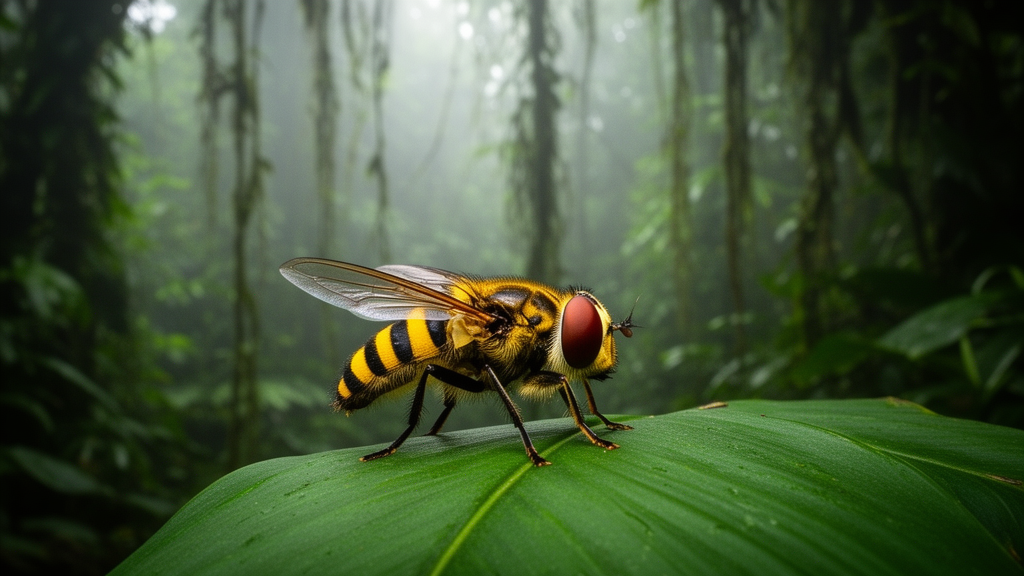
Deep in the lowland rainforest of Ecuador’s Napo Province, a fly with an uncanny resemblance to a stingless bee has turned out to be something entirely new to science. Researchers describing the insect have named it Ubristes mirabilissimus, a superlative form of the Latin word mirabilis, meaning wonderful or strange. The authors chose the name deliberately: in their view, it is the most wonderful species of the genus Ubristes known so far. The discovery, published in the journal Evolutionary Systematics, raises the number of recognized Ubristes species to five and delivers the first DNA barcodes ever obtained for this elusive group of hoverflies.
Ubristes belongs to the hoverfly family Syrphidae, but it is no ordinary flower visitor. The genus sits within the subfamily Microdontinae, an unusual lineage whose larvae are known to live inside ant nests. Adult microdontines are among the rarest and most poorly understood hoverflies in the tropics, with most species known from only one or two specimens. What makes Ubristes particularly striking is its strong resemblance to Neotropical stingless bees of the genus Trigona. The mimicry is built from a combination of long antennae, thickened hind legs armed with corbicula-like brushes on the tibiae, and a matching abdominal shape and colouration, a package that allows the fly to pass among the bees it imitates.
The new species was collected by hand-net along rainforest trails near Grand Selva Lodge and the Campo Cocha Community, at elevations of roughly 500 to 590 metres. The holotype and two paratype males were captured in September 2023 and September 2024, and an additional historical specimen from near Tena, collected in 1976 and held at the Natural History Museum in London, was also studied. The specimens are deposited in the Instituto Nacional de Biodiversidad in Quito, the Natural History Museum in London, and Museum Koenig in Bonn. Observers noted that the flies flew very low, close to the ground, with an erratic, zig-zag-like flight quite unlike the typical flight of most hoverflies, which may partly explain why the species had escaped detection for so long.
Morphologically, Ubristes mirabilissimus is a medium-sized to large hoverfly, measuring 12 to 14 millimetres in body length. Species of Ubristes are diagnosed by a scutellum without calcars and long, brush-like pilosity on the metatibia and metabasitarsomere, with hairs longer than the width of the tibia. Among the genera sharing this hind-leg pilosity, Ubristes alone bears a pair of lateral tubercles on the second abdominal segment at approximately half its length. The male genitalia are unique among all Microdontinae because of well-delimited, oval pits on both sides of the epandrium, structures named lateral fenestrae. These features, together with detailed differences in the cercus and surstylus, allowed the authors to separate the new species from its four known relatives.
What truly sets the new species apart, however, is its wing venation. In all previously described Ubristes species, the wing vein R4+5 carries a posterior appendix, a spur or additional vein extending into cell r4+5, a character also found in many other microdontine genera. In Ubristes mirabilissimus this appendix is entirely absent. As a consequence, the species would probably key out to the genus Hypselosyrphus in existing identification keys, since all Ubristes species differ from Hypselosyrphus and every other microdontine genus only by the presence of the lateral tubercles on tergite 2. The absence of the vein appendix, combined with the elongated abdomen, which is approximately 1.5 times as long as the head and thorax together, and the larger body size distinguishes the new species most notably from its closest relative, the black-bodied Ubristes flavitibia.
To document the species in full, the team applied a combination of classical and modern techniques. Male genitalia were dissected after softening the specimens in a wet chamber for 24 hours, then macerated in lactic acid at room temperature for another day before rinsing and storage in microvials with glycerine. Measurements were taken with an ocular micrometer in a stereo microscope, and high-quality images were produced through a Zeiss Stereo Discovery v12 microscope and processed by focus stacking with Axiovision software. A distribution map of all Ubristes species was drawn in Adobe Illustrator based on published locality information, with symbols placed by approximation because locality data for these rare flies is often imprecise.
The molecular component of the study marks a genuine milestone. One leg of each sequenced specimen was used for DNA extraction following established barcoding protocols, and the remnants were preserved and labelled as DNA voucher specimens. All new sequences were submitted to GenBank via the Barcode of Life Data System. The holotype and paratype males were successfully sequenced, and the resulting DNA barcodes are identical, constituting the first molecular data ever obtained for the genus Ubristes. A quick comparison against other sequences using BLAST showed that the new species’ barcodes share less than 85 percent similarity with other microdontine genera, underscoring how genetically distinct this lineage is and how much of the group’s diversity remains unsampled.
The known distribution of Ubristes mirabilissimus is confined to two localities in Napo Province, in the Amazonian part of Ecuador, approximately 35 kilometres apart. Both sites lie within lowland tropical rainforest, consistent with the ecology of the other Ubristes species, which appear to be rainforest inhabitants. The number of known localities per species across the entire genus is very low, two at maximum, so the true distribution patterns are undoubtedly very incomplete. Ecuador is now the second country from which two Ubristes species are recorded, as Ubristes ictericus was previously described from the same country.
Rarity or easy overcollection seems to be the norm for tropical Microdontinae. Besides the four specimens of the new species, only about ten Ubristes specimens are known to science in total: five of U. flavitibia, three of U. ictericus, one of U. jaguarinus, and one of U. rex. The authors suggest several possible explanations. Unlike most other hoverflies, for which visiting flowers is a characteristic habit, microdontines are rarely observed at flowers, so they escape the standard survey methods. Another possibility is an association with rare species of ants, or with ants that build their nests in forest canopies, keeping the adult flies out of reach. The larvae of Ubristes remain entirely unknown, although microdontine larvae are generally associated with ants.
The female of Ubristes mirabilissimus is unknown, and so is the male of Ubristes rex, raising the theoretical possibility that these two taxa could belong to the same species. The authors reject this on the basis of clear differences in wing venation, the absence versus presence of the spur on vein R4+5, and body colouration. For those Ubristes species where both sexes are known, namely U. flavitibia and U. ictericus, only minor differences in colour and morphology exist between males and females, so a similarly low degree of sexual dimorphism is expected in the two incompletely known species. With an identification key now provided for all five known Ubristes species, together with the first molecular data for the genus, the stage is set for future work to uncover more of the hidden diversity of these remarkable bee mimics in the Neotropical rainforest.
Subject of Research: Taxonomy and molecular characterization of a new stingless bee mimicking hoverfly species from the Ecuadorian Amazon
Article Title: Ubristes mirabilissimus sp. nov., a new stingless bee mimicking hoverfly from the Ecuadorian Amazon ( Diptera , Syrphidae , Microdontinae )
Article References: Reemer, M., & Mengual, X. (2026). Ubristes mirabilissimus sp. nov., a new stingless bee mimicking hoverfly from the Ecuadorian Amazon (Diptera, Syrphidae, Microdontinae). Evolutionary Systematics, 10(1), 47-54. https://doi.org/10.3897/evolsyst.10.185722
Image Credits: AI Generated
DOI: 10.3897/evolsyst.10.185722
Keywords: hoverflies, Syrphidae, Microdontinae, Ubristes, new species, Ecuador, Amazon rainforest, mimicry, DNA barcoding, taxonomy, mirabilissimus, stingless
Cite Scienmag News
Gavin Prescott. (October 17, 2026). New stingless bee mimic: spectacular hoverfly species discovered in Ecuadorian Amazon. Scienmag. https://scienmag.com/new-stingless-bee-mimic-spectacular-hoverfly-species-discovered-in-ecuadorian-amazon/
Gavin Prescott. "New stingless bee mimic: spectacular hoverfly species discovered in Ecuadorian Amazon." Scienmag, 17 October 2026, https://scienmag.com/new-stingless-bee-mimic-spectacular-hoverfly-species-discovered-in-ecuadorian-amazon/. Accessed 17 October 2026.
Gavin Prescott. "New stingless bee mimic: spectacular hoverfly species discovered in Ecuadorian Amazon." Scienmag. October 17, 2026. https://scienmag.com/new-stingless-bee-mimic-spectacular-hoverfly-species-discovered-in-ecuadorian-amazon/


