


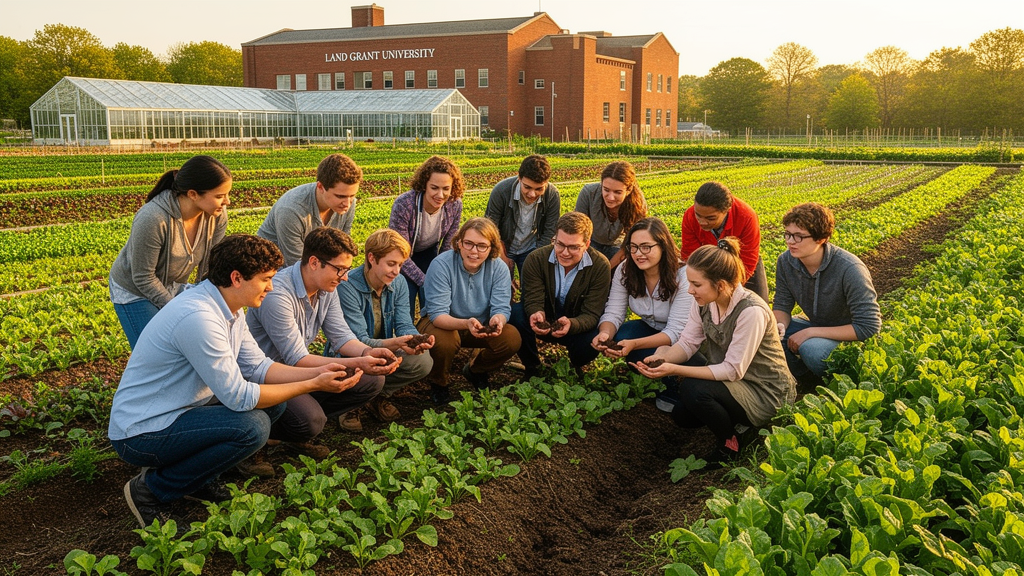
At most American land-grant universities, agroecology and Cooperative Extension occupy separate institutional worlds. Agroecologists tend to work in academic departments focused on ecological principles, systems thinking, and food systems transformation, while extension professionals engage directly with farming communities to address production challenges. Despite sharing buildings, budgets, and a commitment to sustainable agriculture, the two domains rarely collaborate in meaningful ways. A new study from the University of Vermont argues that this separation is a missed opportunity—and documents, over five years, what it takes to bridge it.
The research, published in Frontiers in Sustainable Food Systems, examines the Agroecology Extension (AX) summer Research Fellowship, a five-year, USDA-funded program that ran from 2021 to 2025 and engaged 47 undergraduates in an intensive ten-week model integrating extension research with agroecology education. Drawing on predominantly qualitative evaluation of five cohorts, the team led by Karen Nordstrom, Victor Izzo, Emily Hoyler, and V. Ernesto Méndez identified the enabling and constraining pedagogical factors that shaped the program’s effort to create common ground between two domains that remain institutionally separated at most land-grant universities.
The intellectual stakes are considerable. Agroecology education has grown rapidly over the past two decades, driven by rising student interest and societal demand for professionals equipped to address complex food system challenges. Yet this growth has been characterized more by fragmentation than coherence, with programs evolving independently without shared frameworks or standardized learning outcomes. Scholars have articulated an emerging signature pedagogy for sustainable food systems education—one built on systems thinking, transdisciplinarity, experiential learning, and participation in collective action—but significant gaps remain between stated goals and actual delivery. Recent analyses found that many food systems courses at U.S. land-grant universities fail to incorporate content helping students critically examine equity and social justice or engage in transformative change.
Transformative learning theory, as defined by Mezirow, describes the process by which individuals transform their taken-for-granted frames of reference to make them more inclusive, discriminating, open, and reflective. In agroecology, this aspiration extends beyond skill acquisition: many programs, critics argue, exist in a contextual vacuum that does not analyze the political and economic reasons why the current food system exists. Understanding agroecological transformation requires moving beyond agroecology as science and practice toward a holistic agroecology that also engages food justice and food sovereignty frameworks. The AX Fellowship was designed to test whether such transformative pedagogy could be operationalized within a land-grant institution, where workforce development imperatives often pull programs toward technical and applied orientations.
The program’s structure rested on two integrated components. The Extension Mentor Program engaged students three days per week in ongoing extension research projects spanning pest management, fruit production, crop genetics, agroforestry, community food systems, and watershed management, with soil health running across all projects as a core agroecological principle. Students conducted field data collection, laboratory analysis, farmer surveys, and educational material development alongside extension mentors who served as co-educators. The remaining two days per week were occupied by the Agroecology Leadership Enrichment Program, which provided the conceptual and relational infrastructure through which students could make sense of their field experiences within broader agroecological frameworks, drawing on guest speakers, farm visits, and structured reflection through journals, peer dialog, and shared documentation.
The program’s evolution was driven by embedded, participatory evaluation. Rather than an external assessment appended after the fact, evaluation was built into the program’s design from the outset, grounded in utilization-focused evaluation traditions that position participants as co-creators of knowledge about the program rather than subjects of external measurement. Pre- and post-participation surveys, participant observation, focus groups, document review, and annual advisory team meetings created a cycle from participant experience to structured data collection to collective interpretation to programmatic change. One adaptation proved particularly telling: in 2022, a cohort raised concerns that traditional qualitative methods felt extractive and worked with the evaluation director to co-design a photo-documentation approach as an alternative—a practice that drew on photovoice methodology and subsequently became central to the program’s reflective and participatory architecture.
The 2022 cohort also marked the program’s most significant inflection point around equity. Participant observation surfaced tensions that led a group of BIPOC women fellows to request a meeting with the evaluation director—an act of agency that became a turning point. What the meeting surfaced was not a single incident but a recognized pattern: Vermont’s predominantly white agricultural landscape, the relative homogeneity of extension as a professional field, and the program’s own early limitations in centering equity created conditions in which BIPOC fellows experienced vulnerability and isolation that white fellows did not. The facilitation team responded by treating equity as a sustained pedagogical commitment requiring ongoing attention to how the learning environment itself was structured, including a partnership with UVM’s Center for Cultural Pluralism that brought identity and intersectionality workshops to fellows and cross-cultural competency frameworks to mentors.
Across cohorts, the cohort learning community emerged as the program’s most consistently enabling structure for equity work. Fellows described the peer group as a primary source of support for navigating predominantly white agricultural spaces, the emotional labor of bringing critical food systems perspectives into extension contexts, and the vulnerability of being among few people of color in many field settings. The community did not eliminate these challenges but created conditions in which they could be named and processed collectively. Its most vivid illustration came in response to Vermont’s catastrophic flooding in July 2023, when fellows participated in emergency response efforts including pre-flood harvesting and flood relief at partner farms. A guest speaker described their contribution as immense, embodying the spirit of service learning; fellows’ own reflections spoke of gaining hope and witnessing how people become resilient and come together—expressions, the authors argue, of an emerging agroecological identity formed through collective action in response to community need.
The study’s central findings cohere around three interconnected pedagogical dynamics. First, transformative education at the intersection of agroecology and extension requires explicit engagement with the political dimensions of agroecology and the critical history of extension as an institution—a history, scholars document, that was designed with and for white dominant culture and built on land-grant institutions whose founding rested on the transfer and violent seizure of Indigenous land. Students oriented toward food system transformation encountered extension without the historical and political grounding necessary to make sense of it critically; the authors argue that teaching this history explicitly is itself a critical pedagogical act. Second, equity cannot be treated as a discrete curricular element but must function as a sustained commitment woven into every dimension of program design, from mentor preparation to learning space structure—moving beyond safe space toward brave space across the entire learning community. Third, participatory knowledge co-creation with students requires deliberate structures: photo documentation evolved from a student-selected evaluation tool toward photovoice as an explicit qualitative participatory action research method, and by 2025 the cohort collaboratively developed a shared inquiry question—how do we find purpose and strengthen community through the land and research—presented publicly at a gallery walk.
The authors acknowledge limitations: this is a single case study whose insights are offered as transferable lessons rather than generalizable findings; the evaluation was conducted by the facilitation team itself, mitigated through triangulation across sources; cohorts were small and predominantly white and female-identifying; and arts-based methods came together only in the final year, precluding cross-cohort comparison. Yet the five-year experience demonstrates that bridging agroecology and extension requires more than curricular alignment—it demands explicit pedagogical commitment to political agroecology, relational infrastructure for equity work, and deliberate structures for co-learning. For land-grant universities seeking to develop sustainable programs that prepare graduates to address complex agricultural and food systems challenges, the AX Fellowship offers a rare, detailed roadmap of what transformative integration actually looks like in practice—and a reminder that workforce development and transformative education are complementary imperatives, provided technical skills are situated within the broader formation of becoming an agroecologist.
Subject of Research: Creating common ground: integrating transformative agroecology and extension research in undergraduate education
Article Title: Creating common ground: integrating transformative agroecology and extension research in undergraduate education
Article References: Nordstrom, K. L., Izzo, V., Hoyler, E., & Méndez, V. E. (2026). Creating common ground: integrating transformative agroecology and extension research in undergraduate education. Frontiers in Sustainable Food Systems, 10, Article 1882768. https://doi.org/10.3389/fsufs.2026.1882768
Image Credits: AI Generated
DOI: 10.3389/fsufs.2026.1882768
Keywords: Creating, common, ground, integrating, transformative, agroecology, extension, research, undergraduate, education, scientific research
Cite Scienmag News
Courtney Benton. (October 17, 2026). How a Summer Fellowship Is Rewiring Agroecology Education at Land-Grant Universities. Scienmag. https://scienmag.com/how-a-summer-fellowship-is-rewiring-agroecology-education-at-land-grant-universities/
Courtney Benton. "How a Summer Fellowship Is Rewiring Agroecology Education at Land-Grant Universities." Scienmag, 17 October 2026, https://scienmag.com/how-a-summer-fellowship-is-rewiring-agroecology-education-at-land-grant-universities/. Accessed 17 October 2026.
Courtney Benton. "How a Summer Fellowship Is Rewiring Agroecology Education at Land-Grant Universities." Scienmag. October 17, 2026. https://scienmag.com/how-a-summer-fellowship-is-rewiring-agroecology-education-at-land-grant-universities/


