


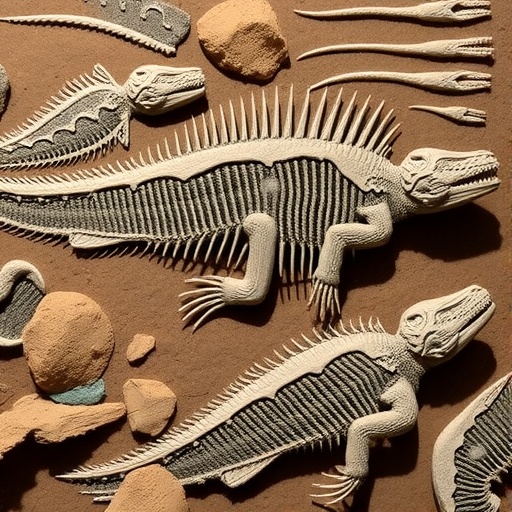
In a remarkable leap forward for paleontology and our understanding of marine ecosystems during the Early Jurassic, scientists have identified an extraordinary new species of plesiosauroid reptile from Germany’s renowned Posidonia Shale deposit. This revelation not only enriches the tapestry of prehistoric marine life but also offers profound insight into evolutionary dynamics during a tumultuous geological epoch approximately 183 million years ago. The newly described species, Plesionectes longicollum, meaning “long-necked near-swimmer,” emerges from a nearly complete fossil skeleton, shedding light on an enigmatic chapter of plesiosaur diversification that had remained underappreciated until now.
The Posidonia Shale, located near Holzmaden in Southwest Germany, has long stood as a paleontological treasure trove, celebrated for its exceptional preservation of Jurassic marine fauna. Among these fossils are multiple previously identified plesiosaur species representing all three major lineages of these iconic marine reptiles. However, the specimen that would become Plesionectes longicollum languished in museum collections, its unique evolutionary significance obscured for decades. Unearthed originally in 1978, this fossil preserves not only nearly the entire skeletal framework but also traces of fossilized soft tissues—an unparalleled window into the biology and functional anatomy of early plesiosaurs.
Comprehensive reanalysis spearheaded by Dr. Sven Sachs of the Naturkunde-Museum Bielefeld, alongside co-author Dr. Daniel Madzia from the Polish Academy of Sciences, applied modern analytical techniques to delineate the specimen’s morphology in exquisite detail. This thorough investigation illuminated a suite of anatomical features that diverge markedly from known plesiosaur taxa. Notably, Plesionectes longicollum exhibits an unusually elongated cervical vertebral series, augmenting its moniker as the “long-necked near-swimmer.” These morphological adaptations suggest specialized ecological roles or locomotive strategies that differentiate it from sympatric plesiosaurs preserved within the same stratigraphic context.
Intriguingly, the specimen represents a juvenile individual, yet its defining skeletal characteristics appear robustly developed, implying that ontogenetic variation did not confound taxonomic assignment. This strengthens the case for recognition as a novel genus and species, expanding the phylogenetic breadth of plesiosauroids documented from the Early Jurassic Posidonia Shale. The implications extend to paleoecological reconstructions—this newly characterized species embodies a hitherto unrecognized ecological niche, hinting at a more complex marine reptile assemblage than previously appreciated.
The timing of Plesionectes longicollum’s existence coincides with the early Toarcian stage, a period marked by dramatic environmental upheaval including the Toarcian Oceanic Anoxic Event (T-OAE). This event caused widespread oxygen depletion in marine environments, triggering ecosystem restructuring and selective pressures on marine fauna globally. Understanding how plesiosaurs such as P. longicollum navigated and adapted during these stressful conditions offers critical insights into evolutionary resilience amid climatic and oceanographic perturbations.
From a functional morphology perspective, the anatomical peculiarities seen in Plesionectes longicollum may reflect a unique mode of swimming or prey capture strategies distinct from contemporaneous plesiosaurs. The elongated neck, combined with preserved soft tissue remnants, permits speculative reconstructions of muscle arrangement, articulation, and potential hydrodynamics. Such comprehensive biomechanical assessments contribute meaningfully to debates about plesiosaur locomotion modalities—whether they were primarily propulsion-driven by paddle-like limbs or employed neck agility for ambush predation.
This discovery also underscores the value of museum collections and the necessity for reexamining historical specimens with advanced methodologies. The fossil’s reclassification after decades illustrates the evolving nature of paleontological science, where previously overlooked or miscategorized specimens can revolutionize our understanding of vertebrate evolution. Moreover, the study highlights the Posidonia Shale as one of the globe’s paramount fossil Lagerstätten, providing unparalleled snapshots of Jurassic biodiversity and taphonomy.
The fossil is now curated at the Staatliches Museum für Naturkunde Stuttgart, cataloged as specimen SMNS 51945, where it serves as a cornerstone for ongoing research into early marine reptile diversity. Its detailed documentation and high-resolution imaging facilitate broader scientific access, promoting collaborative efforts to decipher Jurassic marine ecosystems further. As methods in paleogenomics, isotopic analyses, and digital modeling continue to advance, specimens like Plesionectes longicollum will remain pivotal in reconstructing life’s ancient narratives.
In conclusion, the identification of Plesionectes longicollum dramatically enhances our comprehension of plesiosaur evolution during a critical geological interval. By situating this species within the broader evolutionary and environmental context of the Early Jurassic, researchers gain invaluable perspectives on the adaptive radiations that shaped marine reptile communities against a backdrop of global change. This discovery invites renewed exploration of the relational dynamics between morphology, ecology, and extinction in the fossil record, inspiring both scientific inquiry and public fascination with the deep past.
News Publication Date: 4-Aug-2025
Web References:
http://dx.doi.org/10.7717/peerj.19665
Cite Scienmag News
Gavin Prescott. (August 4, 2025). New Species of Ancient Marine Reptile Unearthed in Germany’s Renowned Jurassic Fossil Sites. Scienmag. https://scienmag.com/new-species-of-ancient-marine-reptile-unearthed-in-germanys-renowned-jurassic-fossil-sites/
Gavin Prescott. "New Species of Ancient Marine Reptile Unearthed in Germany’s Renowned Jurassic Fossil Sites." Scienmag, 4 August 2025, https://scienmag.com/new-species-of-ancient-marine-reptile-unearthed-in-germanys-renowned-jurassic-fossil-sites/. Accessed 3 September 2026.
Gavin Prescott. "New Species of Ancient Marine Reptile Unearthed in Germany’s Renowned Jurassic Fossil Sites." Scienmag. August 4, 2025. https://scienmag.com/new-species-of-ancient-marine-reptile-unearthed-in-germanys-renowned-jurassic-fossil-sites/


