


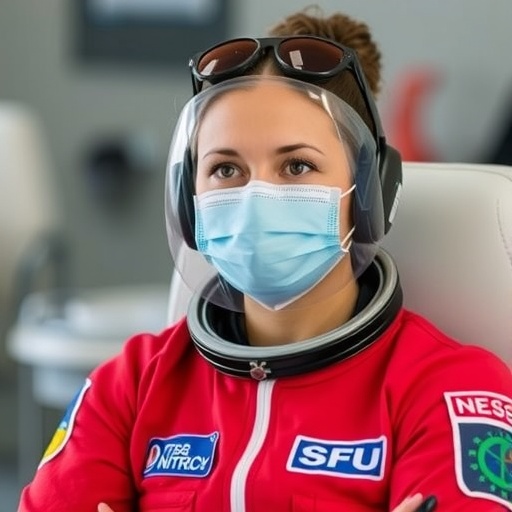

view more
Credit: Photo courtesy of the European Space Agency (ESA)
Just a few days in simulated microgravity can subtly change the way women’s blood clots, sparking bigger questions about health monitoring protocols for astronauts who can spend six months or more in orbit, say Simon Fraser University researchers.
First reported in 2020, an International Space Station mission detected an unexpected blood clot in a female astronaut’s jugular vein. To date, space-health research has had more male participants but with the number of female astronauts on the rise, a new SFU–European Space Agency study examined how microgravity affects blood clotting specifically in women.
Key findings
- 18 female participants experienced five days of continuous simulated microgravity in a European Space Agency (ESA)-sponsored VIVALDI I dry immersion study.
- Coagulation time (the time it took for blood clots to start forming) was longer.
- Once started, clots formed faster.
- Once formed, the strength and stability of the clots was greater
- The study findings were not clinically concerning after just five days in simulated microgravity but indicate more research is needed to evaluate potential risks in longer space flights.
“We know that on Earth, clotting in men and women can vary with age, but we have little information on whether these will be different when in space,” says Andrew Blaber, professor of biomedical physiology and kinesiology, and senior author of the study. “In this microgravity environment, we found the female participants took longer for their blood to start clotting. But once that clotting began, it formed faster and was more stable, making it harder to break down.”
This combination — slower initiation, faster formation, stronger clots — was not shown to be inherently dangerous in the short term, says Tiffany Stead, lead author of the study. But it does raise concerns for astronauts because of how and where in the body these dangerous blood clots can form while in space and far from emergency medical care.
Published in Acta Astronautica, the study looked at real‑time clotting responses in 18 healthy female participants over five days in a dry immersion tank, a specially designed water bath with a waterproof sheet to keep participants dry while floating, and simulating weightlessness.
Using a diagnostic method called rotational thromboelastometry (ROTEM), the study measured how clotting begins and progresses in the body. Participants’ blood was also analyzed for menstrual hormones, which were found to have no effects on blood coagulation.
Why spaceflight changes where and how dangerous clots form
If left untreated, blood clots can dislodge and travel through bloodstream. If they reach the lungs, heart or brain, they can cause pulmonary embolism, heart attack, or stroke.
Gravity on Earth means blood clots most commonly form in the legs, buying the body more time to break the clot up on its own, or be treated by doctors before causing a life-threatening event.
But without the force of gravity, blood pools in the head, and in some cases even reverses direction, creating conditions where clots are more likely to form, Blaber explains.
“We’ve found that in space, blood clots are more likely to form in the jugular vein. From there, it doesn’t have to travel far to reach lungs or heart, and trigger a serious medical event,” he says. “Space is not a place where you want these things to happen.”
Blaber’s team is now analyzing comparable male dry immersion data, which will help guide future medical monitoring or countermeasures needed during spaceflight.
Space agencies are already paying close attention. Astronaut crews now regularly perform jugular‑vein ultrasound scans during missions, the very technology that revealed the initial clot by accident back in 2020.
“Now that they know it can happen, they’re looking at it more frequently as part of the standard measures,” Blaber says.
Blaber and his team at SFU’s Aerospace Physiology Laboratory routinely collaborate with the Canadian Space Agency and international space agencies to study the effects of space on astronauts.
Journal
Acta Astronautica
Subject of Research
People
Article Title
1. Introduction 2. Materials & methods 3. Results 4. Discussion 5. Conclusions CRediT authorship contribution statement Declaration of competing interest Acknowledgments Appendix A. Supplementary data References Show full outline Figures (5) Fig. 1. Illustration of ROTEM measurements for a visual description of coagulation time… Fig. 2. Illustration demonstrating the time course of the dry immersion(DI) study… Fig. 3. Mean ROTEM coagulation parameters A) CT, B) MCF, C) alpha angle, and D) l
Article Publication Date
4-Dec-2025
COI Statement
The authors declare that they have no known competing financial interests or personal relationships that could have appeared to influence the work reported in this paper.
Robyn Stubbs
Simon Fraser University
robyn_stubbs@sfu.ca
Cite Scienmag News
Grant Pearson. (March 4, 2026). New SFU Study Reveals Clotting Risks for Female Astronauts. Scienmag. https://scienmag.com/new-sfu-study-reveals-clotting-risks-for-female-astronauts/
Grant Pearson. "New SFU Study Reveals Clotting Risks for Female Astronauts." Scienmag, 4 March 2026, https://scienmag.com/new-sfu-study-reveals-clotting-risks-for-female-astronauts/. Accessed 4 September 2026.
Grant Pearson. "New SFU Study Reveals Clotting Risks for Female Astronauts." Scienmag. March 4, 2026. https://scienmag.com/new-sfu-study-reveals-clotting-risks-for-female-astronauts/

