


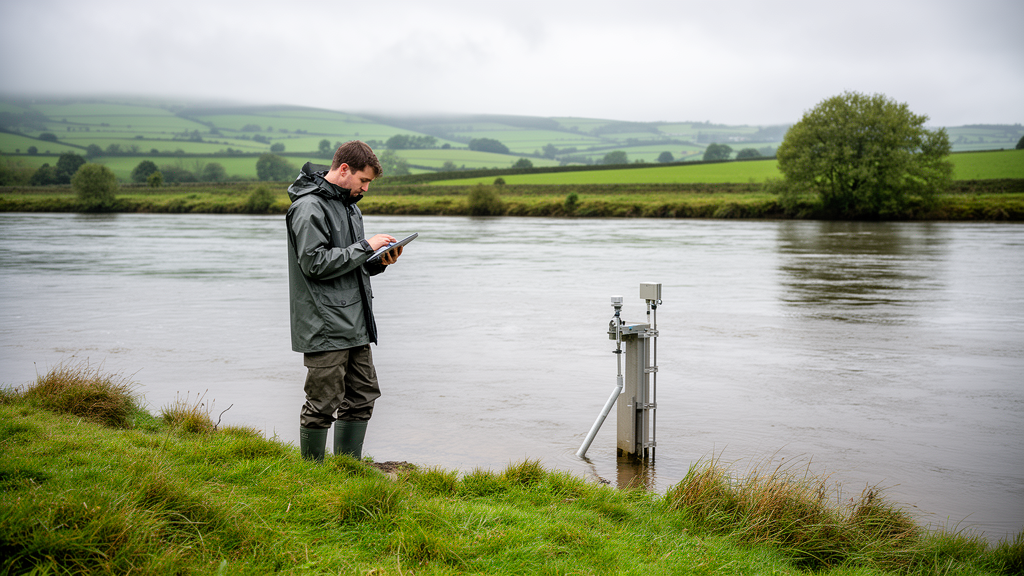
Imagine knowing, three months in advance, whether Britain’s rivers are likely to swell into floods or shrink toward drought. That is the promise of a new seasonal hydrological forecasting system for Great Britain, described in a study published in the journal Hydrology and Earth System Sciences. A team from the UK Centre for Ecology and Hydrology (UKCEH) and the Met Office’s Hadley Centre has combined high-resolution rainfall forecasts built from historical weather analogues with a national-scale hydrological model, producing river flow outlooks at an unprecedented 1 kilometre resolution across the whole country. The system has been running operationally within the UK Hydrological Outlook since December 2023, and the new paper is the first full scientific assessment of how well it performs.
The challenge the researchers faced is a familiar one in the extra-tropics: seasonal weather forecasting is hard. Britain’s variable maritime climate has long limited the usefulness of seasonal hydrological forecasts, and even the best global models achieve only weak correlations with observed seasonal rainfall over the UK. The earlier version of the national forecasting scheme, driven by the Met Office’s GloSea5 seasonal prediction system, had a further handicap. Although the underlying climate model ran at roughly 50 kilometre resolution, only the UK-average rainfall anomaly was supplied operationally. To feed a hydrological model working at 1 kilometre, that single national number was spread uniformly across the country, wiping out the dramatic regional contrasts that define British weather, from the drenched hills of western Scotland to the drier east of England.
The new approach, known as Historic Weather Analogues (HWA), takes a different route. Rather than using raw rainfall output from the climate model directly, the team exploits the fact that large-scale atmospheric circulation patterns, such as the North Atlantic Oscillation (NAO), are predicted considerably better than local rainfall itself. The method begins with an ensemble of roughly 40 mean sea level pressure forecasts from the current GloSea6 system, covering the North Atlantic and Europe. For each ensemble member, the researchers search the observational record for historical years whose pressure patterns most closely match the forecast, ranking candidates by root mean squared difference and selecting the best ten. The observed rainfall from those analogue years, drawn from the 1 kilometre HadUK-Grid dataset and adjusted with a linear climate-change correction, then becomes the rainfall forecast.
There is a subtle statistical twist for winter forecasts. Climate scientists have identified a so-called signal-to-noise paradox, in which the ensemble mean of a seasonal forecast system correlates well with observations even though its variance is too small. To correct for this, the team amplifies the NAO signal in the GloSea6 pressure ensembles for forecasts spanning November through April, restricting the pool of analogue years to those with a monthly-mean NAO index within 4 hectopascals of the adjusted forecast. This conditioning step is one reason the system performs best in winter, when the NAO’s grip on British rainfall is strongest, particularly across the north and west of the country.
These rainfall forecasts then feed a two-stage hydrological pipeline. First, the Grid-to-Grid (G2G) hydrological model is run over the preceding months using observed rainfall and evaporation, producing detailed estimates of the water held in surface and subsurface stores at the moment the forecast begins. These hydrological initial conditions capture the memory of the landscape, how wet the soils are, how full the aquifers lie. Second, a monthly-resolution Water Balance Model combines those initial stores with the forecast rainfall, evaporation and storage-dependent outflows to project river flows one to three months ahead. Runoff from every upstream grid cell is accumulated along the river network, and the resulting flows are expressed as anomalies relative to long-term conditions and sorted into seven classes, from exceptionally low to exceptionally high, mirroring the Environment Agency’s Water Situation Reports.
To test the system, the team generated hindcasts, re-forecasts of past conditions, covering 1993 to 2017, the international standard verification period for seasonal prediction systems participating in the Copernicus Climate Change Service. They scored the forecasts with three complementary metrics: the Pearson correlation, which measures how well the ensemble mean tracks the observed signal; the Continuous Ranked Probability Skill Score, which rewards forecasts whose full probability distributions beat simply assuming climatology; and the Relative Operating Characteristic, which tests the ability to detect above-normal and below-normal flow events. The verdict is nuanced but encouraging. The rainfall forecasts themselves are only marginally skilful on average, with spatially averaged winter correlations of about 0.18 at 1 kilometre resolution, and they are actively misleading in summer, when the underlying GloSea6 model struggles to predict summer pressure patterns.
The river flow forecasts, however, tell a much stronger story. Seasonal flow predictions achieve spatially averaged correlations of 0.48 in winter, with 90 percent of river pixels exceeding 0.2, and remain useful in spring (0.38) and autumn (0.36), collapsing only in summer (0.08). Much of this skill does not come from the rainfall forecasts at all, but from the hydrological initial conditions. Rivers in many catchments have long hydrological memory, and knowing how much water is already stored in the ground can carry a forecast a long way. The most striking example is the chalk of southern England, where deep aquifers dominate river behaviour; there, even summer forecasts reach correlations of 0.4 to 0.7, and the classified forecasts consistently pick the right flow category.
Perhaps the most elegant result is a national-scale decomposition of where the skill comes from. By running the model with rainfall forecasts paired with climatological initial conditions, and separately with historical rainfall sequences paired with modelled initial conditions, the researchers mapped the complementary contributions of meteorology and memory. In responsive catchments of the northwest, where flows track recent rainfall and the NAO, the analogue rainfall forecasts supply most of the skill. In the south and east, where slow-draining aquifers dominate, the initial conditions carry the forecast. In western Scotland, neither source alone suffices, but combining them yields significant skill. This pattern, previously demonstrated only for a handful of gauged catchments, now extends across the entire 1 kilometre river network, and it tells forecast developers precisely where better rainfall predictions or better hydrological modelling would pay the greatest dividends.
Compared with the previous GloSea5-based scheme, the new system better predicts the likelihood of high- and low-flow events in three of the four seasons, with December monthly forecasts flipping from negative to positive skill and spring skill scores more than doubling. The authors are candid about limitations: the hindcast sample is small, excludes the most extreme events, and predates recent climatic shifts, though operational comparisons suggest performance has not changed materially. Future work will enlarge the atmospheric ensemble as supercomputing capacity grows, explore replacing the simple monthly water balance with the full process-based G2G model, and statistically blend the multiple forecasting methods behind the Hydrological Outlook. For now, high-resolution monthly and seasonal forecasts are already being released through the Hydrological Outlook Portal, giving water managers, flood responders and reservoir operators across Britain a genuine three-month head start.
Subject of Research: Seasonal hydrological forecasting of river flows in Great Britain using historical weather analogue rainfall forecasts and national-scale hydrological modelling
Article Title: Improved seasonal hydrological forecasting for Great Britain
Article References: Rhodes-Smith, M. D., Bell, V. A., Stringer, N., Baron, H., Davies, H., & Knight, J. (2026). Improved seasonal hydrological forecasting for Great Britain. Hydrology and Earth System Sciences, 30(19), 6189-6206. https://doi.org/10.5194/hess-30-6189-2026
Image Credits: AI Generated
DOI: 10.5194/hess-30-6189-2026
Keywords: seasonal forecasting, hydrology, river flows, Great Britain, historical weather analogues, North Atlantic Oscillation, GloSea6, flood prediction, drought, hydrological model, UK Hydrological Outlook, water resources
Cite Scienmag News
Violet Maxwell. (October 9, 2026). New Seasonal River Flow Forecasts Give Britain a Three-Month Head Start on Floods and Droughts. Scienmag. https://scienmag.com/new-seasonal-river-flow-forecasts-give-britain-a-three-month-head-start-on-floods-and-droughts/
Violet Maxwell. "New Seasonal River Flow Forecasts Give Britain a Three-Month Head Start on Floods and Droughts." Scienmag, 9 October 2026, https://scienmag.com/new-seasonal-river-flow-forecasts-give-britain-a-three-month-head-start-on-floods-and-droughts/. Accessed 9 October 2026.
Violet Maxwell. "New Seasonal River Flow Forecasts Give Britain a Three-Month Head Start on Floods and Droughts." Scienmag. October 9, 2026. https://scienmag.com/new-seasonal-river-flow-forecasts-give-britain-a-three-month-head-start-on-floods-and-droughts/


