


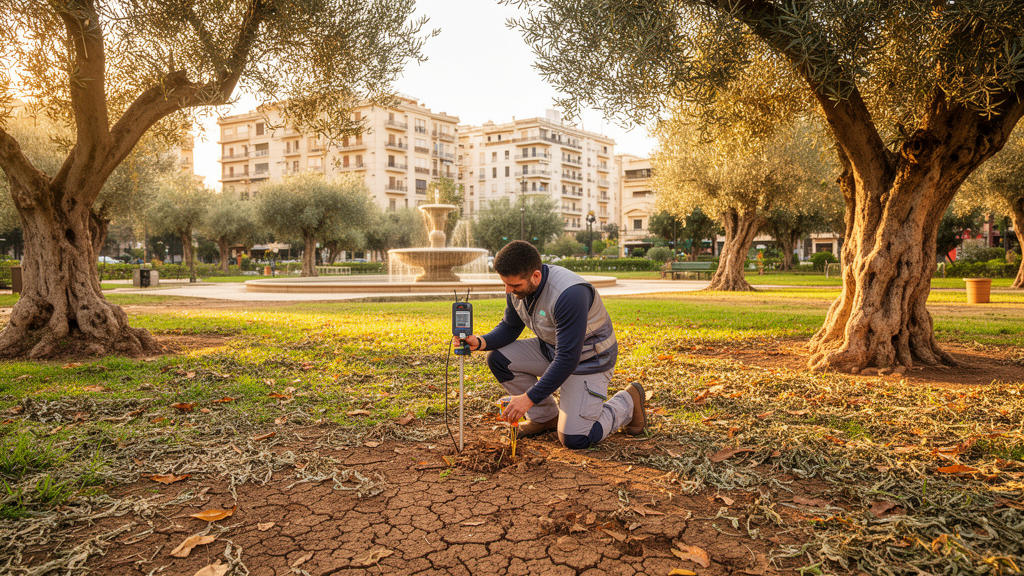
Beneath the lawns and wildflower patches of Madrid’s public parks, an unexpected story about the urban carbon cycle is unfolding. A year-long study of soil carbon dioxide emissions across three of the city’s green spaces has found that soil moisture, rather than temperature, is the dominant force controlling how much CO2 escapes from urban Mediterranean soils. The finding, published in the journal SOIL, challenges one of the most widely used assumptions in carbon modelling and suggests that the urban heat island may act less as a thermal accelerator and more as a drying engine.
Soil respiration, the combined output of microbial decomposition and root metabolism, is one of the largest fluxes of carbon dioxide from land to atmosphere. For decades, scientists have modelled it with the Q10 function, an exponential equation in which emissions rise steadily as temperatures climb. The logic seems intuitive: warmer microbes work faster. But the Q10 framework was built largely on data from temperate and mesic ecosystems, and researchers led by Teresa Alía and Sergio González-Ubierna of the Complutense University of Madrid suspected it might fail in the hot, dry, human-altered conditions of a Mediterranean city.
To find out, the team monitored soil CO2 efflux, temperature and moisture at 36 sampling points across three Madrid green spaces: Ciudad Universitaria, La Elipa and Pinar de Conde Orgaz. Measurements were taken fortnightly from April 2023 to April 2024 using an infrared gas analyser with open chambers, covering four dominant ruderal plant communities: annual herbs dominated by Diplotaxis virgata, annual grasslands of Hordeum leporinum, perennial herbs of Malva species, and perennial grasslands of Dactylis glomerata. The visiting order of parks and plots was systematically rotated and randomised across a broad daily window to avoid timing bias, and all soils shared a similar sandy loam texture, isolating vegetation and climate as the key variables.
The results upended the textbook expectation. Instead of rising exponentially with temperature, soil respiration followed a Gaussian, bell-shaped curve, increasing up to a sharply defined breakpoint of 18.4 degrees Celsius and declining above it. The confidence interval around that threshold was narrow, from 17.17 to 19.79 degrees, indicating a robust feature of the system rather than a statistical fluke. Crucially, the same unimodal pattern appeared in all four plant communities, differing only in the intensity of emissions, not in shape.
The explanation is not that heat directly suppresses soil life. Rather, in a Mediterranean climate, temperature and moisture are tightly and negatively coupled: hot months are dry months. When the researchers split the dataset at the 18.4 degree threshold, a clear division emerged. Below it, soil temperature was the main driver, with a positive linear relationship to CO2 emissions, while water variables played only a minor role because moisture was generally plentiful. Above it, the picture flipped entirely: soil moisture and a rewetting index, which quantifies recent rainfall relative to the time elapsed before measurement, became the strongest predictors, and temperature lost its explanatory power once water availability was accounted for.
The rewetting relationship itself carried a twist. Emissions rose logarithmically with the rewetting index, but only up to values of about 20; beyond that, the link weakened, likely because compacted urban soils and altered rainfall partitioning limit effective infiltration, so heavy rain does not translate into sustained soil moisture. This suppression of the classic drying-rewetting CO2 pulse, well documented in natural Mediterranean ecosystems, appears to be a distinctly urban signature, consistent with the emerging concept of the Urban Dry Island, in which impervious surfaces reduce evapotranspiration and infiltration even within unsealed green spaces.
Building on these patterns, the team derived a mechanistic model from first principles, describing soil respiration as the joint outcome of temperature-driven moisture loss and moisture-stimulated CO2 production. Expressed as a pair of coupled differential equations, the model captures the essential constraint of Mediterranean systems: temperature and moisture cannot rise together indefinitely, because warming inevitably dries the soil. When fitted to the data, the model outperformed both the standard Q10 exponential formulation and an existing Gaussian model, achieving the lowest error and significantly reducing deviance in likelihood-ratio tests. A leave-one-plot-out cross-validation confirmed the model generalises well beyond the plots used to fit it, and sensitivity analyses with mixed-effects and autoregressive structures preserved the same ranking of communities and similar optimum temperatures.
Vegetation mattered, but modestly. Only the perennial herb community dominated by Malva species consistently emitted more CO2 than the others, a pattern the authors attribute to greater soil disturbance and labile carbon availability rather than to microclimatic differences, since temperatures and moisture did not differ significantly among communities. More intriguing was a trade-off revealed by the model: communities with lower basal respiration rates tended to reach higher maximum emissions, and those most sensitive to moisture, such as the annual grassland of Hordeum leporinum, also showed the highest temperature optima. That fits the phenology of Mediterranean annual grasses, which concentrate root growth and carbon inputs in the moist, warming spring window when both drivers align.
The practical implications reach well beyond Madrid. Because conventional temperature-based models ignore the simultaneous decline in soil moisture, urban carbon accounting tools may systematically overestimate summer soil CO2 emissions in water-limited Mediterranean cities. The authors argue that keeping urban soils moist, through reduced compaction, organic amendments, improved infiltration and moisture-sensitive irrigation, will do more for the urban soil carbon balance than any attempt to manage temperature alone. As climate change intensifies both the urban heat island and summer drought, the drying role of cities is likely to grow stronger, potentially suppressing average emissions while amplifying their variability through episodic rewetting pulses.
The study’s authors are candid about its limits. The monitoring year saw above-average rainfall, which may have buffered the moisture limitation typical of drier years, and total CO2 efflux was measured without separating microbial from root-derived components. The findings also come from a single city, and validation across other Mediterranean urban contexts and contrasting hydrological years remains an open task. Even so, the core message is hard to ignore: in the parks of a warming, drying Mediterranean city, water writes the carbon budget, and temperature merely sets the stage on which it is written.
Subject of Research: Controls on soil CO2 efflux in Mediterranean urban green spaces
Article Title: Soil moisture as the dominant driver of CO2 efflux in Mediterranean urban green spaces: evidence for a Gaussian temperature response and mechanistic modelling of moisture and temperature interactions
Article References: Alía, T., González-Ubierna, S., Sánchez-Jiménez, A., Abad-Calderón, R., & Casermeiro, M. Á. (2026). Soil moisture as the dominant driver of CO 2 efflux in Mediterranean urban green spaces: evidence for a Gaussian temperature response and mechanistic modelling of moisture and temperature interactions. SOIL, 12(2), 915-935. https://doi.org/10.5194/soil-12-915-2026
Image Credits: AI Generated
Keywords: soil respiration, soil moisture, carbon dioxide, urban heat island, Mediterranean climate, urban soils, Q10 model, Madrid, rewetting, carbon cycle, mechanistic modelling, urban green spaces
Cite Scienmag News
Alan Morgan. (October 9, 2026). Soil Moisture, Not Heat, Drives Carbon Loss from Mediterranean City Parks. Scienmag. https://scienmag.com/soil-moisture-not-heat-drives-carbon-loss-from-mediterranean-city-parks/
Alan Morgan. "Soil Moisture, Not Heat, Drives Carbon Loss from Mediterranean City Parks." Scienmag, 9 October 2026, https://scienmag.com/soil-moisture-not-heat-drives-carbon-loss-from-mediterranean-city-parks/. Accessed 9 October 2026.
Alan Morgan. "Soil Moisture, Not Heat, Drives Carbon Loss from Mediterranean City Parks." Scienmag. October 9, 2026. https://scienmag.com/soil-moisture-not-heat-drives-carbon-loss-from-mediterranean-city-parks/


