


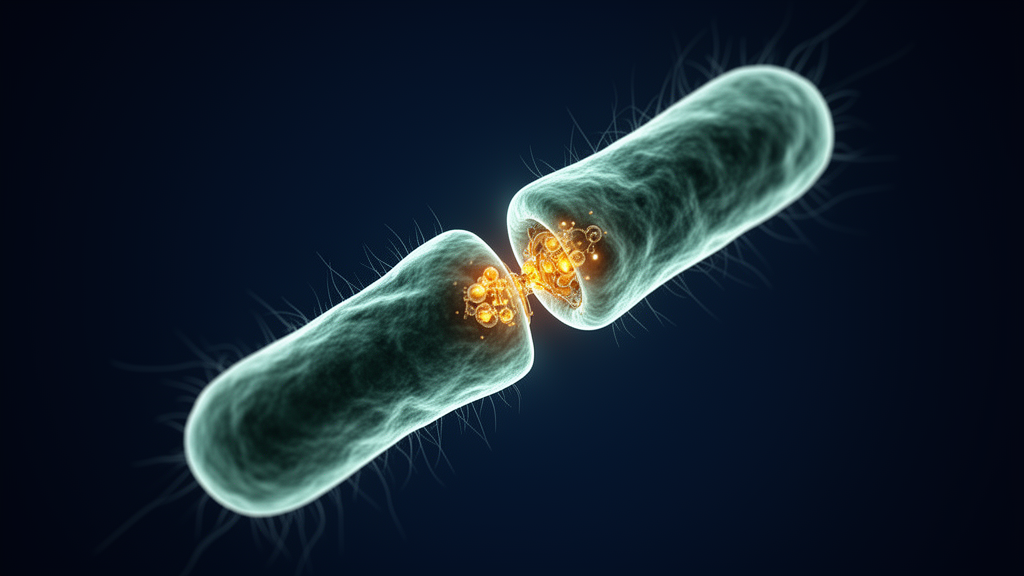
Scientists studying how the deadly hospital pathogen Pseudomonas aeruginosa builds its cell wall have uncovered a surprising connection between the machinery of bacterial cell division and susceptibility to some of medicine’s most important antibiotics. The discovery centers on a protein domain that acts as a regulatory hub, integrating multiple signals that tell the bacterium when and where to synthesize the rigid peptidoglycan layer that separates one dividing cell into two. Because some of the regulatory changes identified in the laboratory have also turned up in clinical isolates with elevated resistance to the antibiotic aztreonam, the findings may help explain how P. aeruginosa, a leading cause of pneumonia and bloodstream infections in vulnerable patients, edges its way around β-lactam drugs.
The research, published in PLOS Genetics by Jake Colautti, Alexander C. Anderson, Wyatt P. K. Clark, and Lindsey S. Marmont, focuses on a long-standing puzzle in bacterial cell biology: how dividing cells switch on the synthesis of septal peptidoglycan, the new cell wall material that must be forged at exactly the right place and time as a bacterium splits in two. In rod-shaped bacteria such as P. aeruginosa and the better-studied Escherichia coli, this task falls to a pair of enzymes known as FtsW and FtsI. FtsW is a member of the SEDS family of membrane proteins, while FtsI is a class B penicillin-binding protein, and together the FtsWI complex carries out the essential work of polymerizing and cross-linking the peptidoglycan strands at the division septum. Without properly regulated FtsWI activity, the cell cannot complete division and dies.
For years, microbiologists have believed that FtsWI sits in a dormant state until it receives an activating signal from the rest of the divisome, the elaborate protein assembly that assembles at the future site of division. The accepted model describes an allosteric cascade: the late-arriving divisome protein FtsN, considered the final trigger of cytokinesis, transmits its signal through the FtsQ, FtsL, and FtsB proteins, which form a complex known as FtsQLB, and this complex in turn stimulates FtsWI to begin building the septum. Yet the molecular details of this handoff have remained murky, and the picture appears to differ from one bacterial species to another. The new study set out to clarify how this regulatory cascade works in P. aeruginosa, an organism that is both a formidable pathogen and, until recently, less genetically tractable than E. coli.
The team’s strategy exploited a key genetic feature: the gene encoding FtsN, while essential, can be studied through conditional essentiality, meaning the researchers could remove it and then search for mutations elsewhere in the genome that allow cells to survive without it. This approach, often called a suppressor screen, is a powerful way to identify the components of a regulatory pathway. If a mutation in another gene can compensate for the loss of FtsN, that gene very likely participates in the same process. When the researchers deleted ftsN and looked for survivors, they found them, and the compensating mutations mapped to a specific region of the ftsI gene encoding the non-enzymatic pedestal domain of the FtsI protein.
The pedestal domain is a region of FtsI that sits outside the enzyme’s catalytic machinery, and it had not previously been considered a major control point for septal cell wall synthesis. The substitutions the team identified did more than merely rescue the loss of FtsN. The mutant cells also suppressed the toxic effects of activation-defective ftsL alleles, versions of FtsL that dominantly disrupt division when present, and they shortened cell length even in an otherwise normal genetic background. Together, these observations indicate that the pedestal mutations change how FtsWI is regulated, allowing the enzyme complex to escape its dependence on stimulation by both FtsN and the FtsQLB complex. In effect, the mutations rewire the switch that normally holds septal peptidoglycan synthesis in check until the divisome is fully assembled.
To understand where these substitutions sit in three-dimensional space, the researchers mapped them onto the recently determined structure of the P. aeruginosa FtsQLBWI complex. The result was striking: rather than clustering at a single site, the mutations grouped onto distinct surfaces of the pedestal domain. Some variants localized to the interface where FtsI contacts FtsL, consistent with the idea that the FtsQLB complex physically transmits its activating signal to FtsWI through this contact. Others sat on the opposite face of the pedestal, suggesting that this surface engages a different regulatory input, possibly FtsN itself or another partner in the divisome. The pedestal domain, in other words, behaves as an integration point where multiple signals converge to control the timing and magnitude of septal cell wall construction.
The most consequential twist came from a clinical observation. Several of the pedestal substitutions identified in the study had previously been found in clinical isolates of P. aeruginosa showing increased resistance to aztreonam, a monocyclic β-lactam antibiotic that is one of the few options remaining against multidrug-resistant Gram-negative infections. That overlap prompted the team to ask a direct question: do these cell-division regulatory mutations change how susceptible the bacterium is to β-lactam antibiotics, which kill cells by sabotaging cell wall synthesis?
The answer depended on which surface of the pedestal domain was altered. Variants affecting the FtsI-FtsL interface modestly reduced the bacterium’s susceptibility to multiple β-lactam antibiotics, nudging the minimum inhibitory concentrations upward. Far more dramatic was the effect of a variant on the opposite face of the pedestal: this mutation produced striking hypersusceptibility to the same drugs, but only when FtsN was present. In other words, a single amino acid change in a non-enzymatic region of a cell wall synthase could either harden the pathogen against β-lactams or render it exquisitely vulnerable, depending on its position and on the presence of the divisome’s triggering protein.
These results carry two significant implications. First, they establish the FtsI pedestal domain as a central regulatory hub for FtsWI, resolving long-standing uncertainty about how the FtsN-to-FtsQLB-to-FtsWI cascade is wired in P. aeruginosa and demonstrating that the non-enzymatic architecture of a cell wall synthase can govern its activity. Second, and more urgently, they reveal a previously unrecognized relationship between divisome regulation and β-lactam susceptibility. Antibiotic resistance in P. aeruginosa is usually attributed to enzymatic drug destruction, efflux pumps, and reduced permeability, but this work shows that subtle alterations in the regulation of septal peptidoglycan synthesis can also shift the balance between life and death in the presence of β-lactams, and that such alterations already exist in clinical isolates.
The study also suggests new directions for drug discovery and surveillance. If the pedestal domain integrates the signals that unleash septal cell wall synthesis, then molecules that lock the domain into a hypersusceptible state, mimicking the effect of the sensitizing mutation, could potentially restore the potency of β-lactams against resistant strains. Conversely, sequencing efforts that monitor pedestal-domain residues in clinical P. aeruginosa populations might provide early warning of emerging β-lactam tolerance that conventional resistance mechanisms would miss. As the authors note, the work highlights the potential relevance of divisome regulation to β-lactam resistance in the clinic, transforming a fundamental question about bacterial cell biology into a matter of direct medical consequence.
Subject of Research: Regulation of septal peptidoglycan synthesis and its effect on β-lactam antibiotic susceptibility in Pseudomonas aeruginosa
Article Title: Altered regulation of septal peptidoglycan synthesis modulates β-lactam susceptibility in Pseudomonas aeruginosa
Article References: Colautti, J., Anderson, A. C., Clark, W. P. K., & Marmont, L. S. (2026). Altered regulation of septal peptidoglycan synthesis modulates β-lactam susceptibility in Pseudomonas aeruginosa. PLOS Genetics, 22(9), e1012319. https://doi.org/10.1371/journal.pgen.1012319
Image Credits: AI Generated
DOI: 10.1371/journal.pgen.1012319
Keywords: Pseudomonas aeruginosa, cell division, peptidoglycan synthesis, FtsI, FtsN, FtsQLB complex, divisome, beta-lactam antibiotics, aztreonam, antibiotic resistance, SEDS-bPBP synthase, pedestal domain
Cite Scienmag News
Gregory Coleman. (October 9, 2026). Cell Division Switch in Pseudomonas Reveals New Route to Antibiotic Resistance. Scienmag. https://scienmag.com/cell-division-switch-in-pseudomonas-reveals-new-route-to-antibiotic-resistance/
Gregory Coleman. "Cell Division Switch in Pseudomonas Reveals New Route to Antibiotic Resistance." Scienmag, 9 October 2026, https://scienmag.com/cell-division-switch-in-pseudomonas-reveals-new-route-to-antibiotic-resistance/. Accessed 9 October 2026.
Gregory Coleman. "Cell Division Switch in Pseudomonas Reveals New Route to Antibiotic Resistance." Scienmag. October 9, 2026. https://scienmag.com/cell-division-switch-in-pseudomonas-reveals-new-route-to-antibiotic-resistance/


