


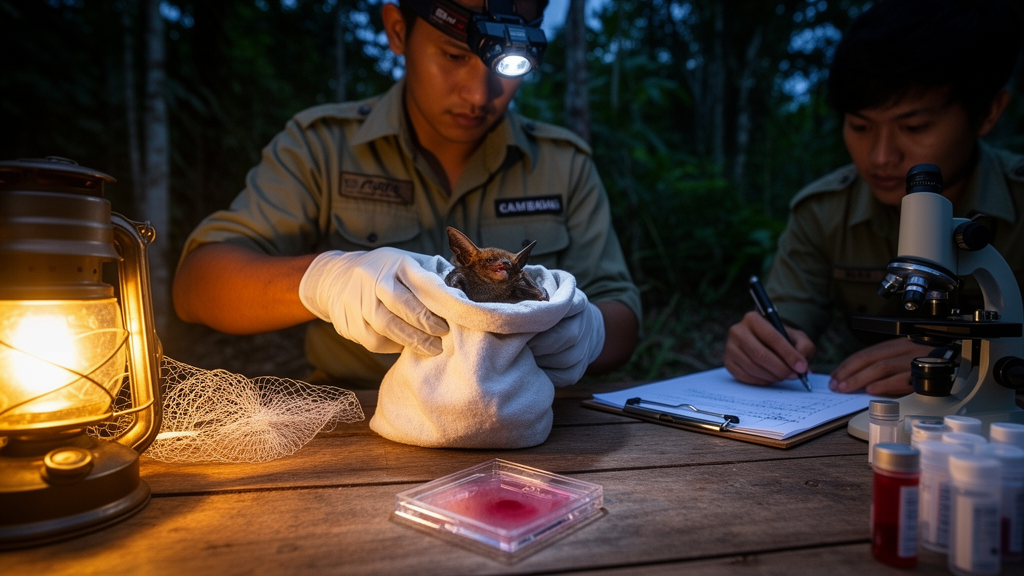
A nationwide survey of bats across Cambodia has uncovered a strikingly rich community of malaria-like parasites, including several host associations never before documented. Researchers screened nearly 1,200 bats representing 34 species from sites spanning the entire country and found that roughly 13 percent carried haemosporidian parasites, the apicomplexan group that includes the agents of human malaria. The study, published in Parasites & Vectors, combined extensive field sampling with multilocus genetic sequencing and ecological modelling to map both the evolutionary relationships of these parasites and the environmental factors that shape where they occur. The results paint Southeast Asia, one of the world’s most biodiverse regions and home to nearly 27 percent of all bat species, as an underappreciated hotspot of mammalian malaria parasite diversity.
The fieldwork formed part of a larger bio-surveillance initiative called CamBatRat, which sampled 2,461 bats at 233 sites across Cambodia between December 2016 and February 2020. From this archive, the team selected 1,180 individuals representing 34 species for retrospective screening of blood samples. DNA was extracted and initially tested using a polymerase chain reaction targeting a fragment of the parasites’ mitochondrial cytochrome b gene. Positive samples were then characterized with additional markers spanning the parasites’ three genomes: mitochondrial genes cytb and cox1, an apicoplast marker called clpC, and two nuclear loci, ef2 and pat. This multilocus approach matters because some bat haemosporidians carry highly rearranged mitochondrial genomes that can defeat standard amplification protocols, and because different genes evolve at different rates, offering complementary windows into parasite evolutionary history.
Sequence-confirmed infections turned up in 152 bats belonging to eleven species from four families: Emballonuridae, Hipposideridae, Pteropodidae and Vespertilionidae. Two parasite genera dominated the findings. Polychromophilus, a genus restricted to bats, was confined to a handful of host species, infecting the vespertilionids Scotophilus kuhlii, Scotophilus heathii and Myotis rosseti as well as the hipposiderid Hipposideros diadema. Prevalence differed dramatically between the two Scotophilus species: 54 percent of S. kuhlii were infected, compared with just 4 percent of S. heathii. Hepatocystis, a genus closely related to mammalian Plasmodium, showed a broader footprint, occurring across three bat families and infecting, among others, 42 percent of Cynopterus brachyotis and 23 percent of Hipposideros cf. grandis individuals examined.
The most taxonomically significant discovery came from the emballonurid bat Taphozous melanopogon, in which 18 percent of sampled individuals carried Hepatocystis. This is the first record of the genus in the family Emballonuridae, substantially expanding its known host range. Because emballonurid bats are widely distributed across the Old World yet rarely documented as haemosporidian hosts, the finding suggests that parasite diversity in this family has gone largely unnoticed. Infections were also newly recorded in the fruit bats Megaerops niphanae and Eonycteris spelaea. By contrast, no infections were detected in bats from the families Molossidae, Megadermatidae and Rhinolophidae, although the authors caution that the molossid sample was spatially concentrated and therefore less conclusive.
Phylogenetic analyses revealed two contrasting evolutionary patterns. The Polychromophilus lineage associated with Scotophilus bats proved remarkably genetically conserved: haplotype networks built from cytb, cox1, clpC and ef2 sequences showed identical or near-identical parasites in hosts from Cambodia, Thailand and Madagascar, thousands of kilometres apart. This lineage forms a well-supported monophyletic group that does not cluster with any currently recognized Polychromophilus species, hinting that it may represent a distinct evolutionary lineage with taxonomic significance. Such extreme genetic uniformity across such a vast range could reflect either recent dispersal or long-term evolutionary conservatism, and in either case points to strong host specificity at the level of the host genus.
Hepatocystis told a very different story. Parasites from Cambodian bats fell into several deeply divergent clades, and lineages infecting hipposiderid bats did not even form a single group. Most strikingly, cytb sequences from the Taphozous-associated parasites formed a well-supported clade with Hepatocystis lineages infecting Southeast Asian squirrels of the genus Callosciurus, despite substantial mitochondrial divergence between the host-associated groups. Analyses at additional loci placed the Taphozous lineage basal to other Hepatocystis taxa, though the authors note that interpretation is limited by the scarcity of comparable rodent-derived reference sequences. Taken together, the patterns suggest that the evolutionary history of Hepatocystis may involve multiple historical host transitions among mammalian groups, with Asian bats and rodents playing a more prominent role than previously appreciated.
Within the genus Cynopterus, the parasite picture was equally complex. Hepatocystis from C. brachyotis and C. sphinx did not form a single group but instead split into two deeply divergent clades differing by 30 to 41 nucleotide substitutions, with no clear structure by host species or geography. The clades also included parasites from Megaerops and Eonycteris hosts. This suggests that host specificity in Asian bat Hepatocystis may be looser than classical morphology-based taxonomy implies, or that recognized morphospecies conceal cryptic diversity, a possibility previously raised for African bat parasites. Because no blood smears were collected during the original sampling, the Cambodian parasites could not be confidently assigned to described morphospecies, underscoring the need to integrate morphological and molecular data in future work.
To understand what drives infection, the team fitted a Bayesian generalized linear mixed model to 589 individuals of ten host species from 84 sites, treating host species and sampling site as crossed group-level effects. The result was clear: host species accounted for 26.3 percent of the variance in infection probability and sampling site for 25.3 percent, while the measured covariates added essentially nothing. Knowing a bat’s species and capture location predicted infection as well as any combination of host traits, landscape attributes and climate variables. The strongest single effect was seasonal, with infection probability substantially lower in the wet season than the dry season, a direction that runs counter to a simple vector-abundance expectation, since the presumed Culicoides midge vectors should thrive when wet-season larval habitat is most available.
One landscape variable did stand out: infection probability declined with increasing human population density within a two-kilometre radius of the capture site. The authors interpret this as consistent with reduced availability of vector habitat in built-up areas, since Culicoides midges depend on aquatic and semi-aquatic larval sites and have limited dispersal ranges, making transmission highly sensitive to conditions close to the roost. Habitat fragmentation showed a weaker, statistically ambiguous negative trend, and land cover class at the site showed no association. Among individual host attributes, sex and body condition were unrelated to infection, while reproductive individuals showed a suggestive but inconclusive elevation in infection probability. Notably, residual variation among sites was not distance-structured, meaning that infection hotspots were not clustered spatially in any simple way.
The broader implications reach into both evolutionary biology and surveillance strategy. Because bats host parasites from at least seven genera, collectively representing roughly a third of all described mammalian haemosporidian species, they are a key system for understanding how malaria parasites have diversified across vertebrate hosts. The Cambodian data reinforce the view that diversification within Hepatocystis may have occurred substantially among Asian mammalian hosts, a hypothesis that will require broader sampling of Asian rodents and additional bat families to test. On the ecological side, the finding that infection is structured principally by host identity and fine-scale roost conditions rather than by landscape composition indicates that roost ecology and vector biology are the most promising targets for understanding transmission. Distinguishing among competing explanations for the seasonal pattern, whether vector phenology, temperature or shifts in host demography, will require paired vector sampling and bloodmeal analysis alongside host screening, work the current study design did not include but which the authors identify as the logical next step.
Subject of Research: Diversity, host associations and ecology of haemosporidian malaria parasites infecting bats in Cambodia
Article Title: High diversity and novel host associations of bat haemosporidian parasites in Cambodia: insights from a nationwide bat survey and multilocus analyses
Article References: Schaer, J., Werb, O., Ch´ng, L., Low, D. H. W., Borthwick, S. A., Furey, N., Frias, L., Pimsai, A., Yim, R., Chor, K., Cheang, D., Smith, G. J. D., Hitch, A., & Mendenhall, I. H. (2026). High diversity and novel host associations of bat haemosporidian parasites in Cambodia: insights from a nationwide bat survey and multilocus analyses. Parasites & Vectors, 19(1), Article 436. https://doi.org/10.1186/s13071-026-07732-3
Image Credits: AI Generated
DOI: 10.1186/s13071-026-07732-3
Keywords: bats, haemosporidian parasites, Hepatocystis, Polychromophilus, malaria, Cambodia, Southeast Asia, phylogenetics, host associations, Culicoides, parasite ecology, molecular survey
Cite Scienmag News
Kristina Jarvis. (October 9, 2026). Nationwide Survey of Cambodian Bats Reveals Hidden Diversity of Malaria Parasites. Scienmag. https://scienmag.com/nationwide-survey-of-cambodian-bats-reveals-hidden-diversity-of-malaria-parasites/
Kristina Jarvis. "Nationwide Survey of Cambodian Bats Reveals Hidden Diversity of Malaria Parasites." Scienmag, 9 October 2026, https://scienmag.com/nationwide-survey-of-cambodian-bats-reveals-hidden-diversity-of-malaria-parasites/. Accessed 9 October 2026.
Kristina Jarvis. "Nationwide Survey of Cambodian Bats Reveals Hidden Diversity of Malaria Parasites." Scienmag. October 9, 2026. https://scienmag.com/nationwide-survey-of-cambodian-bats-reveals-hidden-diversity-of-malaria-parasites/


