


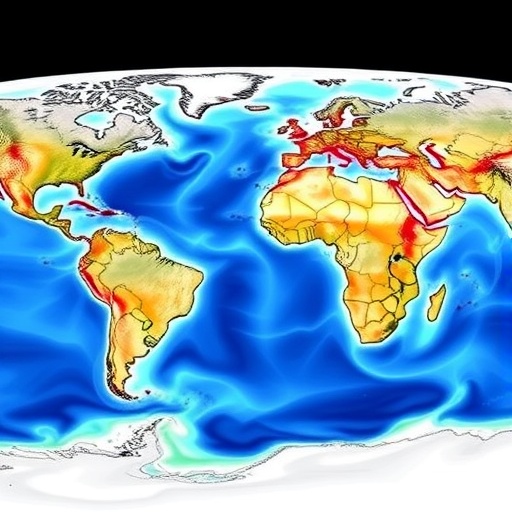
In a groundbreaking study, researchers have delved into the complex and often underestimated interactions between ice and ocean dynamics at the margins of the Earth’s polar regions. As the climate crisis accelerates, understanding the melting processes occurring beneath ice shelves is becoming increasingly vital. A recent paper authored by T. Jayasankar and A. Jenkins presents an innovative physics-based parameterization framework, tailored specifically for assessing basal melting in ice-ocean boundary layers, particularly those situated over dynamically stable pycnoclines.
This research sets the stage for rethinking how we approach the thermal and mechanical interactions that dictate ice melting. Conventional models often fall short, primarily because they tend to simplify the nuanced dynamics of this critical interface. By incorporating a physics-based framework, the authors aim to provide a more robust understanding of the mechanisms driving ice shelf melting. The results of the study not only challenge pre-existing narratives but also highlight the need for enhanced modeling techniques in polar oceanography.
The burgeoning field of ice-ocean interactions is of paramount importance, especially as large ice sheets like those in Greenland and Antarctica continue to shrink at unprecedented rates. The basal melting of these ice formations has far-reaching implications, not just for sea level rise but also for global ocean circulation patterns. The research underscores the urgency of developing accurate predictive models that can simulate these melting processes in real-time and across various climatic scenarios.
One focal point of the study is the role of pycnoclines—layers in the ocean where water density changes rapidly with depth. These layers have significant implications for heat transport, and understanding their stability is crucial for predicting how warming ocean waters affect ice shelf stability. By focusing on dynamically stable pycnoclines, Jayasankar and Jenkins have set a precedent for future studies to better characterize the interactions at play in these critical boundary layers.
Through a series of rigorous simulations, the authors demonstrate the efficacy of their parameterization framework. They provide detailed comparisons with observed melting rates, which suggest that their approach might offer a more accurate representation of the processes at work. This validation is essential, as accurate parameterizations are key to improving climate models, which currently struggle to portray the intricate feedback loops involved in ice melting.
In terms of methodology, the study employs sophisticated computational techniques that are designed to capture the multifaceted interactions between ice and ocean. The framework incorporates empirical data alongside theoretical constructs, allowing for a detailed assessment of melt rates under various oceanographic conditions. This hybrid approach not only enhances the robustness of the findings but also serves as a template for future research in the field.
The implications of this research extend beyond mere academic interest; understanding the melting processes beneath ice shelves opens a window into forecasting future sea level rise. The oceans are interconnected systems, and melting ice contributes significantly to subtle yet impactful changes in global sea levels. By refining our understanding of how and why ice melts, we are better equipped to respond to the impending challenges of climate change.
Moreover, the framework laid out by Jayasankar and Jenkins sets the groundwork for a new era in polar research. It invites other scientists to explore and build upon these findings, encouraging collaborative efforts to create more intricate models that can handle the complexities of ice-ocean interactions. As we continue to observe the dramatic changes occurring in our polar regions, such collaborative engagements will be crucial for generating solutions to combat the adverse impacts of climate change.
In framing this research within the broader context of climate science, we see the convergence of multiple scientific disciplines, including oceanography, glaciology, and atmospheric science. The innovative parameterization not only caters to interdisciplinary requirements but also lays down the framework for cross-cutting discussions on ice loss and its implications. Ensuring that scientists from varied backgrounds can engage with and utilize this framework will be key to devising holistic climate solutions.
As policymakers grapple with the consequences of climate change on global populations, the insights generated from this research could inform critical decisions about coastal infrastructure, disaster preparedness, and resource management. The stakes are particularly high for communities living in low-lying coastal areas, who face the brunt of rising seas. Thus, studies like those conducted by Jayasankar and Jenkins are not just academic exercises; they have real-world implications that necessitate urgent action.
This study also sheds light on the need for improved observational practices in polar regions. The limitations in current observational data highlight the necessity for more comprehensive and sustained monitoring of ice-ocean interactions. The parameterization framework suggests avenues for future research, particularly in developing algorithms that can operate in real time, potentially using satellite data to assess melting trends as they happen.
The overarching narrative in this cutting-edge research is one of adaptation and resilience. In the face of a rapidly changing climate, scientists are called upon not only to understand the past and present but to forecast future scenarios and adapt strategies accordingly. This paper is a step towards ensuring that the scientific community is equipped with the tools it needs to navigate the challenges presented by a warming planet.
In conclusion, the research presented by Jayasankar and Jenkins is both timely and urgent. As the world grapples with the realities of climate change, understanding the mechanics of ice shelf melting has never been more critical. The physics-based parameterization framework they propose offers an innovative go-to model for scientists aiming to decode the intricate relationships between ocean heat and ice dynamics. This ongoing exploration is not just about ice—it’s about the future of our planet and the livelihoods that depend on its delicate balance.
Cite Scienmag News
Violet Maxwell. (November 14, 2025). New Model for Ice-Ocean Melting Dynamics Revealed. Scienmag. https://scienmag.com/new-model-for-ice-ocean-melting-dynamics-revealed/
Violet Maxwell. "New Model for Ice-Ocean Melting Dynamics Revealed." Scienmag, 14 November 2025, https://scienmag.com/new-model-for-ice-ocean-melting-dynamics-revealed/. Accessed 4 September 2026.
Violet Maxwell. "New Model for Ice-Ocean Melting Dynamics Revealed." Scienmag. November 14, 2025. https://scienmag.com/new-model-for-ice-ocean-melting-dynamics-revealed/


