


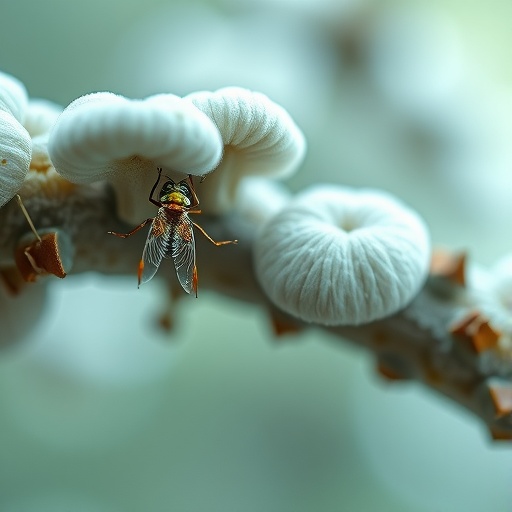
Researchers at the Center for Sustainable Management of Pests, Diseases, and Weeds (CEMASU), a pioneering institution supported by the São Paulo Research Foundation (FAPESP) in Brazil, have unveiled a groundbreaking biopolymer formulation designed to dramatically extend the shelf life and optimize the release rate of the bioinsecticidal fungus Beauveria bassiana. This fungus, known for its potent insecticidal properties, is widely employed in sustainable agricultural practices to combat pests without resorting to harmful chemical pesticides. The study, recently published in ACS Omega, represents a significant leap in biocontrol technologies, showcasing a sophisticated encapsulation method that promises enhanced durability and stability of the fungal agent.
At the heart of this innovation lies the use of carboxymethylcellulose, a water-soluble polymer derived from cellulose, which forms the encapsulating matrix for the fungal spores. The researchers employed a technique called ionotropic gelation, where one solution is dripped into another containing a cross-linking agent, leading to the formation of microbeads encapsulating the bioactive organism. The encapsulation not only preserves the fungal spores but also facilitates a controlled and sustained release, ensuring prolonged efficacy against insect pests. This method stands as a testament to advances in bioengineering aimed at marrying efficacy with environmental compatibility.
The choice of cross-linking agents was pivotal to the study’s findings. Two formulations were explored extensively: one utilizing aluminum ions and the other calcium ions for cross-linking the carboxymethylcellulose polymer. Both methods yielded spherical beads upon initial formation, yet their structural integrity diverged significantly post-drying. Aluminum-crosslinked beads exhibited remarkable morphological uniformity, maintaining their spherical shape and structural cohesion. In stark contrast, calcium-crosslinked beads suffered from collapse and agglomeration, forming irregular aggregates, which could compromise their application consistency and biological performance.
Detailed analysis under scanning electron microscopy revealed critical differences at the microscopic level. The aluminum-based beads showcased a slightly rough surface texture interspersed with fine cracks—features likely contributing to controlled permeability and moisture retention. Conversely, calcium-based aggregates possessed a pronouncedly rough and irregular surface, potentially undermining the protective environment essential for fungal viability. These ultrastructural characteristics underscore the importance of meticulous material design in developing effective biocontrol delivery systems.
Viability tests revealed compelling advantages conferred by the aluminum-crosslinked biopolymer. After five months of storage at –18 °C, the fungal viability within aluminum-based beads remained robust at approximately 85%, notably higher than the 69% viability recorded in pure, unencapsulated fungi. This increased longevity is crucial for the commercialization and practical deployment of bioinsecticides, which often suffer from rapid degradation under storage conditions. The enhanced thermal stability and superior water retention capacity of the aluminum beads contribute significantly to these improved outcomes, ensuring the fungi remain active and infective.
The biological mechanism underlying the effectiveness of Beauveria bassiana involves its blastospores—specialized fungal reproductive cells produced via liquid fermentation. These blastospores germinate swiftly upon contact with target insects, colonizing and ultimately killing them. The fungus is uniquely advantageous due to its specificity; it poses negligible risk to mammals and other non-target species, distinguishing it as a safer alternative to broad-spectrum chemical insecticides. Encapsulation strategies that preserve blastospore viability and control their release thus align perfectly with the goals of sustainable agriculture.
While laboratory results are promising, the research team led by professor Hernane da Silva Barud emphasizes the necessity of field trials to validate efficacy under real-world agricultural conditions. Future experiments aim to test the aluminum-crosslinked beads across diverse crop systems, assessing pest control performance, environmental persistence, and compatibility with existing agronomic practices. Additionally, trials may extend to livestock applications, targeting parasites like ticks, thereby broadening the impact scope of this biocontrol agent.
Of particular interest is the scalability of the encapsulation process. The ionotropic gelation technique employed is inherently simple and efficient, offering viable paths for industrial-scale production with minimal complexity and cost. Should field trials confirm efficacy, this cost-effectiveness could transform bioinsecticide accessibility, enabling widespread adoption in both developed and developing agricultural contexts. Such scalability is vital to meeting the growing demand for sustainable pest management solutions that reduce the environmental footprint of farming.
The study’s co-authors include researchers Mayté Zaldivar, Jean Carlos Machado, and Lívia Contini Massimino, all affiliated with the Biopolymers and Biomaterials Laboratory at the University of Araraquara (UNIARA). Collaborative contributions from Marcel Marques and Ricardo Bortoletto-Santos of the University of Ribeirão Preto (UNAERP), alongside José Eduardo de Almeida and Ana Paula Bartels from the Biological Institute of the São Paulo Agency for Agribusiness Technology (IB/APTA), reflect an interdisciplinary approach blending polymer science with applied entomology and agronomy.
Beyond the immediate scientific contributions, this research vividly illustrates the pivotal role of biopolymer technology in revolutionizing agricultural biocontrol. By extending the shelf life and modulating the release dynamics of microbial agents like Beauveria bassiana, it paves the way for developing next-generation bioinsecticides that are both ecologically harmonious and economically viable. This synergy between material science and biology offers a glimpse into the future of pest management, where precision and sustainability converge seamlessly.
In summary, the innovative encapsulation system leveraging carboxymethylcellulose and aluminum cross-linking represents a major advance in bioinsecticide formulation, enhancing fungal stability and usability. The findings underscore the immense potential for biopolymer-based delivery mechanisms in overcoming longstanding challenges in biocontrol agent storage and deployment. As agricultural sectors worldwide grapple with the twin imperatives of productivity and environmental stewardship, such breakthroughs herald transformative possibilities for integrated pest management strategies.
The publication date of this pivotal study is March 13, 2026, and it can be accessed via the DOI: 10.1021/acsomega.5c06970. The São Paulo Research Foundation’s robust support has been instrumental in driving this multidisciplinary endeavor forward, reflecting the strategic importance of fostering innovative solutions to global agricultural challenges. As this technology progresses towards commercialization, it promises to solidify Brazil’s leadership in sustainable pest control research and its application worldwide.
News Publication Date:
13-Mar-2026
Web References:
https://pubs.acs.org/doi/10.1021/acsomega.5c06970
https://agencia.fapesp.br/50389
References:
Barud, H. da S., Zaldivar, M. P., Machado, J. C., Massimino, L. C., Marques, M., Bortoletto-Santos, R., Almeida, J. E. de, Bartels, A. P. (2026). Sustainable Encapsulation of Biocontrol Agents: Cross-Linker Influence on Carboxymethylcellulose-Based Microbeads. ACS Omega. DOI: 10.1021/acsomega.5c06970
Cite Scienmag News
Roger Howard. (June 10, 2026). New Material Enhances Shelf Life and Sustains Release of Fungus Used in Bioinsecticides. Scienmag. https://scienmag.com/new-material-enhances-shelf-life-and-sustains-release-of-fungus-used-in-bioinsecticides/
Roger Howard. "New Material Enhances Shelf Life and Sustains Release of Fungus Used in Bioinsecticides." Scienmag, 10 June 2026, https://scienmag.com/new-material-enhances-shelf-life-and-sustains-release-of-fungus-used-in-bioinsecticides/. Accessed 4 September 2026.
Roger Howard. "New Material Enhances Shelf Life and Sustains Release of Fungus Used in Bioinsecticides." Scienmag. June 10, 2026. https://scienmag.com/new-material-enhances-shelf-life-and-sustains-release-of-fungus-used-in-bioinsecticides/


