


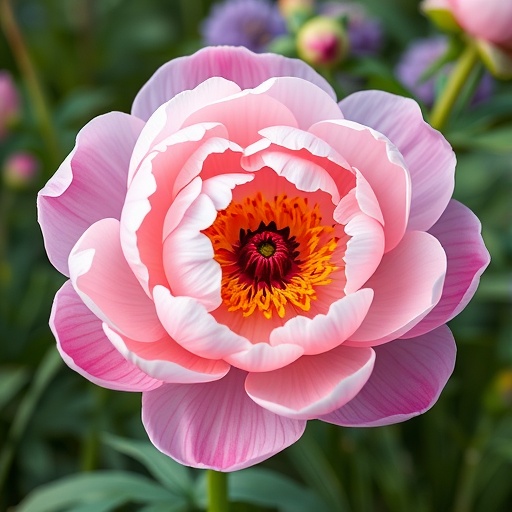
Floral fragrance is often treated as a charming but superficial feature of ornamental plants. In reality, scent is a complex biological signal that can attract pollinators, influence interactions between plants and their environment, and determine the commercial appeal of flowers. A new study of herbaceous peony, Paeonia lactiflora ‘Zifengyu’, has now mapped a major part of the molecular machinery responsible for its fragrance. The research identifies how several enzyme families work together to produce characteristic volatile compounds, including β-caryophyllene, geraniol, citronellol, and 1,8-cineole.
The findings reveal that peony scent is not controlled by a single gene or a single biochemical reaction. Instead, it emerges from a flexible metabolic network that changes as the flower develops and opens. Researchers from the Agricultural Genomics Institute at Shenzhen, the Chinese Academy of Agricultural Sciences, Northeast Normal University, and Karatina University combined volatile-compound analysis, gene-expression studies, enzyme assays, protein localization experiments, and mutation testing to reconstruct the pathways that supply and transform the molecules released by peony flowers.
The team began by analyzing floral volatiles at three developmental stages: the closed-bud stage, the half-open stage, and full bloom. They also compared different tissues, including sepals, stamens, petals, and carpels. Overall terpene emissions increased as the flowers opened, with monoterpenes making up much of the fragrance released by mature flowers. β-caryophyllene was especially prominent during early development and reached its highest level at the half-open stage. By full bloom, geraniol, citronellol, and 1,8-cineole had become particularly abundant in petals and stamens.
Terpenes are among the most diverse classes of plant volatile organic compounds. Their production begins with relatively simple five-carbon building blocks that are assembled into larger precursors, including geranyl diphosphate, or GPP, and farnesyl diphosphate, or FPP. These precursors are then converted into specific scent molecules by enzymes. Monoterpenes generally arise from GPP and contain 10 carbon atoms, whereas sesquiterpenes are formed from FPP and contain 15 carbon atoms. The location of these reactions inside plant cells can strongly influence which type of terpene is produced.
To identify the enzymes involved, the researchers screened 12 peony terpene synthase genes, known as PlTPS genes. Nine of the corresponding proteins displayed catalytic activity in functional tests. One enzyme, PlTPS4, produced β-caryophyllene, a sesquiterpene often associated with spicy, woody, or warm floral notes. PlTPS5 generated 1,8-cineole, a monoterpene with a fresh, eucalyptus-like aroma, while PlTPS9 produced geraniol, an alcohol-type monoterpene with a sweet, rose-like scent. These results directly connected specific peony genes with individual components of the flower’s fragrance profile.
The study also showed that small changes in protein structure can have major effects on scent chemistry. By replacing particular amino acids in PlTPS4 and PlTPS5, the scientists were able to determine which residues were essential for enzyme activity. These amino acids help shape the catalytic pocket where terpene precursors bind and are transformed. Even a single substitution can alter the three-dimensional geometry of that pocket, changing whether an enzyme produces a particular compound, produces several products, or loses activity altogether. Such findings help explain how closely related plant varieties can develop noticeably different aromas.
A second biochemical route was identified through a Nudix hydrolase protein called PlNUDX. Rather than functioning like a conventional terpene synthase, PlNUDX hydrolyzes GPP and neryl diphosphate, or NPP, generating alcohol-related products that support the formation of geraniol and nerol. This alternative pathway suggests that peony can produce overlapping fragrance compounds through more than one enzymatic mechanism. The discovery is important because it expands the range of possible genetic targets for modifying floral scent beyond the terpene synthase family alone.
Prenyltransferase enzymes provided another key part of the system. These proteins help assemble the precursor molecules required by downstream scent-producing enzymes, including GPP and FPP. In effect, prenyltransferases control the supply of raw materials, while TPS and NUDX proteins determine how those materials are converted into volatile compounds. The researchers’ results therefore support a compartmentalized model in which precursor production and terpene modification are coordinated across different cellular environments.
Protein-localization experiments further clarified why peony flowers produce both monoterpenes and sesquiterpenes. Enzymes located in plastids were mainly associated with monoterpene formation, while cytosolic proteins favored sesquiterpene production. This separation reflects the organization of plant metabolism: plastids and the cytosol contain distinct precursor pools and biochemical conditions. As a result, the same flower can operate parallel scent pathways in different parts of the cell, generating a layered fragrance that changes during opening.
The researchers say the work provides a molecular blueprint for understanding and improving peony fragrance. Genes such as PlTPS4, PlTPS5, PlTPS9, and PlNUDX could become targets for breeding programs aimed at increasing specific scent notes or stabilizing fragrance across developmental stages. Manipulating prenyltransferase activity may offer an even broader strategy by changing the amount of precursor available to several pathways at once. Beyond peony, the study demonstrates how combining volatile profiling with biochemical and cellular analysis can reveal the genetic architecture of fragrance in ornamental crops, potentially supporting the development of flowers with stronger, more distinctive, and commercially valuable scents.
News Publication Date: 9 March 2026
Web References: https://academic.oup.com/hr/article/13/7/uhag091/8512145
References: DOI: 10.1093/hr/uhag091
Cite Scienmag News
Alan Morgan. (August 10, 2026). Mapping the Fragrance Profile of Herbaceous Peonies. Scienmag. https://scienmag.com/mapping-the-fragrance-profile-of-herbaceous-peonies/
Alan Morgan. "Mapping the Fragrance Profile of Herbaceous Peonies." Scienmag, 10 August 2026, https://scienmag.com/mapping-the-fragrance-profile-of-herbaceous-peonies/. Accessed 3 September 2026.
Alan Morgan. "Mapping the Fragrance Profile of Herbaceous Peonies." Scienmag. August 10, 2026. https://scienmag.com/mapping-the-fragrance-profile-of-herbaceous-peonies/


