

Monday, July 27, 2026
Science
No Result
View All Result
  • Login
  • HOME
  • SCIENCE NEWS
  • CONTACT US
  • HOME
  • SCIENCE NEWS
  • CONTACT US
No Result
View All Result
Scienmag
No Result
View All Result
Home Science News Agriculture

New insights to extend litchi shelf life

July 27, 2026
in Agriculture
Reading Time: 2 mins read
0
New insights to extend litchi shelf life

New insights to extend litchi shelf life

65
SHARES
587
VIEWS
Share on FacebookShare on Twitter
ADVERTISEMENT

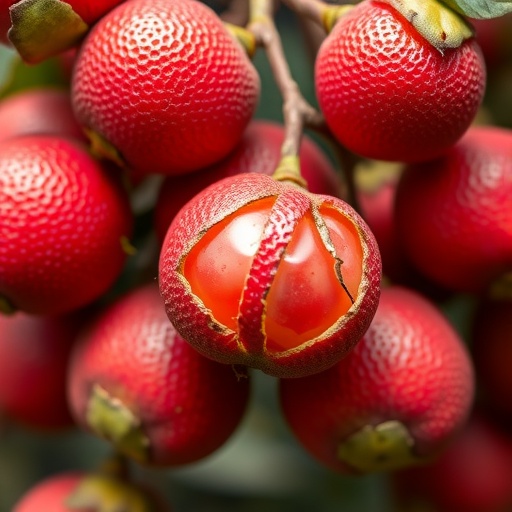
Litchi fruit can deteriorate within days after harvest, with rapid spoilage driven largely by fungal infection and peel browning. Traditional chemical preservatives can extend shelf life, but they also raise food-safety concerns and sustainability questions. A new study from China now proposes a microbiome-centered alternative: using the dynamics of naturally occurring bacteria on the fruit surface to both predict freshness and suppress pathogens.

Researchers led by Prof. Yong‑Xin Liu (Chinese Academy of Agricultural Sciences) monitored bacterial communities on the peels of two litchi varieties—“Huaizhi” (storage tolerant) and “Nuomici” (sensitive)—over a nine-day period. Experiments included both natural storage conditions and fungicide-treated groups, enabling the team to separate microbial succession signals from treatment effects.

To characterize the peel microbiome, the study applied amplicon sequencing to capture temporal community shifts. Time-series analysis identified genera exhibiting consistent freshness-linked patterns, including Methylobacterium, Sphingomonas, and Gluconobacter. In parallel, a machine-learning approach was used to evaluate whether these microbial signatures could forecast quality without relying on chemical indicators.

Using a random forest model trained on microbial biomarkers, the team achieved accurate prediction of fruit freshness, reporting a coefficient of determination greater than 0.90. The authors describe the peel microbiome as a “freshness clock,” reflecting how specific bacterial populations rise or decline in step with storage time and quality loss.

A key step toward application involved culturing bacteria from the peel. From 80 culturable isolates, the researchers tested biocontrol potential against two major postharvest pathogens: Peronophythora litchii (downy blight) and Colletotrichum gloeosporioides (anthracnose). One strain, Gluconobacter sp. Lc45, showed strong inhibitory activity.

In vitro assays demonstrated that Gluconobacter sp. Lc45 suppressed pathogen growth by more than 63%. More importantly, the strain also reduced disease development in living fruit, indicating functional biocontrol performance under realistic postharvest conditions.

Mechanistically, the protective effect was linked to nutrient competition and the secretion of antimicrobial metabolites. Because these actions do not depend on synthetic fungicides, the approach offers a potentially safer and more sustainable option for shelf-life extension.

Beyond individual strains, the study clarified the ecological driver of microbial community change: storage time, rather than cultivar identity or fungicide treatment, was the primary force shaping succession on the fruit surface. As decay progressed, communities shifted from plant-beneficial bacteria toward decomposer-associated taxa, explaining why some genera correlate positively with freshness early and negatively later.

By integrating high-throughput sequencing, culturomics, and predictive modeling, the work delivers both a diagnostic framework for postharvest management and a candidate biocontrol agent. The authors have filed a patent (No. 202610311174.2) based on the results, supporting translation toward real-world applications.

Subject of Research: Postharvest spoilage microbiome; bacterial freshness biomarkers; biocontrol using Gluconobacter
Article Title: Postharvest bacterial dynamics in litchi
Web References: http://dx.doi.org/10.1007/s11427-025-3302-x
Image Credits: ©Science China Press

Keywords: litchi; postharvest; microbiome; freshness biomarkers; time-series analysis; random forest; biocontrol; Gluconobacter; pathogen suppression

Tags: amplicon sequencing for microbiome profilingfruit microbiome analysisfungal infection preventionLitchi shelf life extensionmachine learning in fruit quality predictionmicrobial succession in fruit spoilagemicrobiome-centered food preservationnatural bacterial indicators of freshnesspeel bacterial communitiespost-harvest fruit spoilage controlrandom forest models for freshness forecastingsustainable alternatives to chemical preservatives
Share26Tweet16
Previous Post

Financial Stressors Linked to Increased Suicide Risk

Next Post

First patient enrolled in Phase 3 trial of mocertatug rezetecan for platinum-resistant ovarian cancer

Related Posts

Combining phenology and temperature data to gauge overwintering wheat seedling health
Agriculture

Combining phenology and temperature data to gauge overwintering wheat seedling health

July 27, 2026
KAUST Researchers Create More Precise Method for Engineering Plants
Agriculture

KAUST Researchers Create More Precise Method for Engineering Plants

July 27, 2026
Collagen Peptides Boost Bone Health in Female Runners, Study Finds
Agriculture

Collagen Peptides Boost Bone Health in Female Runners, Study Finds

July 27, 2026
Fine-flavor native cacao matches commercial yields, study shows
Agriculture

Fine-flavor native cacao matches commercial yields, study shows

July 27, 2026
Unwritten social rules, not government oversight, sustain forests for the future
Agriculture

Unwritten social rules, not government oversight, sustain forests for the future

July 27, 2026
Modeling Study Finds Ancient Language Diversity Was Far Greater Than Today’s
Agriculture

Modeling Study Finds Ancient Language Diversity Was Far Greater Than Today’s

July 26, 2026
Next Post
First patient enrolled in Phase 3 trial of mocertatug rezetecan for platinum-resistant ovarian cancer

First patient enrolled in Phase 3 trial of mocertatug rezetecan for platinum-resistant ovarian cancer

  • Mothers who receive childcare support from maternal grandparents show more

    Mothers who receive childcare support from maternal grandparents show more parental warmth, finds NTU Singapore study

    27656 shares
    Share 11059 Tweet 6912
  • University of Seville Breaks 120-Year-Old Mystery, Revises a Key Einstein Concept

    1061 shares
    Share 424 Tweet 265
  • Bee body mass, pathogens and local climate influence heat tolerance

    682 shares
    Share 273 Tweet 171
  • Researchers record first-ever images and data of a shark experiencing a boat strike

    546 shares
    Share 218 Tweet 137
  • Groundbreaking Clinical Trial Reveals Lubiprostone Enhances Kidney Function

    531 shares
    Share 212 Tweet 133
Science

Embark on a thrilling journey of discovery with Scienmag.com—your ultimate source for cutting-edge breakthroughs. Immerse yourself in a world where curiosity knows no limits and tomorrow’s possibilities become today’s reality!

RECENT NEWS

  • APCDd1 Identified as Highly Specific Marker for Ventral Midbrain Dopaminergic Progenitors
  • Iceberg barriers reduce foraging links, causing sharp chick declines in Coulman Island penguins
  • Astronomers Detect First Wandering Black Hole on Outskirts of Galaxy
  • UC Irvine Researchers Develop California Wildfire Damage Risk Map

Categories

  • Agriculture
  • Anthropology
  • Archaeology
  • Athmospheric
  • Biology
  • Biotechnology
  • Blog
  • Bussines
  • Cancer
  • Chemistry
  • Climate
  • Earth Science
  • Editorial Policy
  • Marine
  • Mathematics
  • Medicine
  • Pediatry
  • Policy
  • Psychology & Psychiatry
  • Science Education
  • Social Science
  • Space
  • Technology and Engineering

Subscribe to Blog via Email

Enter your email address to subscribe to this blog and receive notifications of new posts by email.

Join 5,146 other subscribers

© 2025 Scienmag - Science Magazine

Welcome Back!

Login to your account below

Forgotten Password?

Retrieve your password

Please enter your username or email address to reset your password.

Log In
No Result
View All Result
  • HOME
  • SCIENCE NEWS
  • CONTACT US

© 2025 Scienmag - Science Magazine

Discover more from Science

Subscribe now to keep reading and get access to the full archive.

Continue reading
