


The collapse of the Western Roman Empire marked a profound period of transformation across Europe, especially in the regions that now constitute modern Germany. For centuries, the conventional narrative framed this era as characterized by grand migrations of unified Germanic peoples reshaping the sociopolitical landscape. However, groundbreaking genomic research conducted by an international team of scientists led by Professor Dr. Joachim Burger from Johannes Gutenberg University Mainz (JGU) challenges this long-held perception, offering an unprecedentedly nuanced depiction of population dynamics between 400 and 700 CE in the former Roman frontier territories.
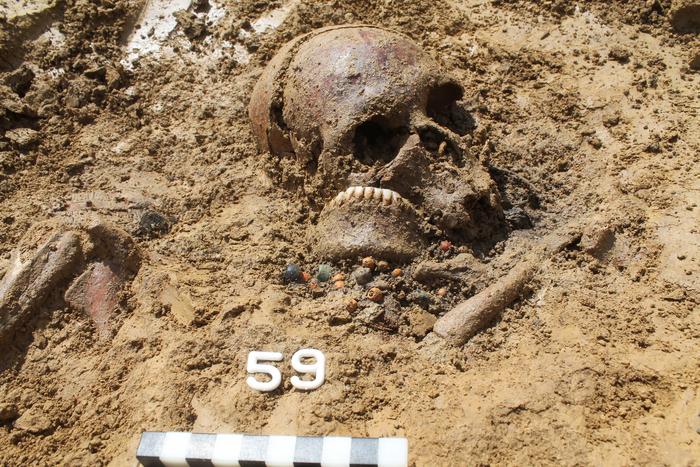
Deploying state-of-the-art paleogenetic techniques, the research team successfully analyzed 258 genomes derived from skeletal remains unearthed in southern Germany, particularly from Bavaria and Hesse. These samples originated from burial grounds known as row grave cemeteries, emblematic of the mid-fifth century and later across northern Gaul, western and southern Germany, and extending to Hungary. By integrating this dataset with a comprehensive reference bank comprising approximately 2,900 ancient, early medieval, and contemporary genomes from northern and southern Germany, the team reconstructed detailed genetic ancestries, illuminating the demographics of a key transitional epoch.
Remarkably, the genomic data unveiled the existence of two distinct populations cohabiting the region prior to and following the decline of Roman authority. One group exhibited northern European genetic roots, present in grave sites such as Altheim near Landshut and Büttelborn near Darmstadt. Contrary to the simplistic notion of massive, sweeping migrations, these individuals appeared to reflect smaller-scale movements occurring over a prolonged timeframe. Genetic and archaeological evidence suggests that their integration into Roman cultural practices was gradual, facilitated by social and administrative structures that maintained their relative separation as agrarian workers with endogamous marriage customs.
Further intrigue arose from the genetic characterization of a Roman military settlement population located within the frontier region. This cohort demonstrated exceptional genetic heterogeneity, mirroring centuries of population influx and exchange across vast geographic expanses, including parts of Asia. Such diversity underscores the cosmopolitan nature of the Roman military apparatus and its role as a conduit for gene flow across continental divides.
The disintegration of centralized Roman governance circa 470 AD precipitated a notable acceleration in population mobility. Professor Burger elucidates how insecurity and political fragmentation encouraged urban and military inhabitants to resettle in rural locales, leading to interactions and eventual coalescence between the previously distinct groups. Shared burial practices in unified row grave cemeteries attest to the emergence of cohesive communities blending northern European lineage with local genetic components. This fusion embodied not only demographic continuity from late antiquity but also marked a transformative phase in social organization.
Revolutionizing previous interpretations, this research repudiates the paradigm of monolithic Germanic migrations and instead posits a scenario of incremental population shifts typified by small familial units or individual movements. Medieval historian Professor Dr. Steffen Patzold emphasizes that these findings, supported by robust genomic datasets, realign historical understanding away from oversimplified mass migration models toward a framework recognizing layered, regional population dynamics.
Beyond reconstructing population movements, the study profoundly informs on the evolution of European kinship structures. The researchers successfully employed genomic data to delineate intricate family relationships within and across burial sites, revealing the predominance of nuclear family household compositions. These findings demonstrate adherence to monogamous marriage patterns, avoidance of consanguinity, and bilateral descent systems, reflecting social norms codified in late Roman cultural practices that persisted into the early medieval era.
This deep dive into genetic lineage unveiled that even before the Western Roman Empire’s political collapse, the communities inhabiting the frontier zone were enmeshed within a shared cultural milieu—what the team refers to as the late Roman cultural sphere. This milieu fostered both the cultural integration of diverse ancestries and the maintenance of distinct identity markers, facilitated by imperial administrative measures such as land allotment policies that constrained intermarriage and helped regulate assimilation.
From a broader perspective, the outcomes of this study elucidate the complex genetic genesis of present-day southern German populations. By the seventh century, the initial dual population groups had largely amalgamated, with northern European ancestry becoming increasingly pronounced. This demographically blended population forms the genetic substratum of Central Europe today, underscoring the enduring influence of late antique demographic processes on contemporary genetic landscapes.
This research exemplifies cutting-edge multidisciplinary collaboration, merging population genetics, bioinformatics, archaeology, and historiography to reframe a pivotal historical narrative. Drawing upon expertise from institutions including the University of Tübingen, University of Fribourg, University of Freiburg, and several European heritage and research bodies, the project showcases the potential of integrative scientific inquiry to resolve longstanding historical ambiguities through empirical data.
Funded by the German Research Foundation and the Swiss National Science Foundation, the comprehensive approach adopted in this investigation embodies an innovative template for unraveling complex human histories worldwide. As genomic methodologies evolve and datasets enrich, such integrative studies will continue to refine our grasp of cultural transformations underpinning societal evolutions across epochs.
As scholars continue to explore the tapestry of human history through the lens of genetics, this research stands as a testament to the nuanced reality beneath broad-stroke historical assertions. It unveils a late antique era marked not by monolithic migrations but by gradual integrations, multifaceted ancestries, and resilient cultural frameworks that seeded the populations and social structures recognizable in Europe today.
News Publication Date: 29-Apr-2026
Web References: 10.1038/s41586-026-10437-3
Cite Scienmag News
Juliet Wilcox. (April 29, 2026). New Genomic Insights from Southern Germany Reveal the Formation of Central European Societies After Rome. Scienmag. https://scienmag.com/new-genomic-insights-from-southern-germany-reveal-the-formation-of-central-european-societies-after-rome/
Juliet Wilcox. "New Genomic Insights from Southern Germany Reveal the Formation of Central European Societies After Rome." Scienmag, 29 April 2026, https://scienmag.com/new-genomic-insights-from-southern-germany-reveal-the-formation-of-central-european-societies-after-rome/. Accessed 3 September 2026.
Juliet Wilcox. "New Genomic Insights from Southern Germany Reveal the Formation of Central European Societies After Rome." Scienmag. April 29, 2026. https://scienmag.com/new-genomic-insights-from-southern-germany-reveal-the-formation-of-central-european-societies-after-rome/


