


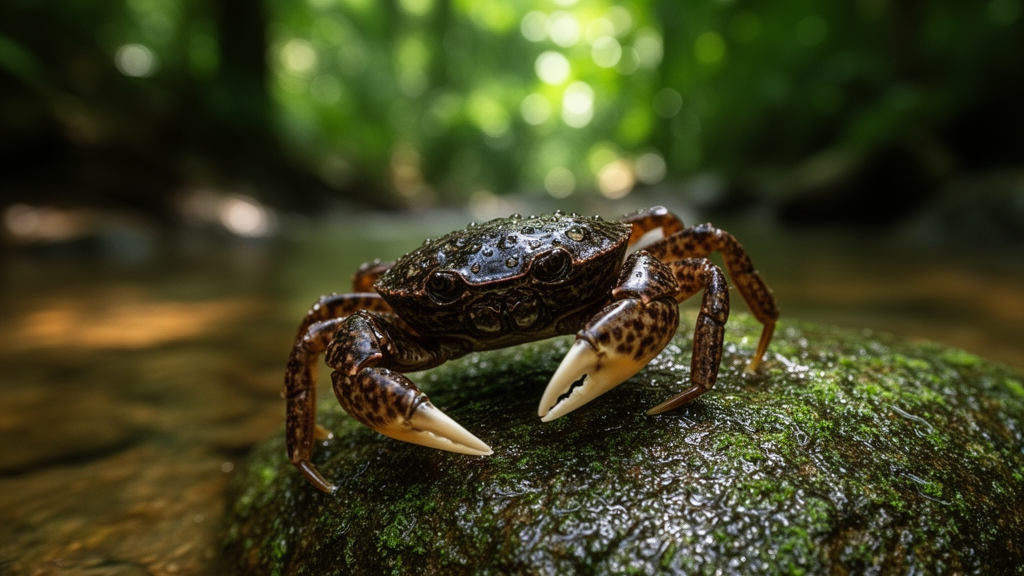
A tangle of names, lost type specimens and mislabelled museum jars has finally been untangled for two little-known freshwater crabs from northern Vietnam, and the resolution has produced something rare: an entirely new genus. In a study published in the journal ZooKeys, researchers from the Lee Kong Chian Natural History Museum in Singapore and Nanjing Normal University in China reassessed the potamid crabs Vietorientalia glabra and Vietorientalia rubra, species that have bounced between three different genera over nearly six decades. Their verdict, based on fresh specimens collected from the original type localities and on DNA sequences from four genes, is that the two species are not even close relatives. One keeps the genus Vietorientalia, now restricted to a single species, while the other moves into a newly erected genus named Dangmon, honouring the late Vietnamese carcinologist Professor Đặng Ngọc Thanh.
The confusion began innocently enough. In 1967, Đặng described a smooth, high-shelled crab from Hoa Binh province as Potamon (Geothelphusa) glabra. By 1975 he had decided it belonged in a genus of its own, Orientalia, which he created together with a similar crab from Hainan Island in China. Two more species from central Vietnam were added in 1992. Almost concurrently, and unaware of Đặng’s work, the Chinese carcinologist Dai established the genus Hainanpotamon in 1995 for the very same Hainan crab, using the species Potamon orientale, described by Parisi in 1916, as its type. Two genera, one crab.
The homonymy problem then escalated. The name Orientalia, it turned out, was already taken: Radoman had used it in 1972 for a genus of freshwater snails from the Balkans, and Bykova had used it even earlier, in 1947, for a genus of foraminiferans. When Yeo and Ng reviewed the situation in 1998, they concluded that the crab genus Orientalia was invalid as a junior homonym and treated all its species as members of Hainanpotamon, citing the similar external appearance and male first gonopod morphology of the animals and the priority of Dai’s name. In 2005, Yeo and Ng moved one species, Hainanpotamon tankiense, into yet another new genus, Laevimon, based on clear differences in sternal and gonopod anatomy. By 2008, Yeo and Naruse recognised nine species of Hainanpotamon spread across Hainan Island, northern Laos and Vietnam.
Đặng, however, was not persuaded. In 2012 he established Vietorientalia as a replacement name for his invalid Orientalia, to accommodate the two Vietnamese species Hainanpotamon glabrum and Hainanpotamon rubrum. But his diagnosis was brief, without illustrations or photographs, and the descriptions and figures in his earlier works were unclear. Worse, the type specimens were apparently lost: Yeo and Naruse reported in 2008 that they had been unable to examine the holotype of either species, the former of which was said to be gone, and for the latter only a female paratype was available, forcing them to rely on diagrams for the male anatomy. The actual carapace and gonopod morphology of both species, and therefore the very validity of Vietorientalia, remained uncertain for years.
The breakthrough came when the second author of the new study managed to collect fresh specimens of both species from their type localities: Hoa Binh province, now part of Phú Thọ, for V. glabra, and Thanh Hóa province for V. rubra. These topotypes, preserved in 75% ethanol and deposited in the Zoological Reference Collection of the Lee Kong Chian Natural History Museum and at Nanjing Normal University, allowed the team to examine the animals under Leica M80 and M205c stereomicroscopes, with illustrations made using mounted drawing tubes and photographs taken with an Olympus OM-D E-M1 Mark III camera and a M.Zuiko Digital ED 60 mm F2.8 lens.
Because the holotype of V. glabra is lost, the authors designated a male topotype, measuring 46.1 by 35.4 millimetres and collected in May 2022 from the Lạc Sơn–Ngổ Luông Natural Reserve in Phú Thọ province, as the neotype of the species. This act stabilises the taxonomy of both the species and the genus it anchors. The neotype displays a carapace that is wider than long, with a width-to-length ratio of 1.30, strongly convex from front to back but only weakly convex from side to side, thanks to gently inflated branchial regions. The epigastric and postorbital cristae are almost indiscernible, the anterolateral margins are completely smooth, and the ambulatory legs are elongate with very long, slender dactyli. The male first gonopod, the G1, is long, slender and gently sinuous, with a terminal article that is very slender, subconical, curving gently outwards and bearing a very pronounced dorsal flap in its proximal part.
On this evidence, Vietorientalia is confirmed as a valid genus, clearly distinct from Hainanpotamon sensu stricto, which the authors now restrict to four species endemic to Hainan Island: H. orientale, H. fuchengense, H. helense and H. daiae. Vietorientalia differs from its Hainan relatives in having a carapace that is weakly convex transversely with inflated branchial regions, smooth rather than rugose sub-hepatic, pterygostomial and sub-branchial surfaces, very weak postorbital cristae, smooth anterolateral margins, more elongate ambulatory legs, and a G1 terminal article that is very slender and curving outwards with a high dorsal flap, rather than broader and curving gently upwards with a relatively low flap.
But the two Vietnamese species turned out not to be sisters. Morphological differences between them, and the results of molecular analysis, support the conclusion that they are not congeneric. Accordingly, the authors erected the new genus Dangmon, with Orientalia rubra Đặng & Trần, 1992, as its type species, now combined as Dangmon rubrum comb. nov. The genus is named after the late Professor Đặng Ngọc Thanh of the Vietnam National Centre for Natural Science and Technology, in honour of his long and substantial contributions to carcinology in Vietnam. Dangmon can be differentiated from Vietorientalia by a carapace that is relatively lower and less inflated, convex transversely with branchial regions not prominently inflated, an anterior thoracic sternum that is narrower transversely and more elongate longitudinally with a smooth surface, major cheliped fingers in adult males that are elongate, slender and distinctly gaping, ambulatory legs that are less elongate with stouter dactyli, and a G1 terminal article that curves gently inwards with a relatively low dorsal flap.
Dangmon also differs from Hainanpotamon sensu stricto in having a completely smooth anterolateral margin rather than a cristate, serrated one, an epibranchial tooth that is almost indiscernible, gently rugose rather than strongly granulose pterygostomial, subhepatic and sub-branchial regions, a third maxilliped flagellum that does not exceed the width of the merus, and smooth cheliped surfaces with very slender and long fingers in the male major chela. The genus is currently monotypic, known only from Thanh Hóa province in northern Vietnam, and is clearly separated from the similar-looking genus Lacunipotamon by its stouter and shorter G1 with a recurved or dilated terminal article tip, whereas in Dangmon the G1 is slenderer and more elongate with a subconical terminal article.
To place these crabs in an evolutionary context, the authors reconstructed phylogenetic relationships using 68 sequences, of which 48 were newly obtained for this study, from 15 species representing seven genera and one new genus. The dataset drew on two mitochondrial genes, cytochrome c oxidase subunit I and 16S ribosomal RNA, and two nuclear genes, 28S ribosomal DNA and histone H3, yielding a concatenated matrix of 2,200 base pairs. Alignments were performed with MAFFT v. 7.310 using the G-INS-i strategy, trimmed with Gblocks v. 0.91b, and concatenated with custom Python scripts. ModelFinder, guided by the Akaike and Bayesian information criteria, identified GTR + I + G as the best-fitting substitution model. Bayesian inference was run in MrBayes v. 3.2.7a with four independent MCMC analyses of one cold and three heated chains for 10 million generations, and maximum likelihood analysis was performed in IQ-TREE v. 2 with 1,000 bootstrap replicates. Both approaches produced congruent topologies with strong nodal support.
The resulting trees confirm that all genera analysed are monophyletic. Hainanpotamon sensu stricto, represented by its four Hainan Island endemics, forms a well-supported clade sister to Calcipotamon puglabrum, also from Hainan. Vietorientalia glabra is recognised as a well-supported monophyletic lineage sister to the Lacunipotamon and Tiwaripotamon species. Dangmon rubrum gen. et comb. nov. forms the basal lineage and is genetically distinct from all other closely related species. The combined phylogenetic and morphological evidence thus supports the present taxonomic arrangement. The study also found that Hainanpotamon sensu Yeo and Naruse (2008) is not monophyletic, with the Indochinese species H. auriculatum from central Vietnam and H. directum from northern Laos not forming a monophyletic group with the Hainan endemics. The generic placement of Hainanpotamon globosum, purportedly from Okinawa but listed as Nanhaipotamon globosum by Ng and colleagues in 2008, remains contentious and will be addressed in a separate revision. For now, the freshwater crabs of northern Vietnam have gained a new genus, a neotype, and a cleaner family tree.
Subject of Research: Taxonomy and molecular phylogenetics of Vietnamese potamid freshwater crabs
Article Title: A new genus of freshwater crab from Vietnam, with comments on the allied genera Vietorientalia Đặng, 2012, and Hainanpotamon Dai, 1995 ( Decapoda , Brachyura , Potamidae )
Article References: Tan, Z. W., Ngo, V. T., & Shi, B. (2026). A new genus of freshwater crab from Vietnam, with comments on the allied genera Vietorientalia Đặng, 2012, and Hainanpotamon Dai, 1995 (Decapoda, Brachyura, Potamidae). ZooKeys, 1294, 61-87. https://doi.org/10.3897/zookeys.1294.199712
Image Credits: AI Generated
DOI: 10.3897/zookeys.1294.199712
Keywords: freshwater crabs, Vietnam, new genus, Dangmon, Vietorientalia, Hainanpotamon, Potamidae, neotype, phylogenetics, ZooKeys, genus, freshwater
Cite Scienmag News
Margaret Porter. (October 16, 2026). New freshwater crab genus Dangmon erected from Vietnam after decades of taxonomic confusion. Scienmag. https://scienmag.com/new-freshwater-crab-genus-dangmon-erected-from-vietnam-after-decades-of-taxonomic-confusion/
Margaret Porter. "New freshwater crab genus Dangmon erected from Vietnam after decades of taxonomic confusion." Scienmag, 16 October 2026, https://scienmag.com/new-freshwater-crab-genus-dangmon-erected-from-vietnam-after-decades-of-taxonomic-confusion/. Accessed 16 October 2026.
Margaret Porter. "New freshwater crab genus Dangmon erected from Vietnam after decades of taxonomic confusion." Scienmag. October 16, 2026. https://scienmag.com/new-freshwater-crab-genus-dangmon-erected-from-vietnam-after-decades-of-taxonomic-confusion/


