


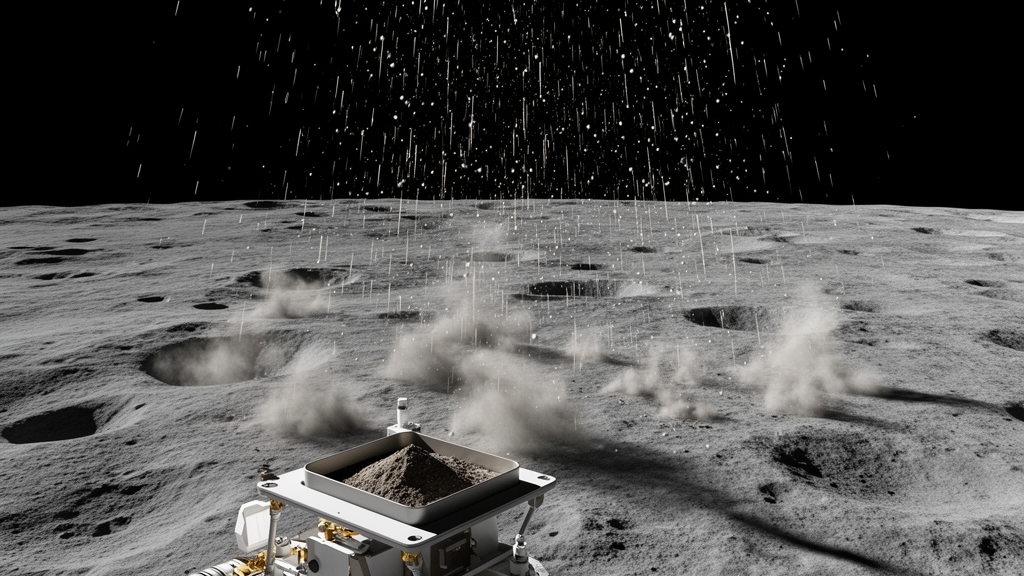
The Moon has no atmosphere to speak of, no wind, no rain, and no oceans, yet its surface is anything but static. A new study published in Communications Earth & Environment shows that the lunar regolith — the fine, fragmented blanket of dust and rock covering the Moon — has been chemically and isotopically reworked across virtually the entire lunar surface by an invisible, relentless rain of microscopic meteorites. By measuring the isotopic composition of nickel in soils collected by six Apollo missions and two Chinese Chang’e missions, a team led by Ke Zhu of the China University of Geosciences in Wuhan, with collaborators at the University of Bristol and elsewhere, has demonstrated that micrometeorite-driven processing is not a local curiosity but a global feature of the Moon’s outermost layer.
The team analyzed high-precision stable nickel isotope ratios, expressed as δ60/58Ni values relative to the NIST SRM 986 standard, in soils returned from Apollo 11, 12, 14, 15, 16 and 17, as well as the Chang’e-5 and Chang’e-6 landing sites. These samples span geographically and geologically diverse lunar terrains, from the basaltic maria of the nearside to the ancient highlands and even the farside material brought back by Chang’e-6. The measured δ60/58Ni values ranged from 0.345 to 1.280 per mil, a spread that is generally heavier than the values found in lunar basalts and heavier than the inferred composition of the bulk silicate Moon. That systematic heaviness is the smoking gun: it indicates that heavy nickel isotopes have been preferentially enriched in surface soils during prolonged exposure to space.
The mechanism behind this enrichment is micrometeorite bombardment. Tiny particles, typically fractions of a millimeter across, strike the airless lunar surface at hypersonic velocities of tens of kilometers per second. At impact, the enormous kinetic energy is converted into heat, vaporizing both the projectile and a thin shell of the target soil. Because lighter isotopes of nickel evaporate slightly more readily than heavier ones, repeated cycles of vaporization and recondensation leave the residual soil progressively enriched in the heavy isotopes. Each individual impact is minuscule, but over billions of years the cumulative effect is profound, driving elemental evaporation, isotopic fractionation, and the thorough mixing of extralunar material into the regolith.
What makes the new work particularly compelling is its breadth. Previous studies had documented nickel isotope anomalies in specific samples, but critics could argue these were local anomalies. By combining newly measured soils from Apollo sites scattered across the nearside with the Chang’e-5 drill-core data published earlier and the fresh Chang’e-6 farside samples, the researchers show that heavy nickel isotope enrichment appears everywhere they looked. Together, these results demonstrate that micrometeorite-driven nickel isotope fractionation is a widespread, indeed near-universal, feature of lunar surface processing.
Yet the story is not entirely uniform, and the deviations are scientifically revealing. The immature soils from the Apollo 12 site, which have experienced comparatively little exposure and reworking at the surface, show relatively low δ60/58Ni values, consistent with limited cumulative micrometeorite processing. In contrast, the mature soils from the Apollo 16 site in the lunar highlands display not only heavy isotope values but also strikingly high nickel concentrations and elevated nickel-to-cobalt ratios. This combination points to an additional process: compositional overprinting by nickel-rich material, most likely delivered by the very micrometeoritic flux that drives the isotopic fractionation in the first place.
This distinction between isotopic fractionation and compositional addition is crucial for interpreting lunar soils correctly. Nickel is a siderophile, or iron-loving, element, and in the lunar interior it is scarce because most of it sank into the Moon’s metallic core during differentiation. The lunar surface, by contrast, is continuously seeded with nickel delivered by incoming extraterrestrial material. The nickel-to-cobalt ratio serves as a diagnostic: chondritic meteoritic material carries a characteristic ratio that differs from that of native lunar rocks, so an elevated ratio in a soil signals an extralunar contribution. When that contribution is combined with heavy isotope signatures, researchers can disentangle how much of a soil’s nickel reflects simple exposure history and how much reflects genuine addition of cosmic material.
The implications extend well beyond the Moon. Micrometeorite bombardment is a fundamental surface process on all airless bodies, including asteroids, Mercury, and the moons of Mars. Any mission that returns regolith samples from such bodies — whether from asteroid Bennu, as OSIRIS-REx did, or from Phobos in future missions — will need to account for the same vaporization-driven fractionation when interpreting surface compositions. Nickel isotopes, particularly when combined with regolith maturity indices and nickel-to-cobalt ratios, therefore provide a sensitive and transferable tracer of surface processing on airless worlds throughout the Solar System.
For lunar science specifically, the findings offer a new calibration tool. Regolith maturity, traditionally assessed through indicators such as the abundance of agglutinates — glassy, welded soil particles — and the concentration of solar-wind-implanted gases, provides a measure of how long a soil has sat at the surface. The nickel isotope data now add an independent, chemically based clock to that assessment. Soils that appear mature by optical criteria but carry light nickel isotope signatures may have experienced unusual histories, such as recent excavation by impact craters that dredged up less-processed material from depth. Conversely, heavy isotope signatures in nominally young soils could flag prolonged exposure in stable surface settings.
The study also showcases the growing power of combined sample return programs. The Apollo collections, gathered half a century ago, remain scientifically vibrant, but the Chang’e-5 samples from 2020 and the Chang’e-6 farside samples returned in 2024 have opened entirely new provinces to laboratory scrutiny. Comparing soils from the maria, the highlands, and the farside within a single analytical framework allows planetary scientists to separate global processes, such as micrometeorite gardening, from local ones, such as the compositional character of the underlying bedrock or the proximity to large impact basins. The agreement between Apollo and Chang’e datasets on the direction and rough magnitude of nickel isotope enrichment strengthens confidence that the observed pattern reflects a genuine planetary process rather than an artifact of any single landing site.
As humanity prepares for a sustained presence on the Moon through the Artemis program and future lunar bases, understanding the regolith is a practical necessity. The uppermost centimeters of lunar soil are the interface through which every lander, habitat, and instrument must interact with the lunar environment, and that interface has been physically and chemically transformed by billions of years of micrometeorite gardening. The nickel isotope record embedded in that soil offers both a scientific archive of the Solar System’s dust flux over time and a practical guide to the properties of the material future explorers will dig, drill, and build with. In the quiet bombardment of the lunar surface by particles too small to see, researchers have now found a signal loud enough to read across the whole Moon.
Subject of Research: Planetary Science
Article Title: Nickel isotopes in Apollo and Chang’e soils reveal widespread micrometeorite-driven processing of the lunar regolith
Article References: Zhu, K., Yang, M., Huang, J., Tian, W., Zhu, M.-H., & Elliott, T. (2026). Nickel isotopes in Apollo and Chang’e soils reveal widespread micrometeorite-driven processing of the lunar regolith. Communications Earth & Environment. https://doi.org/10.1038/s43247-026-04139-x
Image Credits: AI Generated
DOI: 10.1038/s43247-026-04139-x
Keywords: lunar regolith, nickel isotopes, micrometeorite bombardment, Apollo missions, Chang'e-5, Chang'e-6, isotope fractionation, geochemistry, Moon, space weathering, planetary science, regolith maturity
Cite Scienmag News
Violet Maxwell. (October 16, 2026). Nickel Isotopes Reveal Micrometeorite Bombardment Shapes the Entire Lunar Surface. Scienmag. https://scienmag.com/nickel-isotopes-reveal-micrometeorite-bombardment-shapes-the-entire-lunar-surface/
Violet Maxwell. "Nickel Isotopes Reveal Micrometeorite Bombardment Shapes the Entire Lunar Surface." Scienmag, 16 October 2026, https://scienmag.com/nickel-isotopes-reveal-micrometeorite-bombardment-shapes-the-entire-lunar-surface/. Accessed 16 October 2026.
Violet Maxwell. "Nickel Isotopes Reveal Micrometeorite Bombardment Shapes the Entire Lunar Surface." Scienmag. October 16, 2026. https://scienmag.com/nickel-isotopes-reveal-micrometeorite-bombardment-shapes-the-entire-lunar-surface/


