


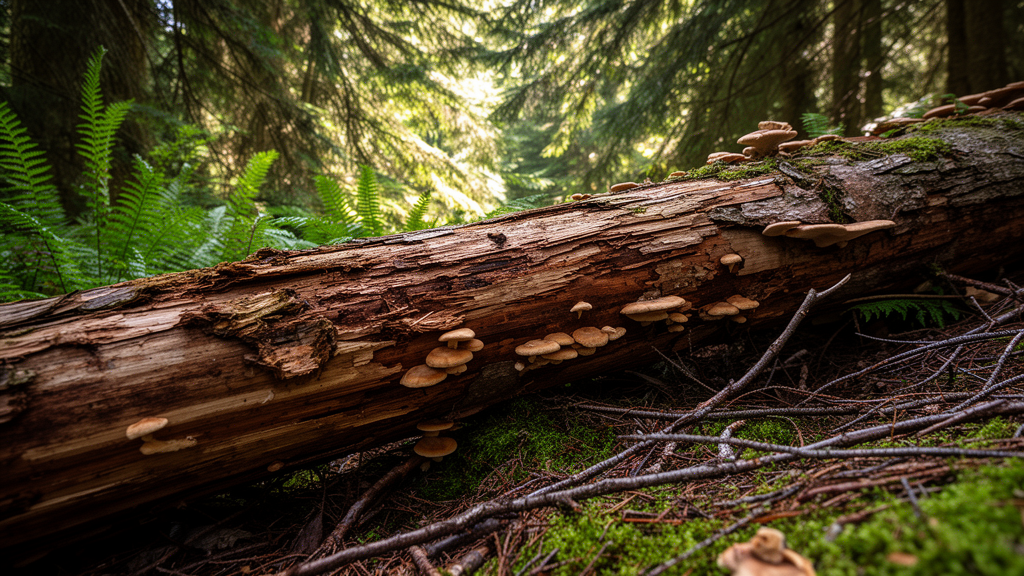
In an ancient Belgian beech forest where dead wood piles up faster than almost anywhere in lowland Europe, researchers have uncovered a hidden rule governing which fungi claim each fallen branch and trunk: the identity of the tree itself. Even after a beech dies, shatters, and scatters into logs, snags, and twigs, its fungal community carries a signature of that individual tree — a legacy that persists across fragmented deadwood fractions and shapes the entire decomposition economy of the forest floor.
The study, published in IMA Fungus, took advantage of a near-perfect natural experiment. The Joseph Zwaenepoel forest reserve in Belgium has been left unmanaged since 1983 and now holds more than 120 cubic meters of dead wood per hectare. Because the stand is dominated by a single tree species, European beech (Fagus sylvatica), with minimal environmental gradients and no recent disturbance, the researchers could strip away the usual confounding factors — differences in host species, climate, soil, and management history — and ask a deceptively simple question: when everything else is equal, what actually determines which fungi live in a given piece of dead wood?
The answer required an unusually ambitious sampling design. Rather than treating dead wood as isolated objects, the team linked every sampled substrate back to its source tree using a shared tree-identity label. They drilled sawdust cores from logs, standing dead snags, attached fine woody debris such as branches still connected to a fallen trunk, and fallen fine woody debris scattered through tree crowns. In total, 264 samples from 39 trees yielded 2,358 fungal species hypotheses, sequenced using long-read nanopore technology that reads the full internal transcribed spacer region of fungal DNA and allows precise assignment to species-level units in the UNITE reference database.
The headline finding is that tree identity outperformed substrate type as a predictor of fungal community composition at the stand scale. After correcting for sampling design with null models that shuffled tree labels, tree identity explained roughly 10 percent of compositional variance across all woody samples, while substrate type explained somewhat less. Within logs, the effect was even stronger, reaching nearly 17 percent in abundance-weighted analyses. Dead wood from the same tree was consistently more similar in its fungal inhabitants than dead wood from different trees, even when comparing across different substrate types. Because no spatial autocorrelation was detected among logs, the signal cannot be dismissed as a proximity artifact — these trees genuinely act as distinct community units.
Why would individual trees imprint themselves so durably on their decomposer communities? The researchers point to a combination of pre-mortem and post-mortem processes. Living beeches harbor accumulated endophytic fungi and bark-associated communities that differ from tree to tree, along with subtle physiochemical variation in wood chemistry. Once a tree dies, priority effects take over: early-arriving colonists modify the substrate and can exclude later arrivals, so communities with different assembly histories diverge. At spatial scales under 480 meters, wood-inhabiting fungi are generally not dispersal-limited, so the tree-level signal most likely reflects these colonization and establishment contingencies rather than restricted spore movement. The result is that each dead tree functions as a partially self-contained ecological arena whose fungal occupants trace back to events that began before the tree fell.
Substrate type, meanwhile, operates through a different mechanism. The study found that substrate effects were much stronger in abundance-weighted analyses than in presence–absence data, suggesting that substrates primarily reorganize dominance within a partially shared species pool rather than assembling entirely distinct communities. A core group of 205 species hypotheses — about a tenth of all taxa detected — occurred across every woody substrate, yet substrate-specific taxa were more numerous. In other words, most fungi can potentially colonize any dead wood, but the conditions in logs, snags, and twigs determine which of them become abundant. The three most influential taxa in the whole dataset illustrate this: Kretzschmaria deusta, Armillaria borealis, and Eutypa spinosa are all common heartwood and butt-rot fungi of beech, often present before trees die, and their relative dominance shifts dramatically between coarse trunks and thin branches.
The fine-scale structure within individual logs proved equally striking. Outer wood samples, taken from the top 8 centimeters beneath the bark, were about 70 percent richer in fungal species than inner samples from 10 to 18 centimeters deep. Yet inner communities were only partially nested within outer ones — substantial taxon turnover separated the two strata, and this depth differentiation persisted across all decay stages. Contrary to an outside-in colonization model, the researchers found no evidence that inner and outer communities progressively homogenize as decay advances. A single log is therefore not one habitat but a mosaic of microhabitats, with fungal territories breaking down at centimeter scales, likely following the vessel and fiber networks of the wood itself.
Snags emerged as an unexpected hotspot of cryptic diversity. Standing dead trees showed the highest molecular richness of any substrate, even though fruitbody surveys typically portray them as species-poor — probably because dry conditions suppress the formation of visible mushrooms. Stressful conditions in snags appear to relax competition and widen niche availability, allowing stress-tolerant and imperfect fungi to coexist without ever fruiting. This means conventional surveys systematically underestimate the contribution of snags, which may make an outsized but largely invisible contribution to stand-level fungal diversity. Even within snags, the compass direction of sampling mattered: north- and south-facing sides hosted modest but consistent abundance shifts across multiple shared species, hinting at subtle microclimatic gradients under the closed canopy.
At the opposite end of the size spectrum, fallen twigs behaved almost anarchically. In fallen fine woody debris, tree identity effects faded to a faint presence–absence signal, while decay stage and piece diameter became the dominant predictors. Turnover between individual twigs was extreme — nearly every fallen branch hosted a distinct assemblage — and detachment from the tree explained almost nothing by itself. Attached branches, by contrast, retained a weak but detectable connection to their parent trunk, indicating that tree identity partly defines a shared species pool extending through the coarse-to-fine wood continuum, until physical detachment severs it. Comparing twigs with the soil directly beneath them confirmed that wood and soil communities remain strongly separated, with only weak hints of convergence under late-decay pieces.
Beyond its ecological insights, the study delivers practical guidance for biodiversity monitoring, which matters because deadwood fungi are increasingly used as indicator taxa in forest conservation. The researchers showed that dominant diversity — the diversity of common, recurrent species — saturates rapidly, requiring only about 20 to 50 samples, whereas total richness never approached saturation even with hundreds of samples. Long-read environmental DNA reliably captures the dominant and structurally important components of the community, but exhaustively cataloging rare species is unrealistic under typical monitoring effort. The most efficient strategy, the authors conclude, is to sample many trees with pooled cores per tree and to cover a broad range of substrate types, decay stages, sizes, and depths — rather than drilling intensively within individual logs. For a forest’s fungal future, it seems, the tree remembers — and so should the surveyors.
Subject of Research: Community structuring of wood-inhabiting fungi by tree identity and deadwood substrate type in an old-growth beech forest
Article Title: Tree identity shapes composition, substrate shifts dominance in deadwood fungi of an old-growth lowland beech forest
Article References: Dierickx, G., Vandekerkhove, K., Van de Kerckhove, P., Asselman, P., & Verbeken, A. (2026). Tree identity shapes composition, substrate shifts dominance in deadwood fungi of an old-growth lowland beech forest. IMA Fungus, 17, Article e190198. https://doi.org/10.3897/imafungus.17.190198
Image Credits: AI Generated
DOI: 10.3897/imafungus.17.190198
Keywords: deadwood fungi, Fagus sylvatica, eDNA metabarcoding, tree identity, fine woody debris, old-growth forest, fungal ecology, nanopore sequencing, biodiversity monitoring, saproxylic fungi, community assembly, decay stage
Cite Scienmag News
Roger Howard. (October 16, 2026). Deadwood Fungi Follow the Tree: Legacy Effects Persist as Logs Break Down. Scienmag. https://scienmag.com/deadwood-fungi-follow-the-tree-legacy-effects-persist-as-logs-break-down/
Roger Howard. "Deadwood Fungi Follow the Tree: Legacy Effects Persist as Logs Break Down." Scienmag, 16 October 2026, https://scienmag.com/deadwood-fungi-follow-the-tree-legacy-effects-persist-as-logs-break-down/. Accessed 16 October 2026.
Roger Howard. "Deadwood Fungi Follow the Tree: Legacy Effects Persist as Logs Break Down." Scienmag. October 16, 2026. https://scienmag.com/deadwood-fungi-follow-the-tree-legacy-effects-persist-as-logs-break-down/


