


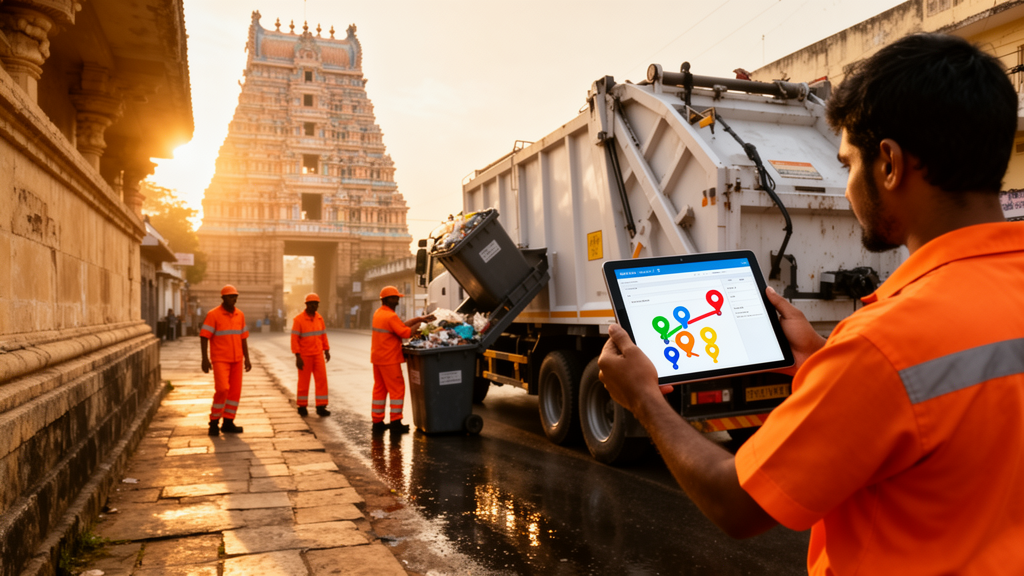
In the southern Indian city of Tirupati, a garbage truck is no longer just a garbage truck. It is a moving data point whose every pickup, route deviation and bin scan feeds into a municipal dashboard, and according to a new case study published in Frontiers in Sustainable Cities, that shift from muscle to metadata is quietly rewriting what urban sanitation means. The research, led by Daggupati Likhitha and Bangalore Morarji of Vellore Institute of Technology, examines how a mid-sized temple city of roughly 374,000 residents — a place that must also absorb one of the largest pilgrim flows in the country — built a digital sanitation system that has kept it ranked among India’s cleanest cities for years running.
The numbers behind Tirupati’s daily waste load are substantial. Ministry of Housing and Urban Affairs figures cited in the study put the city’s output at around 115 tonnes of wet waste per day, 61 tonnes of dry waste and recyclables, 15 tonnes of food waste, 25 tonnes of construction and demolition debris, 2 tonnes of plastic and 1 tonne of domestic hazardous waste. That is a heavy, organic-dominated stream for a city of this size, and it is exactly the profile that decades of Indian municipal waste research have flagged as the hardest to process well. What makes Tirupati interesting is not the composition but the architecture built on top of it.
That architecture has four layers. At the collection level, the Tirupati Municipal Corporation runs an Online Waste Management System in which radio frequency identification tags attached to households or collection points are scanned by sanitation workers, generating a timestamped log of exactly which properties were serviced and when. The collection vehicles themselves — colour-coded auto tippers known locally as Ghanta Gaddis — carry three separate compartments for wet, dry and hazardous waste, meaning segregation is built into the hardware rather than left to household discipline. At the logistics level, 57 GPS-fitted vehicles shuttle waste to 238 designated transfer points, their movements checkable against planned routes. At the integration level, an Integrated Command and Control Centre built under the Smart Cities Mission pulls together feeds from roughly 400 CCTV cameras across 135 locations, environmental sensors and a video analytics module that automatically flags illegal dumping. And at the citizen interface, the state-run Spandana platform lets residents lodge and track complaints through web and phone channels as well as mobile apps.
The study’s central argument is deceptively simple: none of this technology sweeps a street. An RFID scan does not lift a bin. What it does is convert an invisible municipal service into an auditable one, and that auditability — the ability to prove, with records rather than promises, that collection actually happened — is itself a form of urban resilience. The authors draw here on a well-established line of e-government scholarship, including Cordella and Tempini’s work on how digital tools solve an old accountability problem in public services, and on Tangi and colleagues’ finding that the real value of digital reform often lies in what it makes visible to managers rather than in any change to the underlying task. A paper register can be edited or lost; a scan log is far harder to alter after the fact.
This matters enormously in the Indian policy context, because the annual Swachh Survekshan cleanliness survey — now in its ninth or tenth round — turns sanitation into a national competition in which a city’s score depends partly on whether its systems can demonstrate coverage with verifiable records. Tirupati placed eighth among all Indian cities above one lakh population in the 2023 cycle, holds a five-star Garbage Free City rating and a Water Plus certification, and in the 2024–25 round was named to the newly created Super Swachh League for sustained performance in the 50,000 to 3 lakh population band, alongside the New Delhi Municipal Council. That is consistency across cycles, not a single good year, and the timing lines up with the build-out of the RFID system, the GPS logistics layer and eventually the command centre, which recent reporting describes as going fully live in 2026.
But the authors are careful — pointedly careful — not to claim that the technology alone produced these results. The digital layer sits on top of substantial physical investment: a sanitation workforce reported at close to 1,000 workers, six decentralised processing units located at three major markets and three gardens, a bio-methanation plant converting organic waste into biogas and compost, a dedicated plastic recovery facility with washing and agglomerator equipment, and a construction and demolition facility run with a private partner at a reported capacity of 60 tonnes per day. This matches a repeated finding across the smart waste management literature that digital monitoring without matching physical capacity mostly produces better records of an unchanged problem. The three-chambered auto tipper is a good example of a design choice that does not depend on residents changing behaviour through willpower alone, since sorting happens at the point of collection regardless of how carefully a household separated its own waste beforehand.
The most visible environmental payoff is the remediation of the Ramapuram dumpsite, which had accumulated roughly 200,000 tonnes of legacy waste over past decades. Official figures put the reclaimed land at approximately 25.65 acres following full remediation — exactly the outcome that the second phase of the Swachh Bharat Mission Urban, launched in 2021, sets as a national target for closing open dumpsites and returning that land to productive use. Recyclable plastic recovered through the system is sold to recyclers, while non-recyclable plastic is sent for co-processing at a cement plant rather than to landfill, closing the loop on a stream that many Indian cities still struggle to divert.
Yet the study also flags a genuine equity risk that the smart cities literature has been warning about for years. Research on e-governance in Nepal by Dhungana and colleagues found that the benefits of digital public services are moderated by the digital divide — a service can only build satisfaction among the people who can actually use it. In India, Reji and colleagues describe the same tension playing out nationally, with patchy rural infrastructure and uneven digital literacy limiting who benefits from cloud-based citizen services. A grievance system that only works through a smartphone app would risk excluding exactly the older, poorer or less digitally confident residents who may have the most to report. The fact that Spandana is paired with phone and web channels rather than standing alone is therefore not a minor design detail but a genuine safeguard, and the authors argue any future expansion of Tirupati’s digital tools should be judged partly on whether it preserves this multi-channel access rather than narrowing towards app-only interaction.
The authors are equally candid about the limits of their own evidence. This is a qualitative, descriptive single-city case study built entirely from secondary and documentary sources — government records, Swachh Survekshan results, Central Pollution Control Board reports and peer-reviewed literature — with no primary surveys, interviews or sensor logs. Every figure comes from official channels that have a natural interest in presenting the city favourably, and no independent audit was available. The authors refuse to add numbers not on record anywhere and explicitly decline to attribute citizen satisfaction to the digital tools, noting that a strong Swachh Survekshan position is a composite of service progress, certification and citizen voice, with direct feedback entering as only one sub-item. They also raise a quieter concern: a centralised command centre pulling together camera feeds, vehicle locations and sanitation records creates a single point of failure if poorly secured, a cost of digitalisation that discussions of efficiency can easily leave out.
What emerges is less a success story than a template — and a challenge. Tirupati’s experience suggests that for the roughly four thousand other mid-sized urban local bodies in India that share its profile of tight budgets and demanding service loads, the real question is not which sensor to buy but whether a city can pair its digital layer with the workforce, processing capacity and inclusive channels that make the data mean something. The authors close with a call for primary survey data and cost tracking so that the relationships sketched here can be tested with numbers rather than description alone. Until then, Tirupati stands as proof that a mid-sized temple city can run a sanitation system auditable enough to survive national scrutiny — and that the hardest part of the digital sweep is not the technology, but everything that has to be true around it.
Subject of Research: The digital sweep: transforming sanitation through smart governance for contemporary urban resilience and sustainability
Article Title: The digital sweep: transforming sanitation through smart governance for contemporary urban resilience and sustainability
Article References: Likhitha, D., & Morarji, B. (2026). The digital sweep: transforming sanitation through smart governance for contemporary urban resilience and sustainability. Frontiers in Sustainable Cities, 8, Article 1930465. https://doi.org/10.3389/frsc.2026.1930465
Image Credits: AI Generated
DOI: 10.3389/frsc.2026.1930465
Keywords: digital, sweep, transforming, sanitation, smart, governance, contemporary, urban, resilience, sustainability, scientific research
Cite Scienmag News
Blake Davidson. (October 16, 2026). How a temple city turned garbage collection into a data problem it can prove it has solved. Scienmag. https://scienmag.com/how-a-temple-city-turned-garbage-collection-into-a-data-problem-it-can-prove-it-has-solved/
Blake Davidson. "How a temple city turned garbage collection into a data problem it can prove it has solved." Scienmag, 16 October 2026, https://scienmag.com/how-a-temple-city-turned-garbage-collection-into-a-data-problem-it-can-prove-it-has-solved/. Accessed 16 October 2026.
Blake Davidson. "How a temple city turned garbage collection into a data problem it can prove it has solved." Scienmag. October 16, 2026. https://scienmag.com/how-a-temple-city-turned-garbage-collection-into-a-data-problem-it-can-prove-it-has-solved/


