


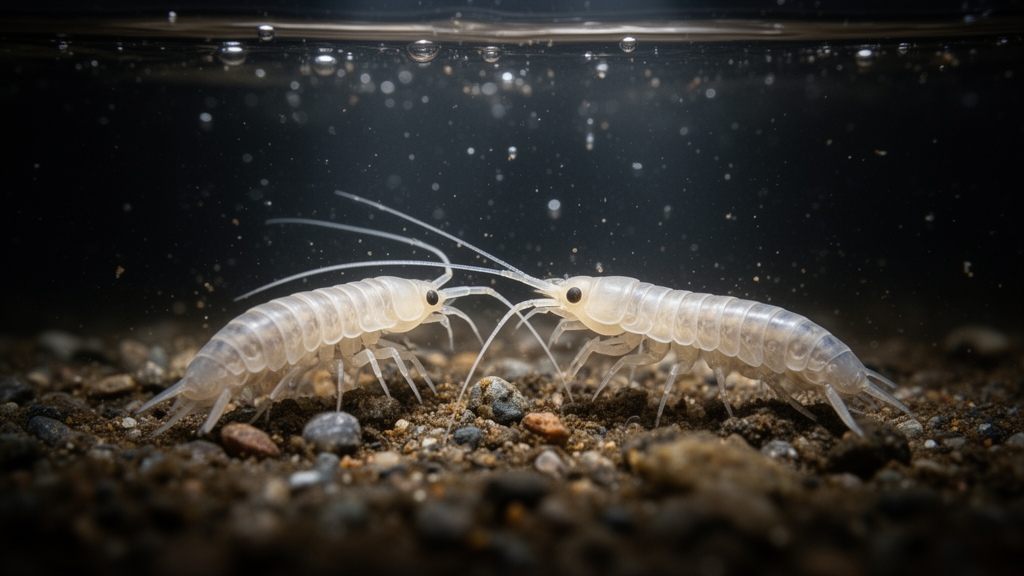
Beneath the lawns, parklands, and highway corridors of metropolitan Washington, D.C., a hidden world of blind, colorless crustaceans has just grown by two species. In a study published in the journal Subterranean Biology, researchers describe Stygobromus scottsruni and Stygobromus paveki, two previously unknown amphipods collected from hypotelminorheic seepage springs, a class of shallow groundwater habitat that looks, on the surface, like little more than a wet spot in the woods. The discovery brings the number of described Stygobromus species in and around the nation’s capital to ten, and the regional total across the Piedmont and Atlantic Coastal Plain of Maryland, Virginia, and the District of Columbia to sixteen, making this one of the most species-rich areas for the genus in eastern North America.
What makes the finding remarkable is not just the biodiversity itself but where it lives. Hypotelminorheic habitats are low-discharge groundwater systems that drain small catchments and extend only a few meters below the surface, typically manifesting as leaf-litter-lined depressions where water seeps upward through colloidal clay. More than 150 such seepage springs have been documented in the Washington, D.C. area alone, many of them supporting populations of obligate subterranean amphipods that spend their entire lives in these narrow, ephemeral-looking zones. The seeps dry at the surface in summer, and the amphipods survive by burrowing into the moist clay that lines each depression, a survival strategy that has allowed these lineages to persist through centuries of urbanization.
The new species were uncovered during a multi-year census of seepage springs within National Capital East, a unit of the National Park Service in the Washington metropolitan area. Stygobromus scottsruni was collected from hypotelminorheic seep 4 at Scott’s Run Nature Preserve in Fairfax County, Virginia, a 336-acre preserve on the south side of the Potomac River. Stygobromus paveki, named in honor of Dr. Diane Pavek, a National Park Service research coordinator and threatened and endangered species specialist, was found in a seep along the southbound lanes of the Baltimore-Washington Parkway in Prince George’s County, Maryland, roughly 50 meters from the highway and near a grocery store parking area. Both type localities sit within heavily trafficked corridors, underscoring how easily such specialized fauna can go unnoticed even in plain sight.
Morphologically, both species are small stygomorphic amphipods allied with the Stygobromus tenuis species group, a complex of closely related groundwater taxa that has proven to be a hotspot of cryptic diversity. Stygobromus scottsruni, whose largest known male measures 6.7 millimeters and largest female 9.4 millimeters, is distinguished by a combination of characters including bifurcate sternal gills, a telson lacking lateral spines, and rastellate setae on the posterodistal margin of the carpus of gnathopod 2. It differs from its closest congeners by a straight palmar margin on gnathopod 1, by the absence of a coxal gill on pereopod 7, and by the absence of a sternal gill on male pleonite 1. Stygobromus paveki, whose largest known male reaches 10.4 millimeters, shares the bifurcate sternal gills and spineless telson but is set apart by a concave palmar margin on gnathopod 1 and by having a greater number of segments on the inner and outer rami of pleopods 1 and 3. These fine anatomical distinctions, documented through detailed dissection and line drawings of specimens stained with lignin pink and examined under Leica stereomicroscopes, are the kind of characters that taxonomists rely upon to separate species that look superficially identical.
To test whether these morphological differences correspond to genuinely distinct evolutionary lineages, the team sequenced three loci commonly employed in Stygobromus phylogenetic studies: mitochondrial cytochrome oxidase subunit I (co1), mitochondrial 16S rDNA, and nuclear 28S rDNA. Specimens were preserved in 100 percent ethanol in the field and stored at minus 20 degrees Celsius prior to DNA extraction using the Qiagen DNeasy Blood and Tissue Kit. Polymerase chain reaction amplification followed standard protocols with an initial denaturation at 95 degrees Celsius for 2 minutes and 35 to 40 cycles of denaturation, primer-specific annealing, and extension at 72 degrees Celsius. Sequences were generated bidirectionally using BigDye Terminator chemistry and assembled into consensus contigs using Geneious Prime before alignment with existing data using MUSCLE as implemented in MEGA 12.
Maximum likelihood phylogenetic analyses conducted in RAxML v8 using the GTR plus Gamma model with 1,000 rapid bootstrap replicates recovered both new species as distinct, strongly supported lineages within the S. tenuis species group. Uncorrected mitochondrial p-distances between Stygobromus scottsruni and other members of the species group ranged from 7.7 to 15.3 percent, while intraspecific divergence within the new species was extraordinarily low, averaging just 0.02 percent. Stygobromus paveki formed a strongly supported clade sister to a S. tenuis potomacus sensu lato lineage from Fort Circle Park and Greenbelt areas, with a mean uncorrected mtDNA p-distance of 3.5 percent between the two, and distances to other S. tenuis group taxa ranging from 7.3 to 15.7 percent. Intraspecific divergence within Stygobromus paveki averaged 0.13 percent, again indicating tight genetic cohesion within each species despite their occurrence in close geographic proximity to other named congeners.
Species delimitation analyses reinforced these conclusions across multiple independent approaches. Assemble Species by Automatic Partitioning (ASAP), Poisson Tree Processes (PTP), and multi-rate PTP (mPTP) applied to the mitochondrial dataset all recovered Stygobromus scottsruni and Stygobromus paveki as separate molecular operational taxonomic units. Bayesian Phylogenetics and Phylogeography (BPP) analyses incorporating both mitochondrial and nuclear 28S datasets under the multispecies coalescent model likewise supported the recognition of both taxa as distinct species. ASAP and PTP identified ten molecular operational taxonomic units within the S. tenuis species group, while mPTP and BPP identified nine, merging Stygobromus hayi and Stygobromus allegheniensis into a single unit. Across all approaches, however, the two new species were consistently delimited as separate evolutionary lineages, providing strong evidence that the morphological and molecular signals align in support of their species status.
The genetic patterns reveal something profound about how biodiversity is organized in shallow groundwater systems. Despite occurring in close geographic proximity to other congeners, sometimes within the same metropolitan area, both new species exhibit strong genetic differentiation and extremely restricted distributions, each currently known from a single seep. This fine-scale isolation among shallow groundwater systems suggests that subtle variation in groundwater flow paths, recharge areas, or local geomorphology can be sufficient to limit connectivity and drive lineage diversification. Hypotelminorheic habitats function as semi-isolated hydrological units that restrict dispersal and promote strong population structure over short geographic distances, generating levels of micro-endemism comparable to or exceeding those documented in deeper karst and cave systems. There is also evidence for metapopulation structure, with individual subpopulations blinking on and off on a decade time scale, adding a dynamic dimension to what might otherwise appear as static isolated populations.
The conservation implications are stark. Both new species received a NatureServe conservation rank of Critically Imperiled (G1) and were assessed as Critically Endangered under IUCN Red List criteria because of extremely small extent of occurrence and area of occupancy, each known from a single seep. Stygobromus scottsruni faces habitat disruption from hikers and pollution of nearby Scotts Run, though the type locality receives some protection within a designated nature preserve. Stygobromus paveki faces increased risk of human intrusion, habitat degradation, and pollution due to its close proximity to the Baltimore-Washington Parkway. Species occupying such narrowly circumscribed habitats are inherently vulnerable to localized disturbance, and even minor alterations to hydrology, water quality, or surface land use may result in population decline or extirpation. These risks are amplified in metropolitan landscapes where shallow groundwater systems are exposed to cumulative pressures from infrastructure development, impervious surface cover, altered forest canopy, stormwater runoff, and contamination.
A key conservation issue emerging from this work is a mismatch between the spatial scale of management and the biological scale at which hypotelminorheic species persist. Shallow groundwater habitats are frequently small, discrete, and hydrologically complex, yet land-use planning and conservation frameworks typically operate at broader watershed or park-unit scales. As a result, individual seepage springs, despite supporting endemic obligate subterranean fauna, may fall outside explicit protection or monitoring efforts. Urban hypotelminorheic habitats also represent a conservation blind spot because they often lack the visibility and legal recognition afforded to caves and karst systems. Recent work further demonstrates that groundwater communities are influenced by land use beyond the immediate vicinity of seepage habitats, indicating that effective conservation requires consideration of broader surface-subsurface connectivity and adequately sized buffer zones. Protecting recharge areas, maintaining natural vegetation cover, minimizing surface disturbance near seeps, and monitoring water quality are likely to be critical for the long-term persistence of these taxa. Because many hypotelminorheic species may remain undiscovered, targeted biological surveys and integration of shallow subterranean habitats into urban conservation strategies will be essential for preventing unrecognized biodiversity loss in metropolitan regions, and the authors suggest that at least three additional species await description within the S. tenuis complex, with others likely to be uncovered as sampling continues across the region’s more than 150 documented seepage springs.
Subject of Research: Two new species of Stygobromus Cope, 1872 ( Amphipoda , Crangonyctidae ) amphipods from hypotelminorheic seepage springs in the Washington, D.C., USA area
Article Title: Two new species of Stygobromus Cope, 1872 ( Amphipoda , Crangonyctidae ) amphipods from hypotelminorheic seepage springs in the Washington, D.C., USA area
Article References: Cannizzaro, A. G., Sawicki, T. R., Schaefer, J., Castrillo, D., Maxwell, E. C., Burch, E., Culver, D. C., & Niemiller, M. L. (2026). Two new species of Stygobromus Cope, 1872 (Amphipoda, Crangonyctidae) amphipods from hypotelminorheic seepage springs in the Washington, D.C., USA area. Subterranean Biology, 57, 23-63. https://doi.org/10.3897/subtbiol.57.188080
Image Credits: AI Generated
DOI: 10.3897/subtbiol.57.188080
Keywords: species, Stygobromus, Cope, Amphipoda, Crangonyctidae, amphipods, hypotelminorheic, seepage, springs, Washington, area, scientific research
Cite Scienmag News
Margaret Porter. (October 16, 2026). Two new amphipod species found hiding beneath Washington, D.C. Scienmag. https://scienmag.com/two-new-amphipod-species-found-hiding-beneath-washington-d-c/
Margaret Porter. "Two new amphipod species found hiding beneath Washington, D.C." Scienmag, 16 October 2026, https://scienmag.com/two-new-amphipod-species-found-hiding-beneath-washington-d-c/. Accessed 16 October 2026.
Margaret Porter. "Two new amphipod species found hiding beneath Washington, D.C." Scienmag. October 16, 2026. https://scienmag.com/two-new-amphipod-species-found-hiding-beneath-washington-d-c/


