


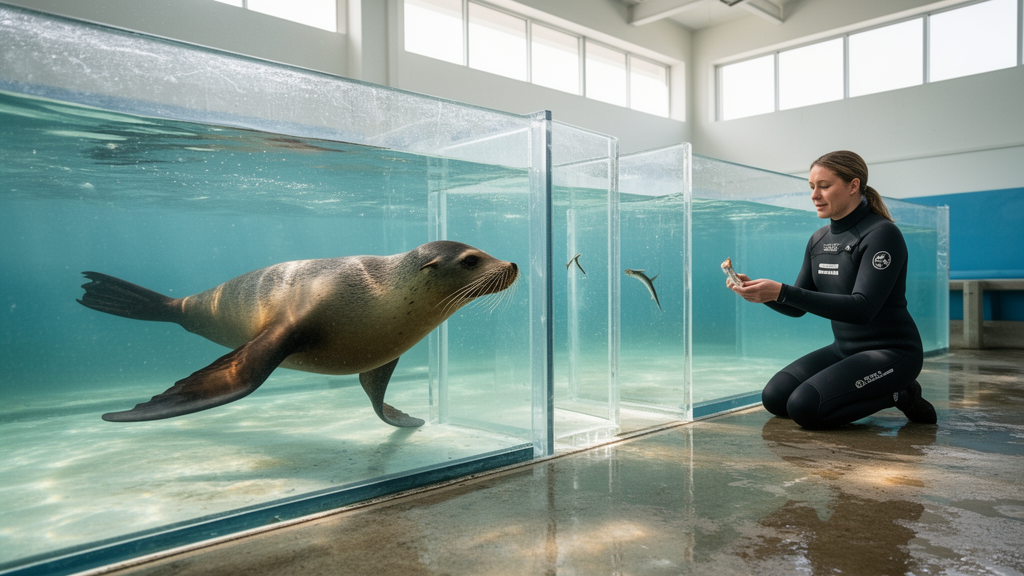
California sea lions can solve a computerized maze, but they may not be planning their route the way primates do. That is the central finding of a new open-access study in Animal Cognition, in which researchers at the U.S. Navy Marine Mammal Program put seven adult male sea lions in front of a touchscreen-style maze task and asked a deceptively simple question: when an animal navigates around obstacles toward a goal, is it thinking ahead, or simply reacting to what it sees? The answer, based on 200 testing trials, appears to lean toward the latter, offering a rare and sobering data point in comparative cognition.
The study, led by Celeste L. Schonberg of the University of Miami’s Rosenstiel School of Marine, Atmospheric, and Earth Science, together with Holli C. Eskelinen of Dolphins Plus, Kelley A. Winship of the National Marine Mammal Foundation, and Mark J. Xitco Jr. of the Navy’s Marine Mammal Program, exploited a piece of technology few laboratories possess. The Enclosure Video Enrichment, or EVE, system is a computerized cognitive testing platform installed at the Navy facility in San Diego. It allows marine mammals voluntarily participating in husbandry and research sessions to interact with on-screen tasks, generating standardized, automated data of the kind that has transformed primate cognition research but has remained scarce for marine mammals.
The task itself was a maze. Each trial presented the sea lion with a layout of barriers on the screen, and success required maneuvering a cursor-like element from a start position to a target while avoiding obstacles. Critically, the researchers designed the layouts so that successful performance demanded short-term forward planning: an animal that simply lunged at the target or followed the most immediate path would run into a trap. Avoiding those traps required the animal to anticipate the consequences of its movements at least a step or two ahead, the cognitive equivalent of checking a route before committing to it.
Seven adult male sea lions completed the full protocol. The experiment consisted of 200 testing trials built from 100 unique maze layouts, which were separated into four trial blocks and repeated randomly across eight testing sessions. This design allowed the team to distinguish between performance on novel layouts and performance on layouts the animals had already seen, a distinction that matters enormously when testing for planning. If an animal is genuinely planning, it should perform well on brand-new configurations; if it is memorizing, its advantage should appear only on repeated exposures.
The researchers scored not just success and failure but the pattern of responses, categorizing trials by layout type, including direct layouts, reversal layouts, away layouts, and layouts requiring an approach-and-return strategy. Response types included clean successes, failures in which the animal fell into a trap, and failures without a trap. This fine-grained scoring was intended to reveal cognitive flexibility, problem-solving strategies, and any evidence that animals adjusted their approach as difficulty increased. A supplementary video released with the paper shows the full range of responses, from a sea lion sailing through a direct layout to one blundering into a trap on a reversal layout.
The results were moderate rather than spectacular. Sea lions achieved moderate success rates across the task, showing that they could use the EVE system and complete maze trials at levels well above pure chance on many layouts. But the more telling result was what did not appear: improvement. Across repeated exposures to the same layouts, success rates did not climb, and response patterns did not shift in ways that would indicate the animals were learning from experience or refining their strategies. In a task where learning should be easy to detect, the absence of a learning curve is itself a finding.
That absence led the authors to conclude that there was limited evidence of planning behavior in this paradigm. If the sea lions were employing short-term forward planning, one would expect them to avoid traps more effectively over time and to perform better on novel layouts as they gained general familiarity with the task structure. Instead, performance stayed flat. The researchers interpret this as suggesting that the sea lions may have relied on strategies other than planning, such as responding to immediate perceptual cues, or that the task’s demands did not align with the species’ natural cognitive strengths.
This is where the study’s comparative framing becomes important. Planning behavior, the ability to act now in anticipation of future states, has been documented in primates, corvids, and a handful of other species, typically using paradigms adapted to each animal’s ecology. Computerized maze tasks have been a staple of primate cognition research precisely because they can be standardized, repeated, and automated. Extending that paradigm to marine mammals is technically ambitious, and the authors emphasize that their goal was as much methodological as cognitive: to expand computerized testing beyond primates and to generate data that can be compared across species. The sea lion result, on its face a negative finding, still delivers value by marking the boundary of where this paradigm succeeds.
The authors are careful about interpretation. A flat learning curve in a computerized maze does not prove that sea lions cannot plan; it shows that this particular task, in this particular context, did not elicit measurable planning or learning. Species-specific cognition is shaped by adaptations and environmental conditions, and a pinniped that navigates three-dimensional underwater environments, hunts cooperatively, and relies on vibrissae and hearing rather than vision may simply not engage with a two-dimensional visual maze the way a primate does. The sensory and ecological mismatch between the test and the test-taker is a central theme of the paper, which argues that comparative cognition research must account for how adaptations influence performance on human-designed tasks.
There is also a welfare and husbandry dimension. The EVE system was developed as video enrichment, and voluntary participation in cognitive testing is a form of enrichment in itself for animals in managed care. The fact that seven sea lions completed 200 trials across eight sessions demonstrates that the platform works, that the animals engage with it, and that it can be deployed repeatedly without coercion. For the Navy Marine Mammal Program, whose animals participate in research and operational tasks, tools that measure cognition while providing enrichment serve dual purposes. For the broader research community, the study establishes a working pipeline for computerized marine mammal testing that future studies can refine, perhaps with designs that better match pinniped sensory worlds.
For now, the headline result is a study in cognitive humility. Sea lions, animals celebrated for trainability and social intelligence in managed care, confronted a maze task engineered to reward forward planning and did not show the improvement or response patterns that planning would produce. Whether that reflects a genuine absence of planning capacity, a mismatch between the paradigm and the species, or motivational and contextual factors unique to this setting remains an open question, and one the authors frame explicitly as a matter of species-specific cognition shaped by evolutionary history. What the study does establish is that the question can now be asked with standardized, automated tools, and that the answers, positive or negative, will accumulate in a form that can be compared across species, laboratories, and lines of evolutionary descent.
Subject of Research: Investigating planning behavior in California sea lions (Zalophus californianus) using computerized MAZE testing
Article Title: Investigating planning behavior in California sea lions (Zalophus californianus) using computerized MAZE testing
Article References: Schonberg, C. L., Eskelinen, H. C., Winship, K. A., & Xitco, M. J., Jr. (2026). Investigating planning behavior in California sea lions (Zalophus californianus) using computerized MAZE testing. Animal Cognition. https://doi.org/10.1007/s10071-026-02115-8
Image Credits: AI Generated
DOI: 10.1007/s10071-026-02115-8
Keywords: Investigating, planning, behavior, California, lions, Zalophus, californianus, computerized, MAZE, testing, scientific research
Cite Scienmag News
Drew Townsend. (October 16, 2026). Sea Lions Confront a Maze Test and Reveal the Limits of Planning. Scienmag. https://scienmag.com/sea-lions-confront-a-maze-test-and-reveal-the-limits-of-planning/
Drew Townsend. "Sea Lions Confront a Maze Test and Reveal the Limits of Planning." Scienmag, 16 October 2026, https://scienmag.com/sea-lions-confront-a-maze-test-and-reveal-the-limits-of-planning/. Accessed 16 October 2026.
Drew Townsend. "Sea Lions Confront a Maze Test and Reveal the Limits of Planning." Scienmag. October 16, 2026. https://scienmag.com/sea-lions-confront-a-maze-test-and-reveal-the-limits-of-planning/


