


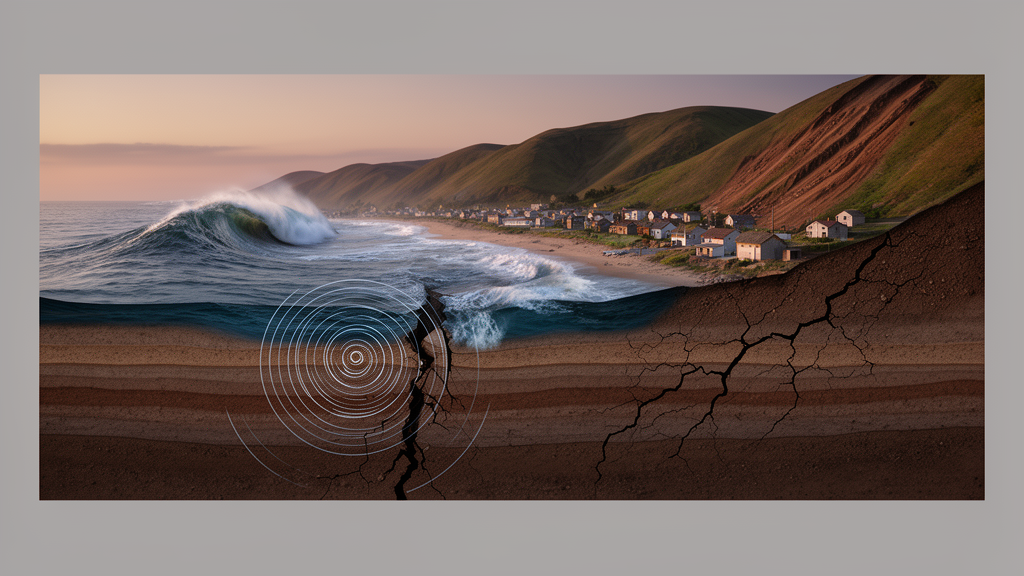
Earthquakes rarely arrive alone. A large rupture beneath the sea can unleash ground shaking, liquefaction, lateral spreading, landslides and tsunami in a single cascading sequence, yet most risk assessments still treat these perils as if they were independent events. A new study published in Natural Hazards and Earth System Sciences by Jose Moratalla and colleagues at Earth Sciences New Zealand presents a probabilistic framework that keeps all of these hazards physically connected, and applies it to the city of Napier, New Zealand, which sits directly above the country’s largest earthquake source.
The core innovation is a fully correlated Monte Carlo simulation that propagates uncertainty from the earthquake rupture itself through every downstream hazard model to the final damage estimate. In conventional multi-hazard studies, ground shaking, tsunami and ground failure are simulated separately and then combined, which artificially inflates variability and breaks the causal chain between the triggering earthquake and its consequences. In the new framework, every simulated realization of an earthquake carries a consistent set of ground motion parameters and a spatial footprint from which the secondary hazards are derived. Liquefaction severity, lateral spreading displacements and landslide probabilities are all conditioned on the same peak ground acceleration field, while tsunami inundation is modelled directly from the rupture’s source parameters. This preserves the conditional dependence between primary and secondary hazards at every stage of the simulation.
The framework requires six inputs: a stochastic earthquake catalogue with rupture geometries, magnitudes and recurrence information; ground shaking footprints generated with Ground Motion Prediction Equations; tsunami inundation depths for each capable rupture; cascading ground-failure models that compute hazard intensities conditionally on the shaking; harmonised fragility functions relating hazard intensity to structural damage probability; and an exposure model describing the location and construction of the buildings at risk. For each event in the catalogue, the workflow steps through shaking, tsunami, liquefaction, lateral spreading and landslide modelling, samples damage states from fragility curves, harmonises those states into a unified five-level scale, and assigns damage ratios representing repair cost as a fraction of replacement value.
The case study focuses on Napier City, a centre of roughly 65,000 people on the eastern coast of New Zealand’s North Island, less than 200 kilometres from the trench of the Hikurangi Subduction Zone. This megathrust, where the Pacific Plate subducts beneath the Australian Plate, is capable of producing events up to an estimated maximum credible moment magnitude of about 9.1, comparable to the 2011 Tohoku earthquake. The researchers generated a 100,000-year stochastic catalogue of Hikurangi ruptures using OpenQuake, with the magnitude-frequency distribution drawn from the 2022 New Zealand National Seismic Hazard Model, and applied it to approximately 30,000 residential buildings extracted from a national building inventory.
Each hazard demanded its own detailed modelling. Tsunami inundation was simulated with the COMCOT hydrodynamic model on nested grids reaching 10-metre resolution over Napier. Because full-resolution hydrodynamic modelling is computationally expensive, the team selected 33 rupture scenarios with magnitudes between 7.5 and 9.1, generated 10 non-uniform slip variations for each, and ran 330 physics-based inundation models. During the Monte Carlo sampling, the tsunami scenario closest in epicentre and magnitude to each catalogue event was randomly drawn from these variants. Napier’s coastal topography, including elevated ground and large gravel ridges, partially shields the city from small to moderate tsunami, which later proved important for the results.
Liquefaction, a persistent threat given Napier’s loose sedimentary deposits and high groundwater table, was assessed using six susceptibility zones derived from geomorphological mapping and validated with seventeen additional cone penetration tests. The Liquefaction Severity Number was sampled from normal distributions fitted to the test data for each zone, conditioned on the modelled peak ground acceleration and earthquake magnitude. Lateral spreading was estimated with the Lateral Displacement Index method, incorporating slope angle and distance to free faces along the city’s many streams and drainage channels. Landslide hazard was modelled with the New Zealand Earthquake-Induced Landslide Forecast Tool, run at ten shaking levels up to the maximum expected from a magnitude 9.1 event, with runout distances estimated from empirical relationships calibrated against the 2016 Kaikōura earthquake inventory.
Damage estimation relied on HAZUS 2.1 fragility functions for shaking and lateral spreading, empirical tsunami fragility functions derived from the 2011 Great East Japan tsunami, and liquefaction aggravation factors calibrated from observed damage in the Christchurch earthquakes. Because the different fragility models use incompatible damage state definitions, the team harmonised all outputs onto a single five-level scale before assigning mean damage ratios, with uncertainty represented by triangular distributions around the HAZUS means. The authors note that this harmonization cannot represent path-dependent weakening, in which shaking damage makes a building more vulnerable to subsequent tsunami loading, and that HAZUS functions calibrated for American construction may not fully capture New Zealand building practices.
The results reveal a striking dependence on return period. Ground shaking and liquefaction together contribute roughly 60 percent of the average annual building damage, with lateral spreading accounting for a further 35 percent, while tsunami contributes less than 3 percent on average. But for very rare events with return periods exceeding about 10,000 years, tsunami losses become comparable to those from shaking and liquefaction, a threshold behaviour reflecting the fact that only the largest subduction ruptures generate inundation that overcomes Napier’s natural coastal barriers. Landslides contribute little to city-wide totals simply because few buildings are exposed, yet the relative damage ratio shows they significantly affect buildings in hilly suburbs at return periods above 50 to 100 years.
The damage state analysis shows a progressive shift toward worse outcomes as return periods lengthen. Minor damage becomes noticeable beyond roughly 100 years, extensive and complete damage remain uncommon until about 500 years, and beyond 2500 years the proportion of undamaged buildings falls below 20 percent. At return periods between 10,000 and 100,000 years, severe damage and collapse approach or exceed half of the building stock. Convergence testing confirmed the statistical robustness of these estimates: mean damage ratios stabilised within 2 percent after 120 to 180 simulations per event, and the catalogue-level mean converged after about 45,000 events, well within the 100,000-year catalogue. The full catalogue was simulated 200 times, with the reported results corresponding to median damage-state distributions.
The framework’s practical value lies in its ability to attribute losses to individual hazards while keeping them consistent with total regional risk, information directly relevant to land-use planning, emergency management, resilience investment and insurance underwriting. The authors acknowledge important limitations: no tidal stage, storm surge, debris impact or sea-level rise is included in the tsunami modelling; landslides are considered only when coseismically triggered, ignoring rainfall and groundwater conditions; and validation remains difficult because observational datasets documenting cascading earthquake impacts are scarce. Because the framework is modular, its components can be upgraded as better hazard and fragility models emerge, offering a template for multi-hazard earthquake risk assessment well beyond New Zealand.
Subject of Research: A probabilistic framework for cascading earthquake hazards applied to Napier, New Zealand
Article Title: An internally consistent framework for calculating cascading probabilistic earthquake risk and its application to a case study in New Zealand
Article References: Moratalla, J., Burbidge, D., Roger, J., Jones, K., Griffin, A., Mueller, C., Ashok, U., Scheele, F., Mahmood, Y., & Bretherton, E. (2026). An internally consistent framework for calculating cascading probabilistic earthquake risk and its application to a case study in New Zealand. Natural Hazards and Earth System Sciences, 26(10), 5261-5279. https://doi.org/10.5194/nhess-26-5261-2026
Image Credits: AI Generated
DOI: 10.5194/nhess-26-5261-2026
Keywords: earthquake risk, cascading hazards, Hikurangi Subduction Zone, Napier, tsunami, liquefaction, lateral spreading, landslides, Monte Carlo simulation, probabilistic risk assessment, New Zealand, multi-hazard
Cite Scienmag News
Violet Maxwell. (October 27, 2026). New Framework Links Earthquake Shaking, Tsunami and Ground Failure in One Risk Model. Scienmag. https://scienmag.com/new-framework-links-earthquake-shaking-tsunami-and-ground-failure-in-one-risk-model/
Violet Maxwell. "New Framework Links Earthquake Shaking, Tsunami and Ground Failure in One Risk Model." Scienmag, 27 October 2026, https://scienmag.com/new-framework-links-earthquake-shaking-tsunami-and-ground-failure-in-one-risk-model/. Accessed 27 October 2026.
Violet Maxwell. "New Framework Links Earthquake Shaking, Tsunami and Ground Failure in One Risk Model." Scienmag. October 27, 2026. https://scienmag.com/new-framework-links-earthquake-shaking-tsunami-and-ground-failure-in-one-risk-model/


