


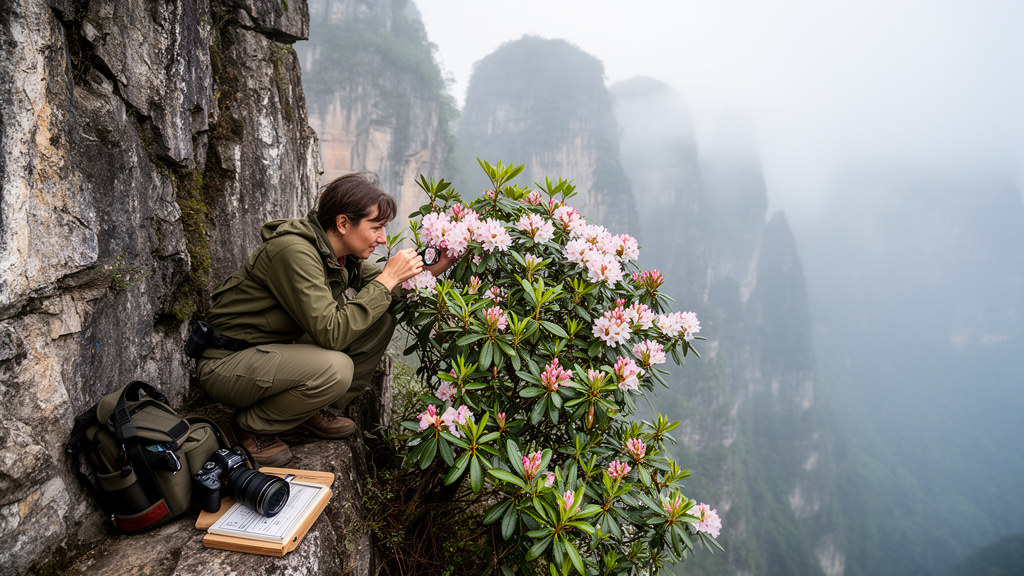
Botanists surveying the cliffs of northwestern Guizhou, China, have identified a previously unknown species of rhododendron, now formally described as Rhododendron jiucaipingensis. The discovery began in May 2019, when researchers encountered an unfamiliar Rhododendron shrub growing on sheer rock faces during a field excursion. After six years of continuous field monitoring and specimen collection between 2020 and 2025, combined with laboratory morphological analysis and whole-genome sequencing, the team concluded that the plant represents a species new to science within the subgenus Hymenanthes.
The species is named after its type locality, Jiucaiping in Xingfa Township, Hezhang County, Bijie City, and carries the Chinese vernacular name jiǔ cài píng dù juān. The new species is an evergreen shrub reaching 1.5 to 3.0 meters in height, with stout branches whose current-year shoots are green and densely covered in white tomentum, while older branches turn grayish brown and lose their hairs. Its leaves are crowded at the branch tips, thickly leathery, oblong-elliptic to oblanceolate-elliptic, and measure 5.5 to 9.5 centimeters long by 2.5 to 4.0 centimeters wide.
The leaf apex is gradually acuminate with a short apiculate tip, the base cuneate, and the margins revolute. Young leaves carry a double-layered white indumentum on the lower surface, the upper layer composed of long glandular hairs; as leaves mature, the superficial layer is shed, leaving a short brown tomentum beneath. Lateral veins number 8 to 11 pairs, faintly visible above and conspicuously raised below.
The reproductive structures provide further distinguishing detail. Inflorescences are terminal, umbellate-racemose, and bear only 4 to 9 flowers on short pedicels densely covered with long white villous hairs. The corolla is funnelform-campanulate, 2.0 to 3.0 centimeters long and across, white with pink fasciculate blotches and spots in the tube, and divided into five orbicular, emarginate lobes.
Ten unequal stamens, 1.5 to 2.0 centimeters long, carry linear filaments densely clothed with white stiff hairs at the base. The cylindric ovary is sparsely covered with colorless stellate hairs, and the capsules are cylindric and curved, 1.2 to 2.0 centimeters long, usually seven-loculed, occasionally six- or eight-loculed, and also bear sparse colorless stellate hairs. Flowering occurs in May and fruiting in June.
Morphologically, R. jiucaipingensis sits closest to R. hypoglaucum and R. argyrophyllum, two karst-endemic relatives from Southwest China that share white to pinkish campanulate corollas. Yet the new species separates cleanly from both. Against R. hypoglaucum, it differs in having current-year branchlets and young petioles densely covered with indumentum rather than glabrous, densely white-villous rather than glabrous pedicels, fewer lateral vein pairs (8 to 11 versus 10 to 14), an ovary sparsely covered with colorless stellate hairs rather than glabrous, and typically seven-loculed rather than six-loculed capsules.
Against R. argyrophyllum, it is distinguished by an acuminate rather than obtuse leaf apex, ten rather than 12 to 15 stamens, and colorless stellate hairs on the ovary instead of white short tomentum. Its cliff habitat at 2,400 to 2,700 meters elevation also contrasts sharply with the lower altitudinal ranges of its relatives, which occupy 1,500 to 2,100 and 1,600 to 2,300 meters respectively. To place the new species in context, the authors compared it against all 20 currently recognized species of subsection Argyrophylla, the group within section Ponticum to which it belongs, using field observations, stereomicroscope measurements of collected specimens, taxonomic literature, and specimen images from online herbaria including Kew, PE, JSTOR Global Plants, CVH, RBGE, and KUN.
They also expanded the identification key from the Flora of China treatment of 2005 to accommodate the new species, which keys out by its 5.5 to 9.5 centimeter leaves with persistent brown tomentum on the lower surface and its ten stamens. The molecular evidence rests on whole-genome resequencing. Fresh leaf material of the new species was collected in the field, and genomic DNA was extracted with a plant DNA kit and assessed by gel electrophoresis, spectrophotometry, and fluorometry.
A sequencing library with an average insert size of 350 base pairs was prepared and run on an Illumina NovaSeq X Plus platform, generating approximately 6.76 gigabases of raw 150-base-pair paired-end data. After adapter removal and quality filtering with fastp, which discarded reads below Phred quality 20, the error rate stayed below 0.03 percent across all read positions and the Q30 score reached 97.48 percent, yielding 6.74 gigabases of clean data. These newly generated reads were combined with clean reads of 14 other taxa retrieved from the National Genomics Data Center under accession CRA005762.
For phylogenetic reconstruction, reads from all 15 samples were aligned to the R. prattii reference genome using BWA-MEM, processed with SAMtools, and duplicate reads removed with GATK MarkDuplicates. Variant calling and joint genotyping were performed with GATK HaplotypeCaller and GenotypeGVCFs, followed by hard filtering on quality metrics including QD, FS, MQ, SOR, MQRankSum, and ReadPosRankSum. Critically, the final alignment was not restricted to variable sites: it retained both filtered biallelic SNPs and all invariant sites with zero missing data, producing a matrix of 5,870,491 nucleotide sites of which 37.65 percent were constant.
Because so many constant sites were retained, no ascertainment bias correction was needed for the substitution model. A Maximum Likelihood tree was inferred in IQ-TREE v2.3.6 under the TVM+F model selected by ModelFinder, with node support assessed through 1,000 Shimodaira–Hasegawa approximate likelihood ratio test replicates and 5,000 ultrafast bootstrap replicates, treating branches as strongly supported when SH-aLRT reached 80 percent and UFBoot reached 95 percent. The resulting tree resolved R. jiucaipingensis as a distinct and independent evolutionary lineage within subsection Argyrophylla, with maximal support of 100 percent for both SH-aLRT and UFBoot.
It sits as sister to a monophyletic clade of five species: R. hunnewellianum, R. hypoglaucum, R. argyrophyllum, R. pingianum, and R. ririei. Despite this close affinity, the new species occupies a well-supported terminal branch reflecting significant genetic divergence, which the authors interpret as evidence of long-term evolutionary isolation. Combined with the clear morphological discontinuities documented in their comparison tables, the genomic and phenotypic evidence together supports its recognition as a distinct species.
The taxon sampling included 12 species of subsection Argyrophylla plus two outgroups, Cassiope selaginoides and R. simsii; genomic sequences for the remaining eight known species of the subsection were unavailable, but the authors note that these eight show distinct morphological differences from the new species in their comprehensive comparison and identification key. The conservation picture is stark. R. jiucaipingensis is currently known only from 21 extremely restricted populations in Jiucaiping, Xingfa Township, totaling just 103 mature individuals.
Its Area of Occupancy is under 10 square kilometers when estimated on a 2 by 2 kilometer grid, and it occurs at a single location under IUCN criteria. Although a continuing decline has not been directly observed, the extremely limited area, single-location occurrence, projected threats to habitat quality from cliffside degradation and potential anthropogenic activities including climate change and collection, and the very small population size qualify the species as Endangered under IUCN Red List Criteria B2ab(iii) and D1. The discovery also underscores how much remains to be catalogued in southern China, the recognized center of diversity for a genus that spans the temperate Northern Hemisphere to tropical Southeast Asia and comprises more than 1,300 species in eight subgenera, 12 sections, and 71 subsections.
China alone harbors more than 700 recognized Rhododendron taxa, and new species continue to be described there. Subsection Argyrophylla, with roughly 20 species, is endemic to China and concentrated in Yunnan, Guizhou, and Sichuan.
Subject of Research: Description of the new plant species Rhododendron jiucaipingensis from Guizhou, China, based on morphology and whole-genome phylogenomics
Article Title: Rhododendron jiucaipingensis ( Ericaceae ), a new species from Guizhou, China
Article References: Hu, H.-F., Xu, J., An, M.-T., Yu, J.-H., & Lu, X. (2026). Rhododendron jiucaipingensis (Ericaceae), a new species from Guizhou, China. PhytoKeys, 275, 15-26. https://doi.org/10.3897/phytokeys.275.183519
Image Credits: AI Generated
DOI: 10.3897/phytokeys.275.183519
Keywords: Rhododendron, new species, Guizhou, China, Ericaceae, phylogenomics, whole-genome sequencing, taxonomy, conservation, Endangered species, karst, botany
Cite Scienmag News
Margaret Porter. (October 27, 2026). Cliff-Dwelling Rhododendron From Guizhou Confirmed as New Species. Scienmag. https://scienmag.com/cliff-dwelling-rhododendron-from-guizhou-confirmed-as-new-species/
Margaret Porter. "Cliff-Dwelling Rhododendron From Guizhou Confirmed as New Species." Scienmag, 27 October 2026, https://scienmag.com/cliff-dwelling-rhododendron-from-guizhou-confirmed-as-new-species/. Accessed 27 October 2026.
Margaret Porter. "Cliff-Dwelling Rhododendron From Guizhou Confirmed as New Species." Scienmag. October 27, 2026. https://scienmag.com/cliff-dwelling-rhododendron-from-guizhou-confirmed-as-new-species/


