

Tuesday, October 27, 2026
Science
No Result
View All Result
  • Login
  • HOME
  • SCIENCE NEWS
  • CONTACT US
  • HOME
  • SCIENCE NEWS
  • CONTACT US
No Result
View All Result
Scienmag
No Result
View All Result
Home Science News Technology and Engineering

New Algorithm Finds Network Communities by Hunting for Core Nodes First

October 27, 2026
in Technology and Engineering
Denise Maddox
By Denise Maddox Scienmag Editorial Profile - Mechanical Engineering
Reading Time: 3 mins read
0
New Algorithm Finds Network Communities by Hunting for Core Nodes First

New Algorithm Finds Network Communities by Hunting for Core Nodes First

65
SHARES
587
VIEWS
Share on FacebookShare on Twitter
ADVERTISEMENT

In a paper published in Data Mining and Knowledge Discovery, Yuxian Zhang, Haiyan Guo and Jing Xiao introduce MLCD-CND, a two-stage method for detecting local communities in multiplex networks, where the same set of nodes is connected across multiple layers of relationships. Their central claim is that the accuracy of local community detection depends heavily on where the search begins, and that this dependency can be engineered away. The problem the authors identify is seed dependency.

Local community detection algorithms typically expand outward from a single query node, and the quality of the resulting community is highly sensitive to that starting point. A seed located in the dense core of a community tends to produce accurate detection, while a peripheral seed often produces a distorted or incomplete result. A second difficulty arises at community boundaries, where nodes frequently have ambiguous memberships and are easily misassigned during expansion.

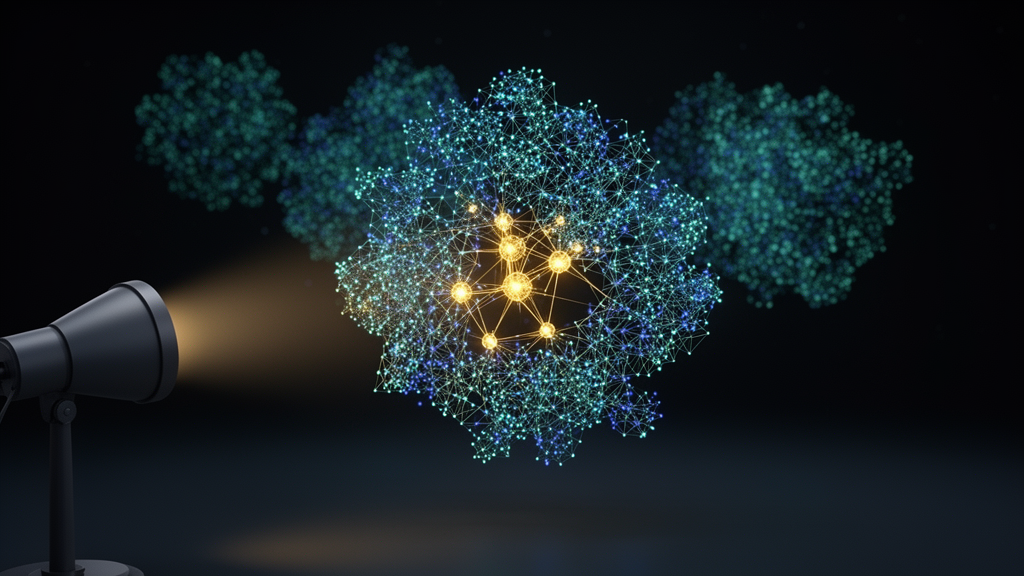
MLCD-CND tackles the first problem by refusing to start from the raw query seed. Instead, the method's first stage searches for high-quality core nodes using a new metric called Node Relation Strength. This metric combines two ingredients: cross-layer structural similarity, measured with the Jaccard Similarity Coefficient, which compares how similar a node's neighborhoods are across the different layers of the multiplex network; and interaction density, measured through a quantity the authors call Node Influence Area Density.

Nodes that score highly on this combined measure replace the original seed, giving the algorithm a more robust initialization before any expansion begins. The second stage grows the community outward while trying to avoid the classic failure mode of over-expansion, in which an algorithm drifts into sparse regions that do not truly belong to the target community. To control this, the expansion is guided by a hybrid objective that balances multiplex local modularity, a multilayer generalization of the standard measure of how internally dense a community is, against a term the authors call community relation strength.

By weighing both signals simultaneously, the algorithm is designed to stop growing when it reaches genuinely sparse territory rather than continuing to absorb weakly connected nodes. According to the paper's reported experiments, the approach improves the F-score, a standard measure combining precision and recall, by up to 72 percent compared with the baseline model. The authors state that the method effectively addresses both seed dependency and over-expansion, and that it delivers robust performance across diverse networks.

As with any algorithmic evaluation, the reported gains reflect the benchmark networks and baselines chosen in the study, and the abstract does not specify the full range of datasets or competing methods involved. The broader significance of the work lies in its treatment of initialization as a first-class design problem rather than an afterthought.

Subject of Research: Local community detection in multiplex networks using core node detection and multilayer modularity

Article Title: Core-driven local community detection in multiplex networks via seed optimization and multilayer modularity

Article References: Zhang, Y., Guo, H., & Xiao, J. (2026). Core-driven local community detection in multiplex networks via seed optimization and multilayer modularity. Data Mining and Knowledge Discovery, 40(6), 119. https://doi.org/10.1007/s10618-026-01283-y

Image Credits: AI Generated

DOI: 10.1007/s10618-026-01283-y

Keywords: multiplex networks, community detection, seed dependency, core nodes, modularity, Node Relation Strength, Jaccard similarity, F-score, graph algorithms, Data Mining and Knowledge Discovery, Core-driven, local

Cite Scienmag News

Denise Maddox. (October 27, 2026). New Algorithm Finds Network Communities by Hunting for Core Nodes First. Scienmag. https://scienmag.com/new-algorithm-finds-network-communities-by-hunting-for-core-nodes-first/

Denise Maddox. "New Algorithm Finds Network Communities by Hunting for Core Nodes First." Scienmag, 27 October 2026, https://scienmag.com/new-algorithm-finds-network-communities-by-hunting-for-core-nodes-first/. Accessed 27 October 2026.

Denise Maddox. "New Algorithm Finds Network Communities by Hunting for Core Nodes First." Scienmag. October 27, 2026. https://scienmag.com/new-algorithm-finds-network-communities-by-hunting-for-core-nodes-first/


Tags: community boundary ambiguitycommunity detectioncore node identificationcore nodesCore-drivencross-layer structural similaritydata mining and knowledge discoveryF-scoregraph algorithmsJaccard similarityJaccard Similarity CoefficientLocallocal community detection algorithmsmodularitymulti-layer network analysismultiplex networksnetwork community detectionNode Relation StrengthNode Relation Strength metricseed dependencyseed dependency in community detectionseed selection impact on community detectiontwo-stage community detection methods
Share26Tweet16
Previous Post

Mass spectrometry workflow fishes receptor-binding toxins straight from snake venom

Next Post

Soft Rot Bacterium Pectobacterium brasiliense Identified on Mississippi Summer Squash for the First Time

Related Posts

Compact Transformer Learns Kazakh Sign Language From Landmarks, Not Pixels
Science News

Compact Transformer Learns Kazakh Sign Language From Landmarks, Not Pixels

October 27, 2026
Discourse2Draft: AI Tool Turns Queries Into Cited, Structured Drafts
Science News

Discourse2Draft: AI Tool Turns Queries Into Cited, Structured Drafts

October 27, 2026
Gecko-inspired laser-textured titanium surface boosts composite laminate bonding by 202%
Technology and Engineering

Gecko-inspired laser-textured titanium surface boosts composite laminate bonding by 202%

October 27, 2026
Federated AI Reads Neonatal Brain Scans Without Moving Patient Data
Technology and Engineering

Federated AI Reads Neonatal Brain Scans Without Moving Patient Data

October 27, 2026
AI Flags Cold Chain Temperature Breaks Before They Strike Apples
Science News

AI Flags Cold Chain Temperature Breaks Before They Strike Apples

October 27, 2026
Eye Gaze and Attention Patterns Power a New AI Screen for Autism in Indian Children
Technology and Engineering

Eye Gaze and Attention Patterns Power a New AI Screen for Autism in Indian Children

October 27, 2026
Next Post
Soft Rot Bacterium Pectobacterium brasiliense Identified on Mississippi Summer Squash for the First Time

Soft Rot Bacterium Pectobacterium brasiliense Identified on Mississippi Summer Squash for the First Time

  • Mothers who receive childcare support from maternal grandparents show more optimized

    Mothers who receive childcare support from maternal grandparents show more parental warmth, finds NTU Singapore study

    27656 shares
    Share 11059 Tweet 6912
  • University of Seville Breaks 120-Year-Old Mystery, Revises a Key Einstein Concept

    1061 shares
    Share 424 Tweet 265
  • Bee body mass, pathogens and local climate influence heat tolerance

    682 shares
    Share 273 Tweet 171
  • Researchers record first-ever images and data of a shark experiencing a boat strike

    546 shares
    Share 218 Tweet 137
  • Groundbreaking Clinical Trial Reveals Lubiprostone Enhances Kidney Function

    531 shares
    Share 212 Tweet 133
Science

Embark on a thrilling journey of discovery with Scienmag.com—your ultimate source for cutting-edge breakthroughs. Immerse yourself in a world where curiosity knows no limits and tomorrow’s possibilities become today’s reality!

RECENT NEWS

  • Soft Rot Bacterium Pectobacterium brasiliense Identified on Mississippi Summer Squash for the First Time
  • New Algorithm Finds Network Communities by Hunting for Core Nodes First
  • Mass spectrometry workflow fishes receptor-binding toxins straight from snake venom
  • Simulated US Cattle Networks Show Current Electronic ID and Digital Reporting Fall Short for Outbreak Tracing

Categories

  • Agriculture
  • Anthropology
  • Archaeology
  • Athmospheric
  • Biology
  • Biotechnology
  • Blog
  • Bussines
  • Cancer
  • Chemistry
  • Climate
  • Earth Science
  • Editorial Policy
  • Marine
  • Mathematics
  • Medicine
  • Pediatry
  • Policy
  • Psychology & Psychiatry
  • Science Education
  • Science News
  • Social Science
  • Space
  • Technology and Engineering

Subscribe to Blog via Email

Enter your email address to subscribe to this blog and receive notifications of new posts by email.

Join 5,151 other subscribers

© 2025 Scienmag - Science Magazine

Welcome Back!

Login to your account below

Forgotten Password?

Retrieve your password

Please enter your username or email address to reset your password.

Log In
No Result
View All Result
  • HOME
  • SCIENCE NEWS
  • CONTACT US

© 2025 Scienmag - Science Magazine

Discover more from Science

Subscribe now to keep reading and get access to the full archive.

Continue reading