


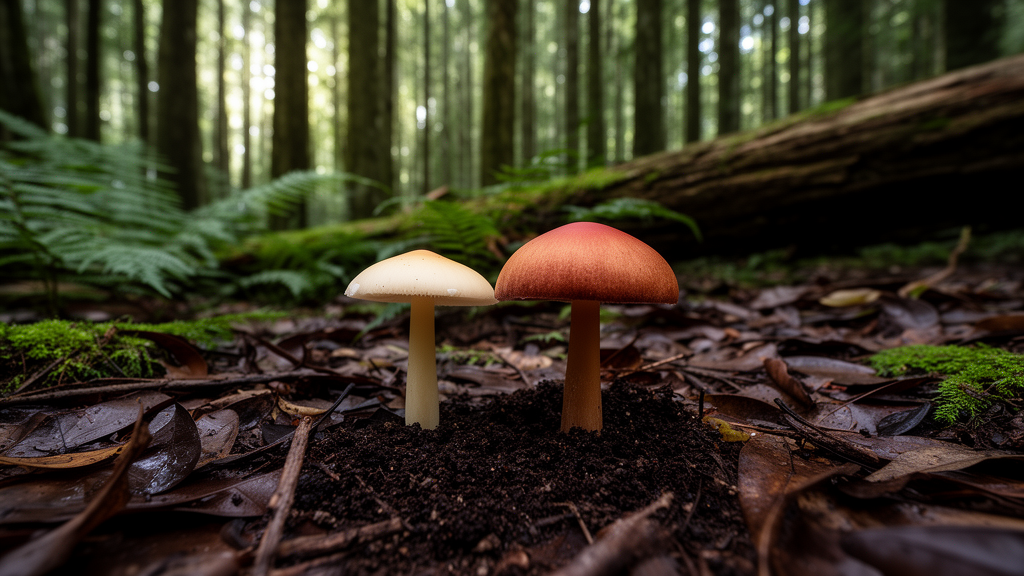
The new species, named Lyophyllum pseudorrhizum and Lyophyllum hemigaleatum, were discovered during field surveys conducted between 2023 and 2024 in the sub-plateau mountainous climate region of Yunnan Province, southwestern China, an area whose diverse vegetation and favourable climatic conditions support exceptionally high fungal diversity. One of the two, L. pseudorrhizum, is already sold in local markets, underscoring how much undocumented fungal diversity may remain hidden in plain sight. The discovery, published in the journal MycoKeys, is the product of a combined morphological and molecular approach that the authors argue is now essential for this notoriously difficult group of fungi.
Lyophyllum is the type genus of the family Lyophyllaceae and currently includes more than 70 described species worldwide. Its members grow solitary, scattered or clustered, are saprophytic or symbiotic, and typically bear smooth caps, cylindrical or basally enlarged stems, and globose, ellipsoid or broadly fusiform spores. Some species also change colour when bruised, a trait that has long featured in attempts to classify them.
That classification history is turbulent. The genus was established in 1881 based on the type species L. leucophaeatum, and early frameworks relied almost entirely on macroscopic traits. In 1986, Rolf Singer divided Lyophyllum into three sections according to growth habit and bruising reaction: species whose fruiting bodies blacken when injured, caespitose species that do not discolour, and species with a collybioid morphology.
A subsection for non-caespitose species with unchanging flesh was added in 2002, and a subgenus lacking clamp connections was later elevated to the separate genus Gerhardtia. But these systems proved unstable, because macroscopic characteristics are often plastic, shaped by environmental factors, and subjective, varying from one researcher to another. Molecular systematics then upended the picture.
Early work using internal transcribed spacer sequences demonstrated that Singer’s section Difformia was polyphyletic, and subsequent multi-gene analyses showed that Lyophyllum itself, along with its traditional sections, was polyphyletic. A key contradiction emerged when the original type species, L. leucophaeatum, was found to cluster with Calocybe sensu lato rather than with other species traditionally placed in Lyophyllum. To preserve nomenclatural stability, the name Lyophyllum was conserved with L. semitale designated as the conserved type species.
Despite these revisions, the currently recognised infrageneric classification still rests on Singer’s three-section scheme, and the steady discovery of new species continues to fuel debate over how useful morphological characters are for delimiting groups within the genus. China currently records 27 Lyophyllum species, 14 of which were originally described there, and most of those were established from specimens collected in Yunnan Province, which serves as their type locality. The new study began with fieldwork in which researchers photographed fresh fruiting bodies in situ and recorded macroscopic details, habitat, substrate, elevation and geographic coordinates.
Specimens were dried at 55 degrees Celsius and deposited at the Herbarium of Cryptogams of the Kunming Institute of Botany, Chinese Academy of Sciences, and the Herbarium of Dali University. Colours of fresh material were matched against digital references, and microscopic structures were examined from dried sections mounted in 5 percent potassium hydroxide, with 1 percent Congo Red staining used where observation was unclear, under a research microscope at 1000-times magnification. For each collection, the team measured 20 basidia and 50 basidiospores, reporting spore dimensions with standard mycological notation that captures minimum, maximum, 95 percent range and average values together with the length-to-width ratio.
DNA was extracted from dried specimens and four genetic loci were amplified and sequenced: the nuclear ribosomal internal transcribed spacer region, the large subunit ribosomal RNA gene, and the protein-coding genes rpb2 and tef1-alpha. In total, 28 new sequences were generated from seven samples and deposited in GenBank, joining downloaded sequences for a phylogenetic dataset of 187 sequences from 77 samples representing 43 species, with three Calocybe species serving as the outgroup. The four single-gene alignments were concatenated into a combined dataset of 3,250 base positions including gaps.
Maximum likelihood analysis with 1,000 rapid bootstrap replicates and Bayesian inference with two independent runs of six Markov chain Monte Carlo chains each produced nearly identical tree topologies with virtually no difference in statistical support. The analysis revealed that the seven new Lyophyllum samples clustered into two well-supported independent clades. Lyophyllum pseudorrhizum, supported by a bootstrap value of 78 and a posterior probability of 0.98, formed a clade with L. pallidofumosum, L. fumosum and L. deqinense, while Lyophyllum hemigaleatum, supported by a bootstrap value of 76 and a posterior probability of 1.00, formed a sister clade with L. semitale.
Lyophyllum pseudorrhizum, collected in Wuding County at an elevation of 2,200 metres, is named for its distinctive pseudorrhiza, a false root-like structure formed where the bases of the stems aggregate. Its caps measure just 1.2 to 2.8 centimetres across, are greyish orange with dark greyish orange floccus, and its flesh and white gills remain unchanged when injured. Its spores are subglobose to broadly ellipsoid, averaging 5.2 by 4.8 micrometres, and it possesses both pleurocystidia and cheilocystidia, sterile cells on the gill faces and edges that several close relatives lack. The species grows caespitose on soil in coniferous forest and is edible and available in local markets. Morphologically it was placed in the L. fumosum group, but true L. fumosum has larger caps, lacks the well-developed pseudorrhiza, and reportedly lacks both types of cystidia, while L. deqinense has larger caps and larger, subglobose to globose spores averaging 6.4 by 6.1 micrometres. Its closest phylogenetic relative, L. pallidofumosum, differs in cap shape, stipe dimensions, growth habit and the absence of cystidia, with an internal transcribed spacer sequence difference of 2.26 percent between the two species.
Lyophyllum hemigaleatum, whose holotype was collected in Jianchuan County, Dali City, at 2,200 metres in September 2024, takes its name from its hemispherical young cap, which the authors liken to a warrior’s helmet. Its caps are smaller still, at 1.4 to 1.8 centimetres, slightly desaturated orange at the centre and darker at the margin, and its stipe context changes to a slightly desaturated orange when injured. Its spores are broadly to subbroadly fusiform in face view, averaging 7.36 by 5.10 micrometres, and the cap surface bears abundant pileocystidia, a feature not reported in the similar-looking L. edulis, which also has larger caps and globose spores averaging 5.81 by 5.47 micrometres. Other relatives can be separated as well: L. aemiliae, originally described from Italy, has a wavy-lobed cap margin with irregular blackish-brown patches, and L. lixivium develops a distinct umbo and a much longer stipe with broadly lacrimoid spores.
The species grows singly to scattered on soil in coniferous forest from August to October. Its closest relative in the tree, L. semitale, was originally described from Sweden, grows saprophytically on decaying wood, and has a larger leaden-grey cap and white stipe, in sharp contrast to the orange-toned, terrestrial new species; their internal transcribed spacer sequences differ by 3.03 percent. Beyond describing the new species, the study delivers a pointed message about the limits of traditional identification in the Lyophyllum decastes complex, a taxonomically challenging group long divided into the L. shimeji, L. decastes, L. fumosum and L. loricatum lineages.
The authors note that macroscopic characters of sampled specimens overlapped so substantially that they were virtually indistinguishable, and that earlier attempts to use growth rates and biomass production in culture likewise failed to yield consistent diagnostic traits. A compiled comparison of morphological traits across the complex shows group-level patterns, such as the predominantly grey-toned caps of the shimeji group and mainly white caps of the fumosum group, but also considerable plasticity within groups. Notably, the phylogenetic analysis found two specimens identified as L. semitale, one from Switzerland and one from Sweden, placed in distinct positions on the tree, suggesting they may represent separate species and warranting detailed comparison with the original description. The authors conclude that neither macroscopic characters nor physiological traits alone provide a reliable basis for species delimitation in this complex, and that multilocus phylogenetic analyses, combined with the search for new and stable diagnostic morphological characters, remain indispensable for clarifying the true species diversity of these forest mushrooms.
Subject of Research: Taxonomy and multi-locus phylogenetics of two new Lyophyllum mushroom species from Yunnan, China
Article Title: Species diversity of edible mushrooms IV: Morphology and phylogenetic analysis reveal two new species of Lyophyllum ( Lyophyllaceae , Basidiomycota ) from Yunnan Province, Southwestern China
Article References: Li, R.-Y., Luo, Y., Zhao, D.-F., Li, Y.-T., Song, H.-B., Shen, H.-W., Luo, Z.-L., & Tang, S.-M. (2026). Species diversity of edible mushrooms IV: Morphology and phylogenetic analysis reveal two new species of Lyophyllum (Lyophyllaceae, Basidiomycota) from Yunnan Province, Southwestern China. MycoKeys, 136, 1-19. https://doi.org/10.3897/mycokeys.136.193238
Image Credits: AI Generated
DOI: 10.3897/mycokeys.136.193238
Keywords: Lyophyllum, new species, Yunnan, edible mushrooms, phylogenetics, taxonomy, mycology, fungal diversity, Lyophyllaceae, China, ITS, coniferous forest
Cite Scienmag News
Roger Howard. (October 27, 2026). Two New Edible Mushroom Species Discovered in Yunnan’s Forests. Scienmag. https://scienmag.com/two-new-edible-mushroom-species-discovered-in-yunnans-forests/
Roger Howard. "Two New Edible Mushroom Species Discovered in Yunnan’s Forests." Scienmag, 27 October 2026, https://scienmag.com/two-new-edible-mushroom-species-discovered-in-yunnans-forests/. Accessed 27 October 2026.
Roger Howard. "Two New Edible Mushroom Species Discovered in Yunnan’s Forests." Scienmag. October 27, 2026. https://scienmag.com/two-new-edible-mushroom-species-discovered-in-yunnans-forests/

