


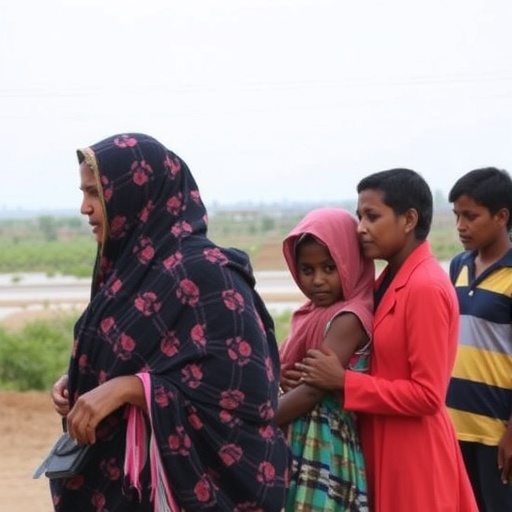
International labor migration continues to be a cornerstone for economic survival in many low- and middle-income nations, providing essential income streams to families left behind. Yet, this phenomenon introduces a delicate paradox, particularly when mothers—the primary caregivers during children’s formative years—seek employment abroad. The implications of maternal absence on child development remain a subject ripe for investigation, with policy interventions often sparking contentious debate. A groundbreaking study spearheaded by Associate Professor Takuya Hasebe of Sophia University offers a rigorous empirical evaluation of these dynamics against the backdrop of a real-world policy implemented in Sri Lanka.
In 2013, Sri Lanka enforced a migration restriction policy specifically targeting mothers with children under five years old, preventing them from seeking work overseas. This legislative measure provided a unique natural experiment to observe the direct impacts of limiting maternal migration. Employing comprehensive data from Sri Lanka’s Household Income and Expenditure Survey spanning 2009 to 2016, the research team meticulously dissected the ramifications of this policy on children’s health, education, and family economics. Their study, recently published in the April 2026 issue of World Development, offers unprecedented insights into how migration controls can reshape human capital investment at the household level.
The policy’s core mechanism curtailed the participation of mothers in international labor markets, compelling a significant number to remain within their domestic environments during critical early childhood stages. By applying robust comparative analyses between households affected by the policy and those exempt, while controlling for broader socioeconomic trends, the researchers isolated the direct consequences of maternal presence or absence. The study specifically spotlighted households with children aged 2 to 10 years, evaluating nuanced indicators including hospital admissions, illness-driven inpatient stays, and educational progression metrics such as grade repetition rates.
An intriguing pattern emerged from the findings. With increased maternal presence due to the migration ban, children exhibited statistically significant improvements in health outcomes. Reduced frequency of hospital visits and fewer prolonged illness-related hospitalizations suggested a direct correlation between maternal caregiving and physical well-being during childhood. This alignment reinforces established developmental theories proposing that parental proximity during early life stages is crucial for fostering resilience and healthy growth trajectories.
Educationally, the policy’s impact was similarly positive but nuanced. Older siblings, often affected indirectly by the migration restrictions on their mothers, demonstrated lower incidences of grade repetition—a critical marker for academic retention and cognitive development. This suggests that maternal presence may engender an enhanced home learning environment, increased supervision, or greater emotional stability conducive to academic success. Such improvements underscore how shifts in family structure driven by policy can cascade across household members, influencing broader human capital formation.
Perhaps the most counterintuitive result pertained to household economics. Conventional wisdom posits that restricting international labor migration diminishes foreign remittances, which often subsidize family incomes in low- and middle-income countries. However, the study elucidated that total household income experienced no net decline. The reduction in overseas remittance flows was effectively counterbalanced by augmented domestic income sources, including increased labor participation among other household members or greater reliance on local support networks. This finding challenges prevailing narratives about the indispensability of international migration for economic sustenance in such contexts.
From a methodological perspective, the researchers employed an observational design utilizing nationally representative survey data, enabling high external validity in interpretation. By comparing pre- and post-policy cohorts and enacting difference-in-differences analytic frameworks, the team controlled for confounding variables and ensured robust attribution of observed effects to the migration policy. This empirical rigor enhances the credibility of conclusions drawn, advancing evidence-based policy discourse.
The broader implications of this work are profound. It illustrates that migration policies targeting parental labor mobility can wield transformative social consequences, extending beyond short-term economic calculations to shape intergenerational human capital. By fostering environments where mothers remain physically present during critical developmental windows, societies may realize gains in child health and educational attainment—investments that compound over time in lifelong productivity and well-being.
Nonetheless, the researchers caution against simplistic applications of these findings. Migration policies operate within intricate social-ecological systems, and restricting maternal migration may precipitate other unintended effects not captured within the scope of this study. For instance, emotional and psychological impacts on mothers barred from migration, broader shifts in gender dynamics, and macroeconomic repercussions warrant further exploration. Dr. Hasebe emphasizes the necessity for multidimensional research paradigms that integrate qualitative and quantitative approaches to holistically assess policy trade-offs.
Associate Professor Hasebe and his colleagues envision their research as a catalyst for more nuanced global conversations on the social costs and benefits of international labor mobility. As nations grapple with balancing economic imperatives with familial welfare, such empirical insights offer invaluable guidance for crafting policies that safeguard child development without unduly compromising economic opportunity. This study stands as a testament to the power of rigorous policy evaluation in illuminating complex human systems.
Sophia University, renowned for its global academic engagement and multidisciplinary research ethos, provided the institutional foundation for this investigation. The collaboration with Cornell University and the Institute of Policy Studies in Sri Lanka exemplifies the transnational scholarly networks essential for addressing pressing global challenges. The authors declare no competing financial interests, underscoring the study’s impartiality and dedication to advancing public knowledge.
This work contributes decisively to the literature on migration, development economics, and family welfare. By leveraging real-world policy shifts and sophisticated data analysis, it bridges the often-segregated worlds of econometric research and policy application. For policymakers, scholars, and advocates, the findings signal the critical importance of thoughtfully considering the familial dimensions of labor migration policies and their far-reaching consequences on human development.
News Publication Date: April 1, 2026
Web References: https://doi.org/10.1016/j.worlddev.2025.107284
References:
Hasebe, T., Noritomo, Y., & Weeraratne, B. (2026). Restricting mothers’ international migration and human capital investment. World Development, Volume 200. https://doi.org/10.1016/j.worlddev.2025.107284
Cite Scienmag News
Courtney Benton. (February 3, 2026). New Evidence Links Limitations on Mothers’ Migration to Impacts on Children’s Health and Education. Scienmag. https://scienmag.com/new-evidence-links-limitations-on-mothers-migration-to-impacts-on-childrens-health-and-education/
Courtney Benton. "New Evidence Links Limitations on Mothers’ Migration to Impacts on Children’s Health and Education." Scienmag, 3 February 2026, https://scienmag.com/new-evidence-links-limitations-on-mothers-migration-to-impacts-on-childrens-health-and-education/. Accessed 4 September 2026.
Courtney Benton. "New Evidence Links Limitations on Mothers’ Migration to Impacts on Children’s Health and Education." Scienmag. February 3, 2026. https://scienmag.com/new-evidence-links-limitations-on-mothers-migration-to-impacts-on-childrens-health-and-education/


