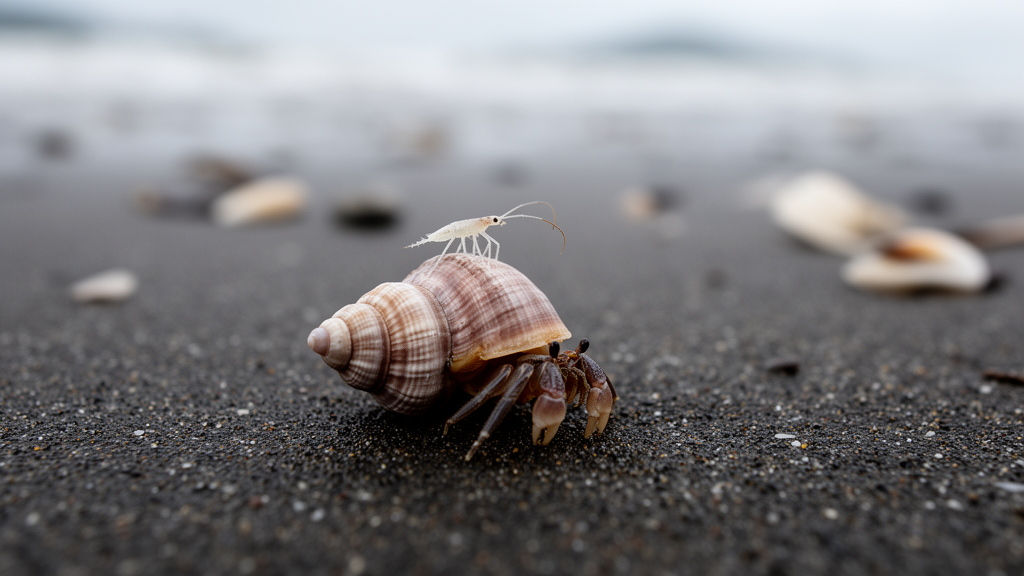
On the humid seashores of Chocó, Colombia, a team of researchers has uncovered a tiny stowaway that has never before been documented by science. Riding on the backs of terrestrial hermit crabs, a new species of commensal springtail has been formally described, expanding our knowledge of one of the most specialized relationships in the microarthropod world. The discovery, published in the journal ZooKeys, reveals how much biodiversity still hides in plain sight along tropical coastlines, and how obligate commensals can be so tightly bound to their hosts that they are found nowhere else on Earth.
The new species, named Coenaletes colombianus, belongs to a family of springtails known as Coenaletidae, a group of minute six-legged arthropods more closely studied by specialists than by the general public. Springtails, or Collembola, are among the most abundant microarthropods on the planet, thriving in soils, leaf litter, and even on the surfaces of glaciers. But the Coenaletidae are unusual in a very specific way: they are obligate commensals, meaning they live exclusively in association with terrestrial hermit crabs of the genus Coenobita. Only two species of this family had ever been described before, one from New Guinea and one from the Caribbean. The Colombian discovery marks the third known species in the entire genus, and the first from the Pacific coast of the Americas.
The expedition that led to the discovery took researchers to the shores of Nuquí, in the Chocó department of Colombia, a region famous for its dense rainforest meeting the ocean. There, they collected hermit crabs of the species Coenobita compressus, easily recognized by their elongated eyestalks and their habit of occupying empty snail shells, in this case shells of the marine snail Tegula atra. To coax the springtails off their hosts, the researchers placed the crabs in plastic containers filled with fresh water. The technique worked: the springtails and their molted exoskeletons detached and floated to the surface, where they could be collected with fine tools. The specimens were then fixed in 96% ethanol and prepared for detailed morphological study.
Back in the laboratory, the specimens underwent a rigorous preparation process. They were cleared with potassium hydroxide and lactic acid to render their tiny bodies transparent, then mounted on slides in Hoyer’s solution, a medium that hardens over a week of drying at 45 to 50 degrees Celsius. Once prepared, the slides were examined and photographed with a Carl Zeiss Primo Star phase-contrast microscope, allowing researchers to document every seta, spine, and sensory organ. Additional images were captured with a LEICA M205A stereomicroscope equipped with an auto-mounting system, and with a HITACHI TM4000Plus II environmental scanning electron microscope, which revealed surface details at extraordinary magnification. For SEM imaging, specimens were transferred from ethanol to amyl acetate for five hours to maintain turgor and prevent body collapse within the vacuum chamber, then air-dried and affixed to cardboard micropoints with polyvinyl acetate adhesive.
The morphological analysis revealed a suite of characters that distinguish Coenaletes colombianus from its two known relatives. Adult males measure 1.56 millimeters in body length and females 1.61 millimeters, with a depressed body form and a head that is wider than long. The antennae consist of four segments, and males bear a distinctive pattern of spines: one on the first antennal segment, two on the second, and three on the third. This 1, 2, 3 arrangement matches that of the New Guinea species, Coenaletes vangoethemi, but differs from the Caribbean species, Coenaletes caribaeus, which shows a 2, 2, 2 pattern. The lateral spines on the trunk, however, follow a 4, 1, 1, 1 arrangement on the third thoracic and first three abdominal segments, matching the Caribbean species rather than the New Guinea one. The combination of these characters, along with differences in the number of setae on the dens, the width-to-length ratio of the second antennal segment, and the length of the mucrodens, confirmed the Colombian population as a species in its own right.
One of the most remarkable aspects of the study is the detailed documentation of the species’ ontogenetic development, from the first instar to adulthood. The researchers measured specimens at each postembryonic stage, recording body length, head dimensions, antennal segment lengths, and the dimensions of the fused third and fourth abdominal segments. First instar juveniles measure just 907 micrometers in body length, growing to over 1.5 millimeters in adults. The ventral setation, in particular, shows a gradual and predictable increase in setae number across development, with the corpus tenaculi, the third thoracic sternum, the ventral second abdominal segment, the coxa furcalis, and the postlabial setae undergoing the most significant changes. This developmental series provides a reference framework that was previously unavailable for the genus, as earlier descriptions of the two known species omitted many of these ventral characters entirely.
The species’ morphology reflects its highly specialized lifestyle. The mandible bears a well-developed molar plate but lacks apical teeth, and the maxilla is small with six subequal lamellae. The pronotum is reduced, and the third and fourth abdominal segments are fused dorsally and laterally but not ventrally, creating an elongated trunk region. Males possess spines on the antennae and on lateral tubercles of the third thoracic and third abdominal segments, and the dorsal apex of the tibiotarsus is excavated at the base of the claw. The claw itself bears enlarged lateral teeth and is capable of folding, an adaptation that may aid in gripping the host crab’s surface. The furcula, the springtail’s characteristic jumping organ, is well developed but does not reach the ventral tube, and the mucro is falcate and fused to the dens.
During the study, the researchers encountered a teratological specimen, an individual with abnormal development that lacked setae laterally on the first three abdominal segments and showed a deformed abdomen. On the left side of the fused third and fourth abdominal segments, most ordinary setae, all macrosetae, both bothriotricha, the microsensillum, and most mesosetae were absent. Such asymmetries and abnormalities, while rare, provide insight into the developmental plasticity of the species and the challenges of documenting chaetotaxy in a group with hypertrichosis, where the dorsal setal pattern is too dense to check reliably during development.
The discovery of Coenaletes colombianus raises compelling questions about the biogeography of this enigmatic genus. With one species on New Guinea, one in the Caribbean, and now one on the Pacific coast of Colombia, the genus appears to have a remarkably disjunct distribution across tropical oceans. The obligate association with terrestrial hermit crabs suggests that the evolutionary history of the springtails is intertwined with that of their hosts, which themselves colonized land from marine ancestors. The Chocó region, with its extraordinary endemism and its position at the crossroads of the Neotropics, may harbor additional undiscovered commensal species, and the researchers suggest that further surveys of hermit crabs along tropical coastlines could reveal more surprises.
The new species is described and illustrated in the journal ZooKeys, with a key provided for the identification of all three species known in the genus. The type material, including the holotype male and numerous paratypes, is deposited at the Facultad de Ciencias of the Universidad Nacional Autónoma de México and at the Entomological collection of the Museo entomológico UNAB of the Universidad Nacional de Colombia in Bogotá. The specific epithet colombianus is a geographical adjective honoring the country where the type material was collected. As researchers continue to explore the microarthropod fauna associated with hermit crabs, each new discovery underscores the extraordinary specificity of commensal relationships and the remarkable diversity that persists in the hidden corners of the natural world.
Subject of Research: Taxonomic description of a new obligate commensal springtail species associated with terrestrial hermit crabs in Colombia.
Article Title: One new obligate commensal species of Coenaletes ( Collembola , Coenaletidae ) from the hermit crab Coenobita compressus ( Crustacea , Coenobitidae ) from Colombia
Article References: Arango, A., Ojeda, M., Serna, F., & Palacios-Vargas, J. G. (2026). One new obligate commensal species of Coenaletes (Collembola, Coenaletidae) from the hermit crab Coenobita compressus (Crustacea, Coenobitidae) from Colombia. ZooKeys, 1293, 79-94. https://doi.org/10.3897/zookeys.1293.206618
Image Credits: AI Generated
DOI: 10.3897/zookeys.1293.206618
Keywords: Collembola, springtails, hermit crabs, commensalism, new species, Colombia, ZooKeys, taxonomy, Coenaletidae, biodiversity, obligate, commensal
Cite Scienmag News
Drew Townsend. (October 17, 2026). New commensal springtail species discovered riding hermit crabs on Colombia’s Pacific coast. Scienmag. https://scienmag.com/new-commensal-springtail-species-discovered-riding-hermit-crabs-on-colombias-pacific-coast/
Drew Townsend. "New commensal springtail species discovered riding hermit crabs on Colombia’s Pacific coast." Scienmag, 17 October 2026, https://scienmag.com/new-commensal-springtail-species-discovered-riding-hermit-crabs-on-colombias-pacific-coast/. Accessed 17 October 2026.
Drew Townsend. "New commensal springtail species discovered riding hermit crabs on Colombia’s Pacific coast." Scienmag. October 17, 2026. https://scienmag.com/new-commensal-springtail-species-discovered-riding-hermit-crabs-on-colombias-pacific-coast/