


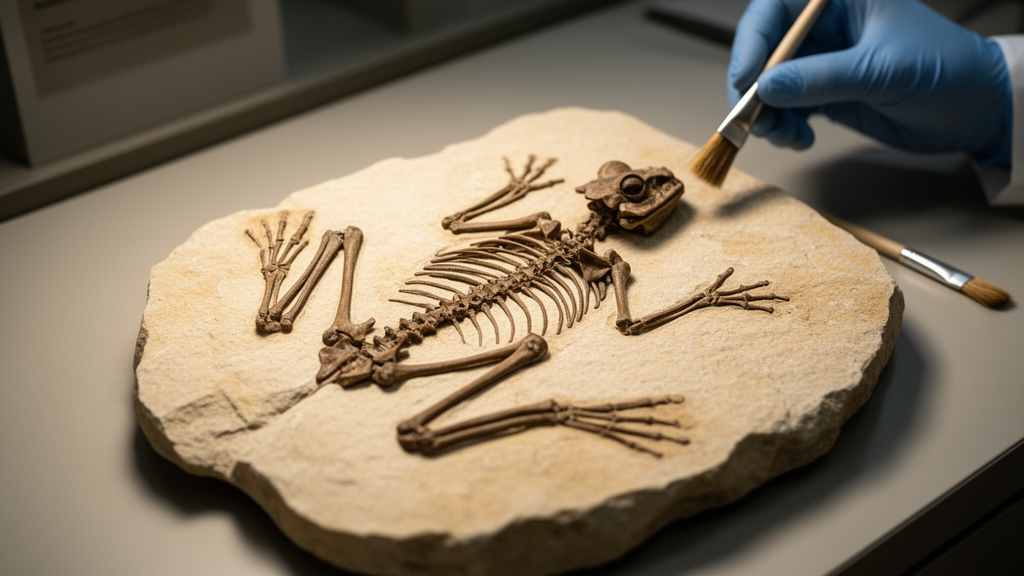
A near-complete fossil frog that lay unnoticed in a private collection for four decades is now one of the most informative early records of the true frog family Ranidae in Europe. The specimen, catalogued as MAB19654, was collected in the early 1980s from the Marnes du Bois d’Asson in the Apt-Manosque-Forcalquier Basin of south-eastern France and donated to the Nationaal Oertijdmuseum in Boxtel, Netherlands, in 2024. Preserved as a slab and counter-slab heralding an articulated male skeleton with a snout-vent length of 64.8 millimetres, it dates to the latest Rupelian stage of the early Oligocene, roughly 33 to 28 million years ago. A new study in Fossil Record assigns the frog to the water frog genus Pelophylax, making it one of the oldest known members of a lineage that still thrives across the Palearctic today.
The timing of the fossil is significant because it falls after the Grande Coupure, a major faunal turnover around 33.4 million years ago triggered by climate cooling at the Eocene-Oligocene transition. This event reduced European anuran diversity by approximately one third and extinguished the speciose Eocene frog genus Thaumastosaurus, along with western European populations of the palaeobatrachid genus Albionbatrachus. True frogs dispersed into Europe from Asia in the aftermath, and the genus Pelophylax spread across the continent by the earliest Oligocene. Yet published Oligocene material of Pelophylax is remarkably scarce, consisting of a partially articulated postcranial skeleton from Chartres-de-Bretagne, fragmentary remains from the Alès Basin in France, material from Möhren 13 in Germany, and specimens from the Transylvanian Basin in Romania. Given this fragmentary record, little has been known about the osteology of early European water frogs, which is precisely what makes MAB19654 so valuable.
The geological setting of the specimen adds ecological context to its preservation. The Marnes du Bois d’Asson is an approximately 350-metre-thick sequence of sandy marls, sandstone and occasional conglomerates, deposited in a large subtropical lake environment. Fossil shells of the marine gastropod Potamides suggest brackish influences, and on-site collection has yielded numerous cyprinodontiform fish of the genera Prolebias and Paralebias alongside undetermined insect fossils. The Luberon Geopark, which includes Bois d’Asson, is celebrated for exquisitely preserved delicate fossils such as pinecones, butterflies and feathered songbirds. The frog itself was found in an otherwise fossil-poor layer of sandy marl at least 10 centimetres thick, and its preservation reflects a stick-and-peel taphonomy in which the carcass adhered to the substrate from head to torso while distal limb elements were displaced by water currents.
Assignment of MAB19654 to Ranidae rests on a suite of diagnostic skeletal characters. The specimen shows elongate transverse processes on the posterior vertebrae, cylindrical sacral transverse processes and non-imbricated vertebrae, a combination that distinguishes it from pelobatoids, palaeobatrachids, alytids and bufonids. The maxilla bears numerous elongate teeth and lacks the ornamentation characteristic of Pelobatidae, Latonia and Thaumastosaurus, while the frontoparietals did not fuse at the mid-line, unlike the condition in pelobatids. The urostyle is a rod-like element without transverse processes and was not fused to the sacral vertebra, both features typical of Ranidae. The sacral angulation between the transverse processes measures 125 degrees, and the dorsal ridge of the urostyle runs from the anterior extremity to roughly two-thirds of its length, gradually reducing in height posteriorly, similar to extant Pelophylax kl. esculentus.
Assignment to Pelophylax rather than the related pond frog genus Rana is based primarily on the humerus. The humeral diaphysis in MAB19654 is straight and robust, maintaining roughly the same width as the humeral condyle, whereas in Rana the shaft becomes narrower than the condyle. A prominent crista medialis on the left humerus identifies the specimen as male, and this crest remains low, not reaching past the mid-point of the diaphysis, a condition diagnostic of Pelophylax and unlike Rana, where the crest extends further along the shaft. The skull outline of MAB19654 more closely resembles that of Pelophylax kl. esculentus and the fossil Pelophylax meriani than that of adult Rana temporaria. The relative shortness of the femur, even with respect to other Pelophylax, makes reference to Rana inappropriate, since Rana species have longer and more slender femora.
To place MAB19654 in a comparative framework, the researchers assembled the largest osteological dataset of Pelophylax limb-bone proportions to date. Their sample included 58 disarticulated osteological specimens of P. ridibundus, 59 of P. lessonae and 89 of P. perezi, alongside one fossil P. aquensis, 20 specimens of the Miocene P. pueyoi from published literature, two of P. meriani and 25 specimens of Rana spp. The specific designation of P. ridibundus and P. lessonae was verified genetically. Measurements included ratios of snout-vent length to femur, tibiofibula and first toe length, the femur-tibiofibula ratio, the femur-tarsal ratio and sacral angulation. For the fossil specimens, ratios were measured on both left and right sides to minimise potential biases from taphonomic distortion and asymmetry. The data were analysed in the statistical computing environment R using violin plots, Bonferroni-corrected pairwise t-tests and a Principal Component Analysis standardised by Z-transformation.
The results show that the limb bone ratios of MAB19654 fall within the range observed in extant Pelophylax osteological specimens. The femur-tibiofibula ratio, 0.893 on one side and 0.933 on the other, plots within the range of P. perezi and P. ridibundus, as well as the fossil P. aquensis, P. meriani and P. pueyoi. In the Principal Component Analysis, the first two axes explain 82.42 percent of variance, and MAB19654 plots within the unique morphospace range of P. ridibundus with a PC1 value of 1.34. The centroids of all three extant species differ significantly in three-dimensional morphospace. Notably, P. lessonae has a significantly higher femur-tibiofibula ratio than all other species, indicating a distinctly longer femur relative to the tibiofibula, while P. perezi has a significantly higher femur-tarsal ratio, signifying a reduced tarsus relative to the femur.
These ecomorphological patterns carry biomechanical implications. A wider sacral angle correlates with improved walking and hopping capabilities, while jumpers are characterised by a narrower angle. The sacral angulation of MAB19654 at 125 degrees falls in the higher range of P. ridibundus and P. perezi but exceeds all measured specimens of P. lessonae, whose narrower angle indicates poorer walking and hopping performance. Elongation of the tibiale is correlated with greater jumping ability, suggesting poorer jumping performance in P. perezi compared with other Pelophylax species. Conversely, femur elongation occurs in aquatic frogs and is consistent with the observation that P. lessonae primarily displaces by swimming. All three sampled extant species are highly aquatic, and since the limb bone proportions of P. ridibundus match those of the fossil species P. pueyoi, P. meriani, P. aquensis and MAB19654, the researchers treat the limb proportions of P. ridibundus as representative of early Pelophylax.
One of the most intriguing findings concerns the morphology of the transverse process of the fourth dorsal vertebra, V4. The researchers defined four morphotypes: narrow parallel, wide parallel, trapezoid and spatulate. MAB19654 displays a clear trapezoid outline, significantly wider than in the Oligocene specimen IGR 144547 and the Pliocene Pelophylax spp. All four morphotypes occur across the three sampled extant species, but complex trapezoid and spatulate morphologies are far more frequent in P. perezi, at 75 percent, while simple parallel morphologies dominate the clade containing P. lessonae and P. ridibundus, at 69.5 and 74 percent respectively. Since P. perezi is the early-branching species, complex V4 morphology appears ancestral in Pelophylax, with simplification being a derived trait of the later-diverging species. The variation is unlikely to be ontogenetic, as each morphotype includes specimens across the size range and no significant difference in snout-vent length exists between morphotypes.
The study refrains from assigning a species to MAB19654, referring it instead to Pelophylax sp., because no osteological synapomorphies currently allow species-level determination among fossil Pelophylax. The researchers also argue that references of Oligocene Pelophylax material to Pelophylax kl. esculentus are invalid, as this klepton represents the fertile hybrid of P. lessonae and P. ridibundus, and a klepton cannot precede the divergence of its parent species, which occurred during the Miocene. Major speciation events in European Pelophylax took place from the early Miocene onwards, meaning MAB19654 predates the genus’s principal radiation and offers a rare window into its ancestral anatomy. Given that extant P. ridibundus tolerates exceptionally high salinity, reproducing on the shores of the Black and Caspian Seas, early water frogs such as MAB19654 could plausibly have adapted to the brackish conditions of the Oligocene lake in which it was buried, closing a loop between anatomy, ecology and environment that spans more than 30 million years.
Subject of Research: Early Oligocene water frog fossil from France
Article Title: New early Oligocene water frog ( Anura , Ranidae , Pelophylax ) occurrence from south-eastern France
Article References: Ponstein, J., Blain, H.-A., Steur, H., & Wallaard, J. J. W. (2026). New early Oligocene water frog (Anura, Ranidae, Pelophylax) occurrence from south-eastern France. Fossil Record, 29(1), 227-247. https://doi.org/10.3897/fr.29.188906
Image Credits: AI Generated
DOI: 10.3897/fr.29.188906
Keywords: early, Oligocene, water, frog, Anura, Ranidae, Pelophylax, occurrence, south-eastern, France, scientific research
Cite Scienmag News
Gavin Prescott. (October 17, 2026). Near-complete Oligocene water frog fossil from France reveals early European ranid anatomy. Scienmag. https://scienmag.com/near-complete-oligocene-water-frog-fossil-from-france-reveals-early-european-ranid-anatomy/
Gavin Prescott. "Near-complete Oligocene water frog fossil from France reveals early European ranid anatomy." Scienmag, 17 October 2026, https://scienmag.com/near-complete-oligocene-water-frog-fossil-from-france-reveals-early-european-ranid-anatomy/. Accessed 17 October 2026.
Gavin Prescott. "Near-complete Oligocene water frog fossil from France reveals early European ranid anatomy." Scienmag. October 17, 2026. https://scienmag.com/near-complete-oligocene-water-frog-fossil-from-france-reveals-early-european-ranid-anatomy/


