


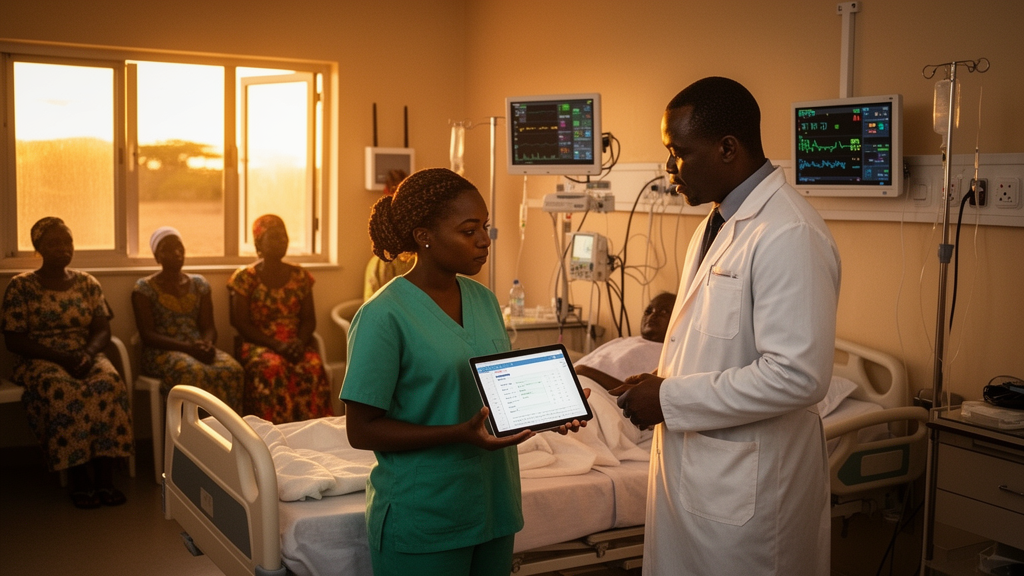
Digital health in Africa has quietly produced some of the most consequential success stories in global medicine, yet a new conference report warns that the continent’s hardest challenge is not invention but integration. The Digital Health Africa 2025 Conference, or DHA-2025, brought together 283 registered delegates across three physical venues in Pretoria, Kampala and Berlin, plus a virtual platform, to confront a sobering paradox: tools that work brilliantly in pilots routinely stall when asked to serve entire nations. The report, published in Frontiers in Pharmacology, argues that scientific advancement alone is insufficient, and that the true test of innovation lies in its safe and practical delivery to the end user, whether that is a nurse in a rural clinic or a mother waiting for a text message that could change her pregnancy’s outcome.
The conference framed its discussions around two tracer areas, maternal and child health and antimicrobial resistance, alongside advanced methodologies such as artificial intelligence and pharmacometrics. This was not an abstract exercise. The maternal health platforms examined at the meeting collectively touch millions of lives. South Africa’s MomConnect, a government-backed mobile messaging service, has registered nearly five million mothers through public antenatal services in more than 95 percent of the country’s public health facilities. Over a decade of operation, studies have shown the platform positively shifts health-seeking behaviours in ways that contribute directly to the Sustainable Development Goals on reducing maternal mortality and ending preventable deaths of newborns and children under five.
Kenya’s MomCare platform demonstrates a different operational model, one built on value-based healthcare rather than national messaging. It links expectant mothers to designated public and private clinics, many in remote rural areas or urban slums, to detect and reduce pregnancy-related risks early. Its agility was proven during the COVID-19 pandemic, when a dedicated set of interventions was added to the MomCare bundle within just three weeks of the outbreak, sustaining skilled deliveries and reducing complicated births. Yet the platform’s dependence on continuous financial backing, and the difficulty of replicating it in countries without a unified digitally integrated public-private ecosystem, illustrate a recurring theme of the conference: even celebrated successes carry structural fragilities that rarely appear in press releases.
The evidence on scaling is particularly instructive, and often uncomfortable. Rwanda’s RapidSMS programme recorded a 27 percent increase in facility deliveries during its initial pilot phase in Musanze district, supported by intensive supervision and error logging. But national evaluations later showed the programme’s positive outcomes were largely restricted to districts that received additional international donor funding and equipment from UNICEF. National scale, in other words, does not guarantee community-level efficacy. Surveys in rural Limpopo province in South Africa reached a similar conclusion, finding that grassroots adoption of national platforms remains fragile and heavily dependent on local health worker dynamics and infrastructural constraints. Uganda’s electronic maternal and neonatal system was highlighted as the kind of localized foundational infrastructure needed to bridge the gap between national platforms and community clinics.
Some failures are more striking than others. Malawi’s Chipatala Cha Pa Foni hotline successfully reduced pediatric clinic visits for fever by 15 percent by promoting home-based management, but its institutionalization stalled when the country’s Nursing and Midwives Council opposed transitioning registered nurses from physical bedsides to virtual telephone helpdesks, arguing the move would erode clinical skills and worsen acute staffing shortages at frontline hospitals. The public rollout also stumbled on a bureaucratic detail with enormous consequences: there were no official civil service job codes or budgets for nurses working in a virtual advisory capacity. Community skepticism posed its own barriers, with some local populations associating the hotline’s phone-based delivery predictions with witchcraft. These are not technology problems; they are governance, trust and human-resource problems wearing a technology costume.
Against these cautionary tales, Madagascar’s PANDA system offered one of the conference’s most compelling data points. The Pregnancy and Newborn Diagnostic Assessment is a point-of-care clinical standardization tool that requires providers to complete all integrated screening modules before a visit can be closed, effectively enforcing adherence to World Health Organization guidelines. The results were dramatic: near 100 percent compliance in blood pressure checks and 92.7 percent in HIV testing, compared with national baselines of 68 percent and 10 percent respectively. Second-trimester first antenatal care visits rose to 73 percent against a 45 percent national average. But the report is candid about the methodological gaps, noting the evaluation lacked a randomized control group, did not measure long-term mortality outcomes, and never assessed cost-effectiveness against traditional paper-based checklists.
On the antimicrobial resistance front, the conference identified a profound deficit in comprehensive pediatric-specific data as the dominant constraint. Without high-quality data, health systems cannot accurately map the clinical realities of AMR and infectious disease transmission in children, making targeted digital interventions nearly impossible to design. Mathematical modeling showcased at the meeting demonstrated what is achievable when data and collaboration align: satellite imagery was used to identify unmapped villages in Nigeria for polio vaccination campaigns, drone technology mapped malaria-infested areas in West Africa, and models predicted antibiotic resistance patterns and disease outbreak trajectories. The challenge, speakers emphasized, is moving beyond acknowledging these burdens toward actionable mechanisms that embed specialized digital tools into existing, often rigid, clinical workflows.
The pharmacometrics sessions revealed how quantitative modeling can bridge evidence gaps where ethical and physiological constraints make traditional clinical trials impossible. Physiologically based pharmacokinetic modeling can simulate drug behavior in pregnant women and children, joint longitudinal and time-to-event models can estimate preeclampsia risk, and the Dutch Pediatric Formulary demonstrates how scarce empirical data can be systematically translated into precise pediatric dosing guidelines. Yet the report identifies a deep disconnect between developers and frontline end-users in Africa, where clinicians and nurses often lack the specialized skills, training and trust required for clinical adoption. Operationalizing artificial intelligence in low-resource clinics also demands continuous surveillance pipelines to monitor algorithms for real-world accuracy and bias, all hindered by weak regulatory frameworks.
From this landscape of partial successes and instructive failures, the report distills three co-dependent pillars on which any scaling effort must rest: technical capacity in the form of infrastructure, legal legitimacy through regulation, and effective management through governance. Legacy architectures illustrate why the first pillar matters so much. MomConnect’s SMS and USSD foundations suffer severe timeouts during registration, and commercial texting tariffs account for roughly three-quarters of its ongoing operational costs. Using mobile numbers as proxy identifiers prevents reliable longitudinal medical records. In Cameroon, the BornFyne-Prenatal Management System confronts clinic-level electricity deficits, poor connectivity, and equity gaps because underprivileged rural households often lack the smartphones the platform requires. The report also flags a chronic policy translation failure: only 3.8 percent of maternal and child health implementation studies successfully influence national government health policies.
The recommendations are pointed. Policymakers should prioritize interoperable, government-owned digital infrastructure over donor-dependent pilots, and establish formal job codes, budgets and AI-specific regulatory pathways for virtually deployed staff. Funders should demand randomized or quasi-experimental designs, long-term clinical and cost-effectiveness outcomes, and pre-registered evaluation frameworks. Developers should design for infrastructure-constrained settings from the outset, minimizing dependence on continuous connectivity and expensive messaging tariffs, and build interoperability with national health information systems. The report’s authors acknowledge their own limitations, noting that ethics, data privacy and AI governance were not major conference themes and that some findings remain unpublished. But their central message lands with force: digital health cannot be an isolated technological overlay. True transformation requires an ecosystem approach, cross-continental collaboration, and long-term commitments that outlast the pilot phase, because the distance from a working prototype to a clinic bedside is measured not in code but in governance, trust and sustained investment.
Subject of Research: Scaling digital health interventions for maternal and child health, antimicrobial resistance, AI and pharmacometrics in Africa
Article Title: Digital Health Africa (DHA 2025) – Conference Report
Article References: Maluleke, T., Waitt, C., Pillay-Fuentes Lorente, V., Rosenkranz, B., Kampmann, B., Steinecke, K., & Pillai, G. C. (2026). Digital Health Africa (DHA 2025) – Conference Report. Frontiers in Pharmacology, 17, Article 1909596. https://doi.org/10.3389/fphar.2026.1909596
Image Credits: AI Generated
DOI: 10.3389/fphar.2026.1909596
Keywords: digital health, Africa, maternal health, child health, antimicrobial resistance, artificial intelligence, pharmacometrics, mHealth, health policy, MomConnect, MomCare, health systems scaling
Cite Scienmag News
Harold Sullivan. (October 17, 2026). From Pilot to Bedside: Africa’s Digital Health Revolution Hits Its Hardest Test. Scienmag. https://scienmag.com/from-pilot-to-bedside-africas-digital-health-revolution-hits-its-hardest-test/
Harold Sullivan. "From Pilot to Bedside: Africa’s Digital Health Revolution Hits Its Hardest Test." Scienmag, 17 October 2026, https://scienmag.com/from-pilot-to-bedside-africas-digital-health-revolution-hits-its-hardest-test/. Accessed 17 October 2026.
Harold Sullivan. "From Pilot to Bedside: Africa’s Digital Health Revolution Hits Its Hardest Test." Scienmag. October 17, 2026. https://scienmag.com/from-pilot-to-bedside-africas-digital-health-revolution-hits-its-hardest-test/


