


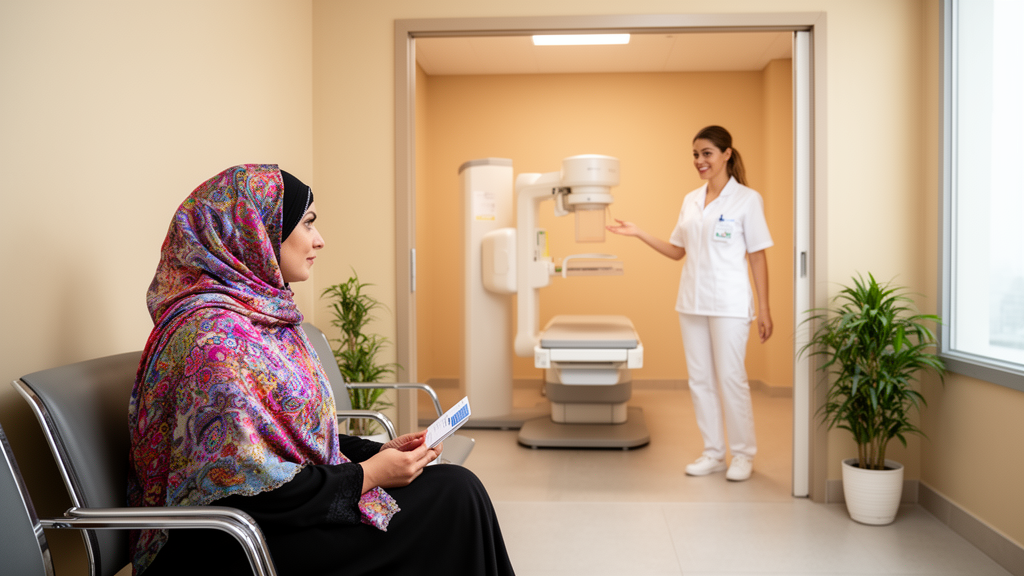
Breast cancer remains the most common cancer among women worldwide, and mammography is one of the most powerful tools for catching it early, when treatment is most effective. Yet in Bahrain, a new cross-sectional study published in BMC Public Health reveals a troubling gap between awareness and action: although nearly six in ten Bahraini women aged 40 to 74 have had a mammogram at least once, fewer than one in five are screened within the recommended interval. The findings, drawn from 302 randomly selected women attending primary healthcare centres across all four of Bahrain’s governorates, expose both the personal beliefs and the systemic failures that keep regular screening rates dangerously low.
The study, led by Fatema Habbash of Arabian Gulf University and colleagues, used multistage and systematic sampling to recruit participants and conducted face-to-face interviews with a structured questionnaire. Among the 302 women surveyed, 181, or 59.9%, had undergone mammography at least once. But only 59, or 19.6%, had been screened within the recommended interval. That distinction matters enormously. A single mammogram can detect an existing tumour, but regular screening at fixed intervals is what allows radiologists to compare images over time and identify subtle changes that signal early malignancy. The low regular-screening rate suggests that many women view mammography as a one-time event rather than an ongoing preventive habit.
The barriers the researchers identified are striking in their ordinariness. The most common reason for not screening, cited by 67.9% of women, was simply believing mammography was unnecessary. Close behind, at 64.4%, was the absence of a physician recommendation. Insufficient information accounted for 42.4% of non-uptake. Fear of pain and fear of a cancer diagnosis each affected 30.9% of women, while fear of treatment or mastectomy affected 27.6%. Being asymptomatic was cited by 23.4%, embarrassment by 23.0%, concerns about radiation by 15.6%, and lack of time by 10.0%. Taken together, these numbers paint a picture of a population that largely does not see itself as at risk and has not been told otherwise by the medical professionals it trusts.
That last point deserves particular attention. The belief that mammography is unnecessary unless symptoms appear is a well-documented misconception in many populations, and it is especially consequential because early breast cancer is frequently asymptomatic. The whole purpose of screening is to detect disease before it announces itself. When nearly a quarter of women cite being asymptomatic as a reason not to screen, it signals a fundamental misunderstanding of what screening is for. Similarly, the finding that two-thirds of women lacked a physician recommendation highlights the decisive role that primary care providers play in translating public health guidelines into individual action.
When the researchers analysed which factors were actually associated with screening uptake, the results were unambiguous. Screening was significantly linked to age, family history of breast cancer, previous breast-related problems, and receiving a screening invitation from a healthcare provider. In multivariable analysis, which adjusts for the influence of other variables, receiving a formal screening invitation within the previous two years was strongly associated with higher uptake, with an adjusted odds ratio of 5.23 and a 95% confidence interval of 2.55 to 10.72. In practical terms, women who received a formal invitation were more than five times as likely to have been screened as those who did not. That is one of the strongest effects a public health intervention can produce, and it points to a remarkably simple lever for change.
The other significant predictors reinforce the clinical logic of existing screening programmes. Women aged 50 and above were more likely to undergo screening, consistent with the fact that breast cancer risk rises with age and that most international guidelines prioritise this group. Women with a family history of breast cancer were also more likely to screen, reflecting heightened perceived susceptibility. And those with previous breast-related problems were more likely to have had a mammogram, likely because such problems prompt clinical follow-up. What emerges is a pattern in which women who already perceive themselves as at risk, or who have been personally prompted by the health system, take action, while everyone else falls through the cracks.
The implications for Bahrain and the wider Gulf region are significant. The Gulf Cooperation Council countries share cultural, demographic, and healthcare-system characteristics, and the barriers identified here—misconceptions about necessity, fear of diagnosis, embarrassment, and reliance on physician prompting—are likely to resonate across the region. The study’s authors argue that culturally tailored health education, systematic screening invitations, and proactive physician recommendations may improve participation. The strength of the invitation effect suggests that a structured invitation system, in which every eligible woman receives a formal prompt at recommended intervals, could dramatically raise regular screening rates without requiring new technology or infrastructure.
The researchers also point toward the future of screening outreach. They call for future research to assess technology- and AI-supported outreach strategies, especially for younger, asymptomatic, and under-screened women. The logic is compelling: the women least likely to screen are those who feel well and see no reason to visit a clinic, and reaching them may require digital reminders, mobile health applications, or AI-driven risk stratification that identifies who needs prompting most. In a country with high smartphone penetration and a well-developed primary healthcare network, the technical foundations for such outreach already exist.
What makes this study particularly valuable is its methodological rigour. By randomly selecting participants across all four governorates using multistage and systematic sampling, the researchers produced a sample that reflects the broader population of Bahraini women in the target age range. The face-to-face interview approach minimised literacy barriers and ensured consistent data collection. The multivariable analysis distinguished between factors that merely correlate with screening and those that independently drive it. The finding that a formal invitation independently predicts uptake, even after adjusting for age, family history, and breast-related problems, gives policymakers a clear, evidence-based target.
For a condition that is the most common cancer among women worldwide, the gap between what screening can achieve and what regular screening rates actually are remains one of public health’s most stubborn challenges. This study shows that in Bahrain, the solution may not lie in convincing women one by one, but in building a system that reaches out to them automatically. A formal invitation, delivered at the right interval, backed by culturally attuned education and proactive primary care physicians, could transform mammography from an occasional event into a routine preventive habit. The evidence suggests that the simplest intervention—asking women to come in for screening—may be the most powerful one available.
Subject of Research: Public Health
Article Title: Determinants and barriers to mammography screening uptake among Bahraini women: a cross-sectional study in primary healthcare settings
Article References: Habbash, F., AlMohri, M., Waleed, A., Hamdan, H., Salman, K., Obaid, S., Abdulla, Z., Almarabheh, A., & Salah, A. B. (2026). Determinants and barriers to mammography screening uptake among Bahraini women: a cross-sectional study in primary healthcare settings. BMC Public Health. https://doi.org/10.1186/s12889-026-29859-9
Image Credits: AI Generated
DOI: 10.1186/s12889-026-29859-9
Keywords: mammography, breast cancer screening, Bahrain, public health, preventive medicine, primary healthcare, cancer epidemiology, Determinants, barriers, screening, uptake, Bahraini
Cite Scienmag News
Phoebe Ingram. (October 17, 2026). Why Most Bahraini Women Skip Mammograms—and the Simple Fix That Could Change It. Scienmag. https://scienmag.com/why-most-bahraini-women-skip-mammograms-and-the-simple-fix-that-could-change-it/
Phoebe Ingram. "Why Most Bahraini Women Skip Mammograms—and the Simple Fix That Could Change It." Scienmag, 17 October 2026, https://scienmag.com/why-most-bahraini-women-skip-mammograms-and-the-simple-fix-that-could-change-it/. Accessed 17 October 2026.
Phoebe Ingram. "Why Most Bahraini Women Skip Mammograms—and the Simple Fix That Could Change It." Scienmag. October 17, 2026. https://scienmag.com/why-most-bahraini-women-skip-mammograms-and-the-simple-fix-that-could-change-it/


