


Every time a car, truck, or ship engine fires up, its exhaust carries a plume of particles far too small to see. Many of these soot particles measure just tens of nanometres across, small enough to slip deep into human lungs and cross into the bloodstream. Yet because they are so tiny, they contribute almost nothing to the mass of particulate matter that regulators traditionally measure. A filter weighing a few milligrams of soot may conceal trillions of individual particles. That is why modern emission regulations, particularly in Europe, increasingly rely on counting particles by number rather than weighing them by mass, and why the accuracy of the instruments doing the counting matters so much.
The instruments at the heart of this regulatory system are particle number counters, most commonly condensation particle counters, or CPCs. These devices work by drawing aerosol through a chamber saturated with a working fluid, typically butanol or water, where each particle acts as a seed for droplet growth. A particle too small to detect optically becomes a droplet large enough to scatter a laser beam, and each flash of light is registered as a count. It is an elegant physical trick, but it comes with a metrological catch: the counting efficiency of a CPC depends on particle size, composition, and concentration, and two instruments of the same model can disagree if they have drifted apart in calibration. When those counts feed into compliance decisions worth millions of euros, the disagreement is not a technical curiosity but a regulatory problem.
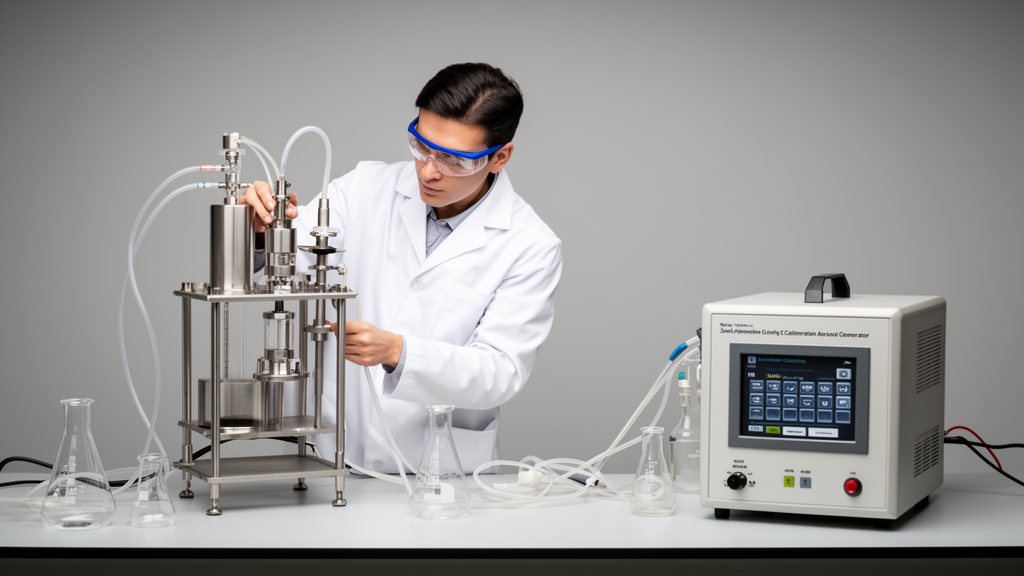
Researchers at the Physikalisch-Technische Bundesanstalt, Germany’s national metrology institute in Braunschweig, have now built a dedicated calibration facility designed to anchor particle number measurements to national standards. The facility, described in a preprint under review for the journal Aerosol Research by Anza Waheed and colleagues, serves as a primary reference standard for particle number concentration, the quantity at the core of solid soot emission quantification in national and European regulatory frameworks. In practical terms, it means that when a laboratory calibrates its particle counter against PTB’s facility, the result can be traced through an unbroken chain of comparisons back to the national standard for electrical current, the physical basis of the reference measurement.
That reference instrument is a Faraday Cup Aerosol Electrometer, or FCAE, and it is the quiet hero of the whole enterprise. Unlike a CPC, which counts particles one by one, the FCAE collects charged aerosol particles on an insulated electrode inside a Faraday cup and measures the total electric charge they carry. Since each particle carries a known, small number of elementary charges, dividing the measured current by the charge per particle and the aerosol flow rate yields the particle number concentration directly, without relying on optical detection at all. This makes the FCAE a primary standard: its reading depends on fundamental constants and measurable quantities rather than on a calibration of its own. The PTB team used this primary aerosol number standard to calibrate a condensation particle counter, determining how efficiently the CPC detects particles across a range of sizes and how linearly it responds across concentrations.
The technical scope of the facility is considerable. It enables high-accuracy determination of CPC counting efficiency for particles with mobility diameters between 17 and 200 nanometres, a range that spans the sizes most relevant to combustion emissions, from the smallest nucleation-mode particles up to the accumulation mode where soot agglomerates settle. It also supports linearity measurements of particle number concentrations ranging from 1 to 20,000 particles per cubic centimetre, covering the dilute conditions of ambient monitoring through to the concentrated aerosols encountered in raw exhaust testing. Linearity matters because a counter that reads correctly at low concentrations may compress or saturate at high ones, and emission measurements routinely push instruments toward the upper end of their range.
Generating a suitable test aerosol is a science in itself, and the facility’s aerosol generation chain reflects that. Soot particles are produced by a miniCAST 5303, a widely used combustion aerosol generator that burns a controlled propane flame under adjustable conditions to yield soot with reproducible size and structure. The freshly generated aerosol then passes through a catalytic stripper, a heated device that oxidises and removes volatile and semi-volatile components, leaving behind a stream of essentially solid, non-volatile particles. This step is critical for emission work, because regulatory particle number measurements are defined for solid particles only; volatile species that form droplets or evaporate during sampling would otherwise distort the comparison between instruments. After stripping, the aerosol is homogenised in an integrated mixing unit to ensure that every instrument sampling from the system sees the same particle population.
Distributing that aerosol fairly among the instruments is handled by a ten-port manifold, and this is where the facility reveals its capacity for efficiency. Up to eight condensation particle counters can be connected simultaneously, alongside a Faraday Cup Aerosol Electrometer attached to two different ports at once. The dual connection of the reference instrument is a clever detail: it allows the team to verify that the aerosol delivered to different ports of the manifold is itself uniform, so that any difference in the counters’ readings can be attributed to the instruments rather than to spatial variations in the aerosol. Simultaneous multi-instrument evaluation also means that calibration campaigns that once required long sequences of individual measurements can now be completed faster and with better statistical control.
The results reported by the PTB team demonstrate that the facility delivers state-of-the-art metrological capabilities for CPC calibration. For the emission measurement community, the significance lies in reliability and comparability. Particle number measurements appear in type-approval testing of vehicles, in periodic technical inspections, in portable emissions measurement systems carried aboard vehicles during real driving, and in the laboratories of national authorities that police those systems. Each of these contexts depends on instruments whose readings mean the same thing in Braunschweig as they do in Barcelona or Warsaw. A calibration facility that anchors those readings to a primary standard gives regulators, manufacturers, and testing laboratories a common yardstick, reducing the risk that a vehicle could pass an emission limit in one laboratory and fail it in another simply because the counters disagreed.
There is also a broader scientific payoff. Ultrafine soot particles are implicated in respiratory and cardiovascular disease and influence climate through their absorption of sunlight and their effects on clouds, yet their measurement remains one of the harder problems in aerosol science precisely because they are small, numerous, and chemically complex. Facilities that can produce stable soot aerosols of defined sizes and compare many instruments against a primary reference help tighten the observational foundation on which both health studies and climate models rest. As particle number limits continue to spread through regulatory frameworks worldwide, the demand for traceable, comparable measurements will only grow, and the infrastructure described by Waheed and her colleagues offers a template for meeting it.
The work is published as a preprint under open review in Aerosol Research, with the discussion open to community comment, reflecting the increasingly transparent path that metrological research now takes toward formal publication. For a field in which the difference between a passing and failing emission test can hinge on a few percentage points of counting efficiency, the arrival of a primary calibration facility for particle number counters is more than a laboratory achievement. It is a step toward making the invisible quantities of air pollution measurement as rigorously anchored as the kilogram or the second, ensuring that when the world counts its soot, it counts it the same way everywhere.
Subject of Research: Metrological calibration of particle number counters used in vehicle emission measurements
Article Title: A metrological calibration facility for particle number counters used in emission measurements
Article References: A metrological calibration facility for particle number counters used in emission measurements. (n.d.). https://doi.org/10.5194/ar-2026-33
Image Credits: AI Generated
DOI: 10.5194/ar-2026-33
Keywords: particle number counters, condensation particle counter, soot emissions, metrology, calibration facility, Faraday Cup Aerosol Electrometer, ultrafine particles, aerosol research, emission regulations, PTB, traceability, catalytic stripper
Cite Scienmag News
Russell Cooper. (October 8, 2026). New Calibration Facility Puts Soot Particle Counting on a Traceable Footing. Scienmag. https://scienmag.com/new-calibration-facility-puts-soot-particle-counting-on-a-traceable-footing/
Russell Cooper. "New Calibration Facility Puts Soot Particle Counting on a Traceable Footing." Scienmag, 8 October 2026, https://scienmag.com/new-calibration-facility-puts-soot-particle-counting-on-a-traceable-footing/. Accessed 8 October 2026.
Russell Cooper. "New Calibration Facility Puts Soot Particle Counting on a Traceable Footing." Scienmag. October 8, 2026. https://scienmag.com/new-calibration-facility-puts-soot-particle-counting-on-a-traceable-footing/

