


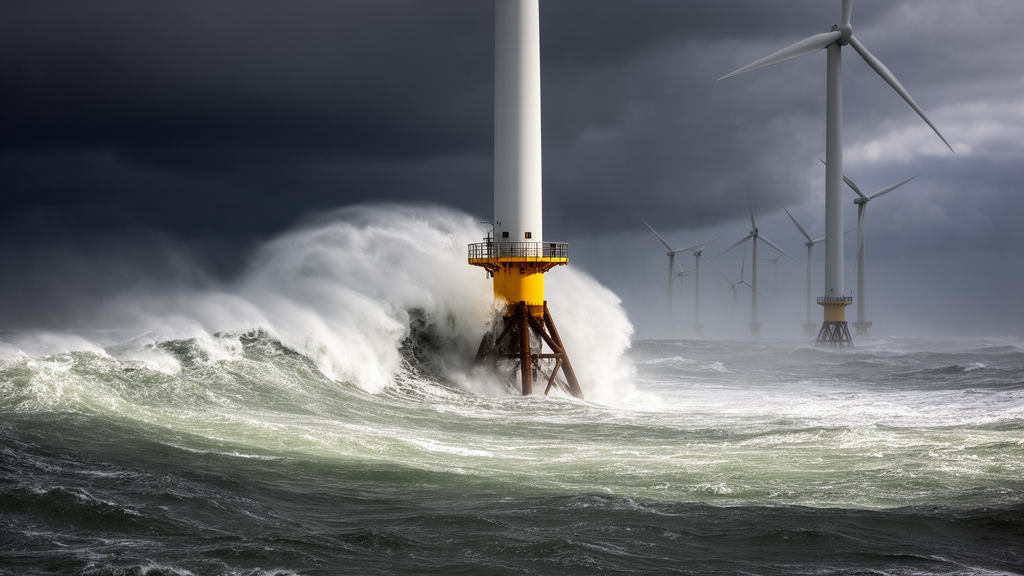
The ocean off the coast of France is quietly rewriting the rules of engineering. As the climate warms, the waves that batter the country’s three maritime seafronts are changing not only in intensity but in rhythm, with winters growing stormier and summers becoming calmer, longer, and later in the year. A new study published in Advances in Statistical Climatology, Meteorology and Oceanography by Nicolas Raillard of the French Research Institute for Exploitation of the Sea (IFREMER) and colleagues presents a statistical framework designed to capture exactly these shifts, and its findings carry direct consequences for the multi-billion-euro offshore wind industry now expanding along the French coast.
The stakes are far from abstract. France’s offshore wind sector is projected to reach a cumulative capacity of 3.6 gigawatts by the end of 2027, driven by the commissioning of seven major projects. These turbines and their foundations are engineered to survive more than two decades in one of the most hostile environments on Earth, and their designs rest on a deceptively simple statistical assumption: that the statistics of the ocean, including the mean, the variance, and above all the extremes of wave height, remain stationary over time. Climate change breaks that assumption. Rising sea levels, migrating storm tracks, and shifting seasonal patterns mean that the wave climate a turbine faces in 2080 may be fundamentally different from the one measured during the historical record used to certify it.
At the heart of the study lies a class of statistical tools known as generalized extreme value, or GEV, models. These models describe the distribution of extreme values, such as the maximum wave height recorded in a given block of time, using three parameters: a location parameter that sets the central tendency of the extremes, a scale parameter that controls their spread, and a shape parameter that governs the behavior of the distribution’s tail, which determines how catastrophic the rarest events can become. Traditionally, engineers fit a GEV distribution to annual maxima, extracting the so-called 100-year return level, the wave height expected to be exceeded on average once per century. But annual maxima throw away most of the data, leaving only one point per year and producing wide, often impractically large, uncertainty bands.
Raillard and his team took a different route. Instead of annual maxima, they modeled monthly maxima, which multiplies the available data by a factor of twelve. The catch is that monthly maxima are not identically distributed, because wave climate is strongly seasonal. To handle this, the researchers turned to Generalized Additive Models, allowing the location and scale parameters of the GEV distribution to vary smoothly across the months of the year using spline functions, flexible curves fitted to the data. The shape parameter, notoriously difficult to estimate, was held constant. From the fitted monthly distributions, the team reconstructed the distribution of annual maxima by multiplying together the twelve monthly cumulative distribution functions, an operation justified by statistical tests showing no remaining time dependence in the model residuals once seasonality was accounted for.
The framework then went a step further into genuinely non-stationary territory. The researchers extended their model so that the seasonal cycles themselves evolve over time, using spline surfaces defined over the joint space of month and year. Cyclic P-splines captured the annual seasonality, while thin plate regression splines captured its long-term drift. Fitted independently to each of eight global climate models from the CMIP6 ensemble, under both a low-emission scenario (SSP1-2.6) and a high-emission scenario (SSP5-8.5), the model could shrink gracefully to a stationary form wherever the data showed no evidence of change, while flexibly tracking complex, non-linear evolutions elsewhere. Model selection was performed using the Akaike Information Criterion, and uncertainty was quantified through a Monte Carlo procedure simulating model parameters one thousand times.
The wave data themselves came from a numerical wave model, WaveWatch III, forced by the eight CMIP6 general circulation models, covering a historical period from 1985 to 2014 and a future window from 2071 to 2100 at three-hour temporal and half-degree spatial resolution. Because global climate models are too coarse to represent local conditions accurately, the team applied a statistical bias correction known as the CDF-t method, which maps the cumulative distribution of the global model onto that of a high-resolution local reanalysis, HYWAT for the English Channel and Atlantic and MED-WAV for the Mediterranean. The correction was applied month by month at six representative offshore sites chosen to span the diversity of the French seafront, and it markedly tightened the scatter of the climate models around the reanalysis reference.
The results paint a vivid picture of a changing wave climate. At the representative site in the Eastern English Channel, historical significant wave heights, the average height of the highest third of waves, ranged roughly between 3 and 7 meters. Under the high-emission scenario, that range widens to about 2 to 8 meters, with winter extremes pushing toward 8 meters and summer minima dipping near 2 meters. Perhaps most striking is the temporal redistribution: in most models the calm summer period grows longer and peaks later in the year, with the lowest wave heights shifting from June toward July, and January extremes exceeding December values by 0.2 to 0.5 meters. The seasonal cycle itself appears to be migrating toward the end of the year, hinting that conventional definitions of the seasons may need revision in a warming ocean.
When the researchers translated these shifts into design quantities, the ensemble average of the 100-year return level rose from approximately 6.15 meters in the historical period to 6.75 meters under SSP1-2.6 and 7 meters under SSP5-8.5 at the Eastern Channel site. Across all seafronts, the equivalent lifetime design level, the wave height that should not be exceeded over the operational life of a wind farm, increased almost everywhere: from about 7.4 meters historically to 8.2 meters under the high-emission scenario in the English Channel, and from 11 to 13 meters to 13 to 15 meters along the Atlantic coast. The North Atlantic site showed a clear increase of roughly 2.5 meters. The Mediterranean told a messier story, with weaker seasonal signals, much larger inter-model spread, and some physically implausible outliers, reaching simulated wave heights of up to 20 meters with uncertainties of 30 meters, likely reflecting coarse model resolution and poorly resolved coastal dynamics in that enclosed basin.
Methodologically, the payoff of using monthly maxima was substantial. Because the model is fitted to twelve times more data, the confidence intervals around the return levels narrowed dramatically compared with the classical annual-maxima approach, which the authors note can yield spurious results when data are scarce. Compared with an earlier study reporting an uncertainty of 13.15 meters for the 100-year return level under a comparable scenario, the new method achieved a maximum uncertainty of about 10 meters, a reduction the authors attribute to the larger effective sample size. The team also introduced a new definition of the design condition itself: rather than a fixed 100-year return level, they computed the quantile of the maximum wave height over the entire lifetime of the structure, calibrated so that the cumulative probability of failure over, say, thirty years matches the conventional stationary target.
The implications ripple outward from engineering offices to energy markets. Under-designed structures face reduced operational lifespans, escalating maintenance costs, and, in the worst case, catastrophic failure, while over-conservative designs inflate capital expenditure unnecessarily. By providing a statistically rigorous, uncertainty-aware way to translate climate projections into design loads, the framework offers engineers, designers, and stakeholders a tool for building offshore wind farms that remain both safe and economically viable across decades of environmental change. The authors see their work as a starting point rather than an endpoint, pointing toward refined wave modeling along the French coastline, parametric treatments of evolving seasonality, and joint analyses of wave height and peak period under future climates. As the ocean’s moods continue to shift, the mathematics used to tame them is shifting with it.
Subject of Research: Non-stationary extreme value analysis of projected changes in significant wave height for offshore wind farm design along the French coasts
Article Title: Non-stationary GEV models for estimating design sea-states in a changing climate – applications to offshore wind farms along the French coasts
Article References: Non-stationary GEV models for estimating design sea-states in a changing climate – applications to offshore wind farms along the French coasts. (n.d.). https://doi.org/10.5194/ascmo-12-195-2026
Image Credits: AI Generated
DOI: 10.5194/ascmo-12-195-2026
Keywords: offshore wind, significant wave height, GEV distribution, non-stationary extremes, CMIP6, climate change, return levels, French coasts, English Channel, Mediterranean Sea, extreme value analysis, wave climate
Cite Scienmag News
Sloane Callahan. (October 8, 2026). Extreme Ocean Waves Are Shifting With Climate Change, Redesigning Offshore Wind Farms. Scienmag. https://scienmag.com/extreme-ocean-waves-are-shifting-with-climate-change-redesigning-offshore-wind-farms/
Sloane Callahan. "Extreme Ocean Waves Are Shifting With Climate Change, Redesigning Offshore Wind Farms." Scienmag, 8 October 2026, https://scienmag.com/extreme-ocean-waves-are-shifting-with-climate-change-redesigning-offshore-wind-farms/. Accessed 8 October 2026.
Sloane Callahan. "Extreme Ocean Waves Are Shifting With Climate Change, Redesigning Offshore Wind Farms." Scienmag. October 8, 2026. https://scienmag.com/extreme-ocean-waves-are-shifting-with-climate-change-redesigning-offshore-wind-farms/


