


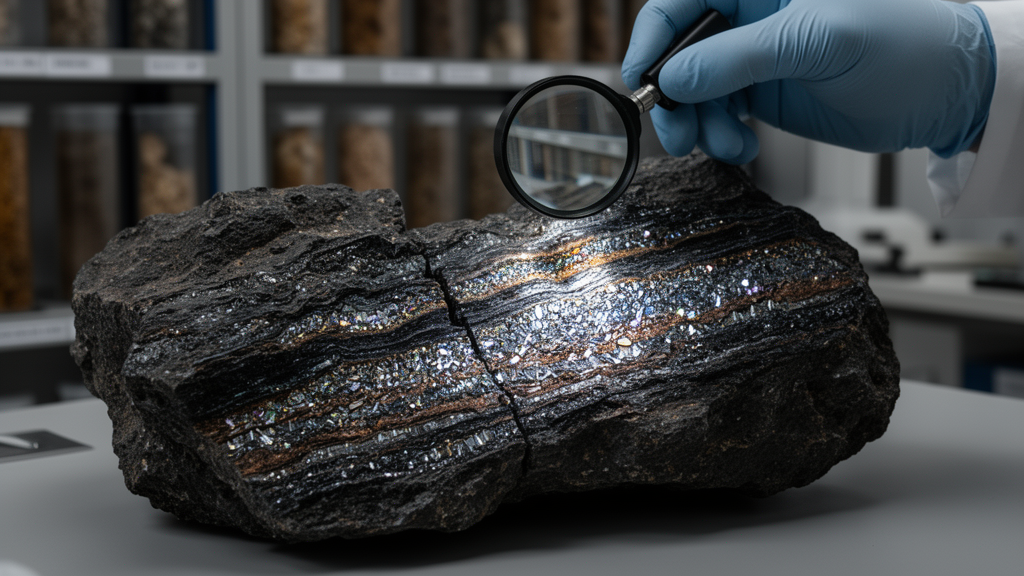
Deep beneath South Africa’s Bushveld Complex lies one of the most extraordinary mineral repositories on Earth: a vast suite of layered igneous rocks containing the largest vanadium resources in the world. The Bushveld Complex, a colossal mafic layered intrusion covering roughly 65,000 square kilometers, hosts magnetite-rich layers that are laterally continuous over tens or even hundreds of kilometers, with vanadium ore grades reaching up to 1.5 weight percent V2O5. These deposits account for approximately 30 percent of the planet’s total vanadium reserves, a metal that is indispensable for steel alloys, batteries, and emerging energy technologies. Yet a new study published in the European Journal of Mineralogy reveals that the fate of this critical metal is decided at a scale invisible to the naked eye, in microscopic intergrowth textures that determine whether vanadium can be economically extracted or remains locked away inside the rock.
The research, led by Thomas Daniel van Gerve, Philippe Muchez, Ted Nuorivaara, and Olivier Namur of KU Leuven and the Geological Survey of Finland, examined magnetite and ilmenite assemblages from drillcore samples taken in the western limb of the Bushveld Complex. The team set out to answer three interconnected questions: what variety of textures exists in the iron-titanium oxide minerals of the ore, how do these textures relate to the chemical composition of the minerals, and what do these relationships mean for the degree of mineral liberation and concentration during industrial processing. Their findings demonstrate that the microstructures formed during slow cooling of the intrusion exert a first-order control on both the vanadium content of the ore minerals and the efficiency of the beneficiation techniques used to concentrate them.
The story begins with the peculiar crystal chemistry of iron-titanium oxides. Magnetite in these ores crystallizes as a solid solution between iron-rich magnetite and titanium-rich ulvöspinel, while ilmenite forms a related series with hematite. At magmatic temperatures these solid solutions are stable, but as the intrusion cools below roughly 600 to 900 degrees Celsius, depending on the components involved, they become unstable and unmix through a process called exsolution. In addition, the ulvöspinel component within magnetite can react with oxygen to produce ilmenite and purified magnetite according to a well-known oxidation reaction. The result is an intricate family of microscopic textures, each recording a different thermal and chemical history and each carrying distinct consequences for how the ore behaves when it is crushed, ground, and separated.
The researchers identified two principal texture types in the Bushveld magnetites. The first, known as cloth texture, consists of a dense three-dimensional network of ulvöspinel lamellae exsolved along the (100), (010), and (001) crystallographic planes of the magnetite host. These lamellae are astonishingly fine, ranging from a few micrometres down to nanometres in thickness, with spacings between roughly 0.1 and 3 micrometres. When cut parallel to the exsolution planes they intersect at right angles, but along other orientations they cross at angles of 60 to 120 degrees, producing the woven appearance that gives the texture its name. Small granular and needle-like aluminum-rich spinel, up to 3 micrometres long, sometimes accompanies these lamellae, although its modal abundance is so low that its impact on processing is expected to be minor.
The second texture family comprises sandwich and trellis textures, characterized by much coarser ilmenite lamellae, roughly 10 to 300 micrometres thick, hosted within magnetite grains and spaced tens to hundreds of micrometres apart. These ilmenite lamellae form through the oxidation of the ulvöspinel component: in sandwich textures the lamellae develop along a single (111) crystallographic plane, while in trellis textures they grow along two or three sets of {111} planes, intersecting at characteristic angles. Notably, the samples with cloth textures all come from stratigraphically lower positions in the intrusion, more than 1,500 metres deep in the studied drillcore, whereas trellis-textured samples occur above 1,300 metres. The presence of residual ulvöspinel cloth in the interstitial magnetite of sandwich-textured grains indicates that these magnetites were never completely oxidized and that the sandwich ilmenite lamellae formed before the cloth texture developed.
The chemical consequences of these textures are profound. Using energy-dispersive X-ray spectroscopy on a field emission gun scanning electron microscope at KU Leuven, the team showed that vanadium is strongly concentrated in magnetite relative to ilmenite. In trellis and sandwich textures, where oxidation has converted all the ulvöspinel to near-endmember phases, ilmenite exsolutions contain 0.27 to 0.46 weight percent V2O5, while the host magnetite carries considerably more, between 0.72 and 1.14 weight percent. This enrichment arises because vanadium is three to four times more compatible in magnetite than in ilmenite, and roughly twice as compatible in endmember magnetite as in ulvöspinel. Every increment of oxidation therefore expels vanadium-poor ilmenite and concentrates the metal into the remaining magnetite, meaning that fully oxidized grains host the highest possible vanadium contents. Titanium behaves in the opposite way, being extracted from the magnetite solid solution into near-stoichiometric ilmenite lamellae with TiO2 contents of 52 to 56 weight percent.
In the cloth-textured grains the analytical picture is different. Because the ulvöspinel lamellae are thinner than the spatial resolution of any current in situ analytical technique, measurements represent mixtures of host and lamellae. These mixed compositions show V2O5 contents rising from about 1.19 weight percent at low magnetite fractions to 2.4 weight percent at higher magnetite fractions, confirming that vanadium preferentially resides in the magnetite component. The researchers attribute the compositional evolution primarily to changes in the parent magma rather than to heterogeneous exsolution, noting that the stratigraphically higher, later-crystallizing trellis samples simply derive from magmas with lower overall vanadium contents. Crucially, however, the pervasive fine intergrowth of the cloth texture means that its degree of mineral liberation, the extent to which individual minerals can be physically separated from one another, is inherently low.
This is where the study connects microscopic mineralogy to industrial economics. Every vanadium processing route begins with crushing and milling followed by magnetic separation, and the efficiency of these steps depends on grain size, intergrowths, microcracks, oxidation states, and surface defects. For sandwich and especially trellis textures, the outlook is comparatively bright. The coarser ilmenite lamellae can be liberated through conventional grinding, and emerging technologies such as high-pressure grinding rolls and microwave treatment, which generate microcracks along grain boundaries, promise to enhance liberation while reducing energy consumption. Once liberated, the larger ilmenite-bearing grains can be separated from vanadium-bearing magnetite by magnetic separation and further enriched by gravity methods or froth flotation, which works best on particles in the 100 to 150 micrometre range. Surface chemistry matters too: the ratio of ferrous to ferric iron on ilmenite surfaces governs the adsorption of anionic collectors such as sodium oleate, and activation with sodium persulfate can further improve flotation performance.
Cloth textures present a far more stubborn challenge. Even a theoretical complete liberation of the cloth structure would require grinding to particle sizes so fine that enrichment becomes nearly impossible, not to mention the immense energy demand such comminution would entail. In the flotation-optimal size range, the ilmenite surface area available to collectors is too small to render particles sufficiently hydrophobic, while at sizes below 20 micrometres gangue minerals form slime coatings that act as depressants and non-selective entrainment carries fine particles into the concentrate. Micro-flotation technologies for fine fractions offer a possible route forward, but they remain under investigation. In any realistic mining scenario, ores containing all texture types cannot be segregated into separate processing streams, so the authors argue that efficient utilization demands carefully planned beneficiation chains combining selective blasting, high-pressure grinding, and a sequence of unit operations designed for different particle size ranges with strategically positioned re-grinding stages.
Ultimately, the study delivers a message that resonates far beyond the Bushveld: the microscopic architecture of ore minerals, forged hundreds of millions of years ago as a magma chamber slowly cooled, dictates the economic viability of critical metal extraction today. Oxidation-driven exsolution simultaneously upgrades the vanadium grade of residual magnetite and purifies titanium into separable ilmenite, but only when the resulting textures are coarse enough to liberate. As global demand for vanadium grows with the expansion of vanadium redox flow batteries and high-strength steels, and as new layered intrusions from Canada to China to Australia are evaluated for exploitation, detailed textural characterization before processing may prove to be one of the cheapest and most powerful tools available for maximizing metal recovery and minimizing wasted energy in the beneficiation of the world’s vanadium-titanium endowment.
Subject of Research: Exsolution textures in Fe–Ti oxide minerals and their control on vanadium and titanium beneficiation in the Bushveld Complex
Article Title: The impact of exsolution textures in Fe–Ti oxide minerals on crushing strategies and vanadium and titanium pre-concentration
Article References: van Gerve, T. D., Muchez, P., Nuorivaara, T., & Namur, O. (2026). The impact of exsolution textures in Fe–Ti oxide minerals on crushing strategies and vanadium and titanium pre-concentration. European Journal of Mineralogy, 38(4), 545-556. https://doi.org/10.5194/ejm-38-545-2026
Image Credits: AI Generated
Keywords: vanadium, titanium, Bushveld Complex, magnetite, ilmenite, exsolution textures, ore beneficiation, mineral processing, layered intrusions, titanomagnetite, froth flotation, critical metals
Cite Scienmag News
Violet Maxwell. (October 8, 2026). Microscopic Mineral Textures Hold the Key to Unlocking the World’s Largest Vanadium Deposit. Scienmag. https://scienmag.com/microscopic-mineral-textures-hold-the-key-to-unlocking-the-worlds-largest-vanadium-deposit/
Violet Maxwell. "Microscopic Mineral Textures Hold the Key to Unlocking the World’s Largest Vanadium Deposit." Scienmag, 8 October 2026, https://scienmag.com/microscopic-mineral-textures-hold-the-key-to-unlocking-the-worlds-largest-vanadium-deposit/. Accessed 8 October 2026.
Violet Maxwell. "Microscopic Mineral Textures Hold the Key to Unlocking the World’s Largest Vanadium Deposit." Scienmag. October 8, 2026. https://scienmag.com/microscopic-mineral-textures-hold-the-key-to-unlocking-the-worlds-largest-vanadium-deposit/


