


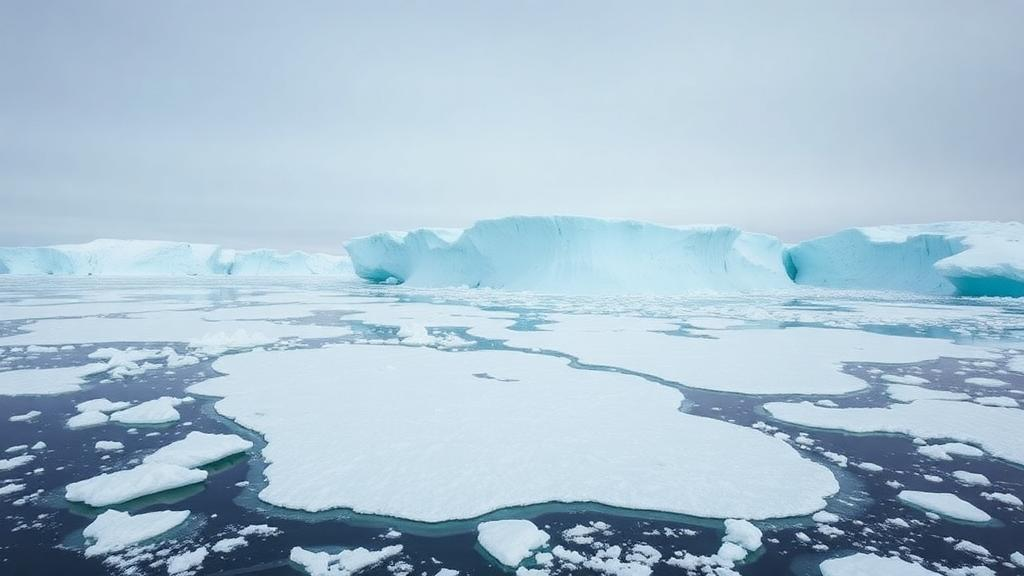
Antarctic sea ice has spent the past decade behaving in ways that no one predicted. After decades of gradual expansion between 1979 and 2015, the frozen fringe surrounding the southernmost continent suddenly produced a string of unprecedented lows: the austral summers of 2016–2017 and 2021–2022 shattered records, and the austral winter of 2023 delivered an even more startling blow, when sea ice failed to recover during the season when it should have been growing fastest. Some scientists now argue that these events signal a genuine regime shift in the dynamics of the Southern Ocean. A new study published in Nonlinear Processes in Geophysics by Andrew Axelsen of the University of Tasmania and CSIRO, together with Terence O’Kane, Courtney Quinn and Andrew Bassom, offers a fresh and technically sophisticated window into what was happening in the atmosphere during those critical years, and the answer lies in weather patterns that simply refused to move.
The team’s central innovation is methodological. Most previous investigations of anomalous sea ice have relied on averages over fixed windows — a month here, a season there — or on stationary statistical tests that assume the underlying climate behaves the same way throughout the record. Both approaches have blind spots. Short-lived but impactful atmospheric events can be averaged into oblivion, while longer-lived patterns can be artificially chopped in half by arbitrarily chosen calendar boundaries. Axelsen and colleagues instead turned to an unsupervised machine learning framework known as Finite Element Method Bounded Variation Vector Autoregressive modelling, or FEM-BV-VAR, which allows the data itself to decide when one atmospheric regime ends and another begins.
The technical machinery is worth unpacking. The researchers assembled daily reanalysis data from the NCEP-NCAR Reanalysis Project spanning 1959 to 2024, covering the entire Southern Hemisphere at a resolution of 2.5 degrees in latitude and longitude — 73 by 144 grid points for each of 24,046 days. They combined geopotential heights at three levels of the troposphere (850, 500 and 200 hectopascals) with sea ice concentration data, applying a principal component analysis via multivariate singular value decomposition to compress this enormous dataset. The leading twenty principal components, explaining 56 percent of the total variance, were then fed into the FEM-BV-VAR algorithm, which searched across 72 combinations of hyperparameters — the number of metastable states, the memory length of the model, and the allowed persistence — to find the configuration that minimised reconstruction error under ten-fold cross-validation.
The winning model identified four metastable atmospheric states, each a distinct large-scale circulation pattern that the coupled atmosphere–sea ice system can occupy for days to months at a time. From the daily probabilities of occupying each state, the team derived a Viterbi path — essentially a best-guess sequence of which state dominated on any given day — and then applied discrete-time Markov chain transition matrices over sliding windows of up to thirty days. This allowed them to extract what they call persistent background events: contiguous stretches, lasting from ten days to more than two months, during which one atmospheric pattern remained prominent. Crucially, the boundaries of these events were defined by the dynamics themselves rather than imposed in advance, making the analysis genuinely non-stationary in a way that monthly averages can never be.
Applying this framework to 2016 revealed a year of mounting atmospheric tension. Ten persistent events unfolded across the year, most correlating strongly with the Southern Annular Mode, the ring of westerly winds that encircles Antarctica. But the story darkened as the year progressed. Positive surface temperature anomalies began to accumulate over the continent from March onward, gradually trapping heat over the entire Antarctic landmass by October. A deep Amundsen Sea Low — a centre of low pressure over the southeastern Pacific with surface pressure anomalies plunging below minus 2,400 geopotential metres — appeared in September, coinciding with the onset of the major sea ice retreat. By December, the pattern had shifted into what the authors call the Antarctic warming pattern, a continent-wide warm anomaly, just as sea ice concentration collapsed.
The 2021–2022 event told a strikingly different story. Rather than the asymmetric, wave-like patterns of 2016, the atmosphere in 2021 cycled through a sequence of increasingly zonal — that is, longitudinally uniform — flow regimes. Anomalously warm air was entrained over Dronning Maud Land, the Weddell Sea and the Ross Sea by persistent onshore winds, and by late October a general warming pattern covered the entire Antarctic continent and sea ice zone. From September onward, an Amundsen Sea Low signature persisted through nearly every remaining event, though notably shallower than the deep lows of 2016. The result was a zonally uniform contraction of sea ice extent — a smooth, hemispheric-scale melt rather than the patchy, regionally concentrated decay of earlier events.
The 2023 case was stranger still, because the record low unfolded during autumn and winter, when sea ice should have been expanding. The year opened with zonal atmospheric patterns that gradually gave way to wavetrains. A combined Southern Annular Mode and Amundsen Sea Low pattern in mid-year pushed winds into the Antarctic Peninsula, suppressing ice growth in the Bellingshausen Sea and contributing to a record low maximum extent. Later, a Pacific–South American pattern brought a high-pressure system extending from the Amundsen Sea across the Bellingshausen Sea into the Weddell Sea, accompanied by surface temperatures up to ten degrees Celsius above normal across most of the continent — except over the Weddell Sea itself, which stayed cold. The consequence was a lopsided melt season: ice collapsed almost everywhere else while Weddell Sea ice lingered, eventually pulling the annual anomalies back toward neutral by December.
Comparing the three years, the authors draw a crucial distinction between thermodynamic and dynamical drivers. Warming alone, they find, cannot account for the rate and spatial heterogeneity of the ice losses. Instead, the character of each event was set by the persistent synoptic patterns that accompanied it. The Amundsen Sea Low accelerates melting by strengthening offshore winds that push ice northward away from the Ross Sea while transporting warm air toward the Antarctic Peninsula. The Pacific–South American patterns act as a bridge between tropical climate modes such as El Niño and high-latitude Antarctic circulation. The zonal wave-3 pattern redistributes ice through cyclonic and anticyclonic flow, advecting warm air southward in some sectors and cold air northward in others. Even the Southern Annular Mode, long treated as a primary suspect, appears in this analysis to act most often in concert with the Amundsen Sea Low rather than as an independent driver — and the authors suggest that the negative SAM phase recorded in late 2016 may have been coincidental rather than causal.
The methodological lesson may prove as important as the physical one. Stationary analyses tuned to a single timescale tend to filter out patterns that evolve faster or slower than the chosen window: the zonal wave-3 signature in late 2021 would have been smoothed away by monthly averaging, while the Antarctic warming pattern of 2016 risked being truncated by calendar boundaries. By letting the events define their own duration, the non-stationary approach captured both. The authors point toward natural extensions — coupling sea ice with ocean temperatures, applying the framework to other reanalysis products such as ERA5 and JRA-55, and ultimately building full atmosphere–ocean–ice models within the same machine learning architecture. As Antarctic sea ice continues to confound expectations, tools that respect the inherently non-stationary character of the climate system may become indispensable for understanding whether the frozen continent has entered a new and unsettling era.
Subject of Research: Atmospheric drivers of recent record low Antarctic sea ice events
Article Title: Covariations between persistent synoptic features and record low Antarctic sea ice events via unsupervised regression learning
Article References: Covariations between persistent synoptic features and record low Antarctic sea ice events via unsupervised regression learning. (n.d.). https://doi.org/10.5194/npg-33-455-2026
Image Credits: AI Generated
Keywords: Antarctic sea ice, machine learning, unsupervised regression, Amundsen Sea Low, Southern Annular Mode, zonal wave-3, Pacific-South American pattern, reanalysis data, Markov transition matrices, non-stationary climate analysis, sea ice retreat, Southern Ocean
Cite Scienmag News
Teresa Odom. (October 8, 2026). Machine Learning Reveals Stubborn Weather Patterns Behind Antarctic Sea Ice Collapse. Scienmag. https://scienmag.com/machine-learning-reveals-stubborn-weather-patterns-behind-antarctic-sea-ice-collapse/
Teresa Odom. "Machine Learning Reveals Stubborn Weather Patterns Behind Antarctic Sea Ice Collapse." Scienmag, 8 October 2026, https://scienmag.com/machine-learning-reveals-stubborn-weather-patterns-behind-antarctic-sea-ice-collapse/. Accessed 8 October 2026.
Teresa Odom. "Machine Learning Reveals Stubborn Weather Patterns Behind Antarctic Sea Ice Collapse." Scienmag. October 8, 2026. https://scienmag.com/machine-learning-reveals-stubborn-weather-patterns-behind-antarctic-sea-ice-collapse/


