


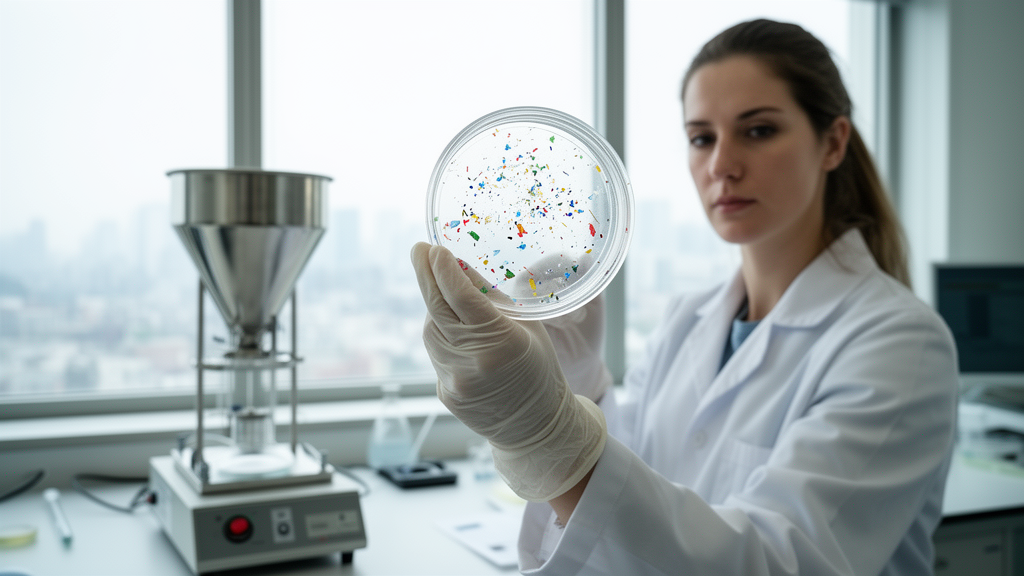
The air around you is not just carrying dust and pollen. It is carrying plastic. A sweeping new review published in Environmental Monitoring and Assessment has synthesized 161 peer-reviewed studies conducted between 2021 and 2025, and the picture that emerges is stark: atmospheric microplastics have become a truly ubiquitous pollutant, detectable from megacity smog to Antarctic snow, from hospital wards to the foothills of the Himalayas. The review, led by Lei Cao and Ming Lei of Hunan Agricultural University together with colleagues at the Tibet Academy of Agricultural and Animal Husbandry Sciences, offers the most consolidated assessment yet of what these airborne particles are, where they come from, how they move, and what they may be doing to human bodies.
At the most basic level, atmospheric microplastics are plastic particles smaller than five millimeters that have become suspended in air, with fibers and fragments dominating the observed morphologies. The review identifies three primary engines of emission: the release of fibers from textiles, the progressive degradation of larger plastic debris under sunlight and mechanical stress, and direct industrial emissions. Polymer compositions vary markedly by region, reflecting local economies and land use, so the plastic signature of a coastal textile hub differs from that of a desert agricultural region or a dense urban core. Photoaging studies cited in the review show that humidity itself plays a mechanistic role in how plastics break down in air, with water molecules influencing the oxidation processes that fragment particles into ever smaller sizes.
One of the review’s most consequential technical findings concerns how scientists measure this pollution. The authors report a systematic discrepancy of one to two orders of magnitude between active sampling, which draws air through a pump and filter, and passive sampling, which relies on particles settling onto collection surfaces. That gap means the two most common measurement approaches are not simply interchangeable, and comparisons across studies must account for methodology. The review also highlights persistent weaknesses in standardization: sampling protocols, detection limits, and identification techniques vary widely across laboratories, and particles at the nanoscale remain largely beyond the reach of routine detection, even though surface-enhanced Raman spectroscopy and machine-learning-assisted identification of individual nanoplastics represent promising recent advances.
Geographically, the 2021 to 2025 literature has pushed the frontier of microplastic science into some of the planet’s most remote environments. Studies documented microplastics in Antarctic snow and in bulk atmospheric deposition along coastal Victoria Land, on Mount Everest, and across the Tibetan Plateau, including urban, rural, and wildland settings. Transport mechanisms are now far better understood than they were five years ago. The East Asian summer monsoon has been shown to efficiently carry airborne microplastics onto the continent, typhoon events over the South China Sea enhanced atmospheric microplastic loads, and dust storms entrain plastic particles from potential source regions and loft them into long-range atmospheric circulation. Airborne concentrations fall off exponentially from megacity to open ocean, but the atmosphere clearly functions as a global conveyor for plastic debris.
Seasonal and meteorological drivers shape these distributions in consistent ways. Rainfall washes particles out of the atmosphere, producing measurable deposition pulses in urban waters, while dry seasons allow accumulation of suspended particles. Coastal and inland cities differ in their winter microplastic profiles, as demonstrated by comparative work in Beijing and Shanghai, and monsoon winds can carry plumes from landfills across coastal cities in India. Desert agricultural regions, karst wetlands in Guilin, the North China Plain, and peri-urban Patna have all yielded distinct deposition signatures tied to local climate, human activity, and land use. The review emphasizes that these patterns are regulated by an interplay of climate, emissions, and environmental parameters rather than by any single factor.
Indoor air, however, may be where human exposure concentrates most intensely. The review finds that indoor and outdoor concentrations are significantly influenced by ventilation conditions, localized point sources, and environmental parameters. Studies of indoor environments reveal striking hotspots: nail salons generate airborne plastic particles from cosmetic applications, subway stations in Istanbul carry their own microplastic loads, hospitals in Iran and India show measurable settled-dust contamination, and educational institutions in megacity Bangladesh are not exempt. Residential buildings in a Middle Eastern study showed seasonal differences in settleable microplastics between warm and cool months. Because people spend the majority of their time indoors, and because indoor sources such as synthetic textiles, furniture, and flooring continuously shed fibers, the indoor environment arguably represents the primary exposure arena for most of the global population.
The exposure pathway of greatest concern is inhalation. The review states that particles smaller than ten micrometers can readily penetrate respiratory barriers, and the toxicological literature has begun mapping what happens next. Researchers have isolated microplastics from the lower airways of European citizens, detected them in human lung tissue using micro-FTIR spectroscopy, and found them in the bronchoalveolar lavage fluid of Chinese children, with associations to age, city development level, and disease features. On the mechanistic front, laboratory studies elucidate key signaling pathways, including oxidative stress and inflammatory responses, that are activated when micro- and nanoplastics interact with lung tissue. Animal work has shown that polystyrene nanoplastics combined with benzo(a)pyrene can synergistically induce lung fibrosis and inflammation via relaxin signaling in mice, and comparative evaluations suggest that toxicity depends on both polymer type and particle size.
The health implications may extend well beyond the lungs. A landmark study in the New England Journal of Medicine found microplastics and nanoplastics within atheromas, the arterial plaques implicated in cardiovascular events, and patients with detectable plastic in their plaques faced elevated risks. A global systematic review has compiled molecular and cellular evidence linking these particles to diseases of the cardiovascular, nervous, urinary, digestive, and reproductive systems. The review also notes that plastics carry chemical additives, including plasticizers and other compounds that can migrate out of the polymer matrix, adding a chemical-exposure dimension on top of the physical particle burden. Hydrophobic organic contaminants can also hitchhike on microplastic surfaces, raising concerns about particles acting as vectors for other pollutants.
Despite the rapid growth of the field, the review is candid about its limitations. Method standardization remains incomplete, making cross-study comparisons difficult. Detection of nanoscale particles is still technically constrained, leaving a potentially important size fraction undercounted. And the long-term toxicological mechanisms of chronic, real-world exposure remain poorly understood, since most laboratory studies use short durations, high doses, and limited polymer types that may not reflect the heterogeneous particle mixture people actually inhale. The authors call for cross-regional, multi-media collaborative monitoring networks, the development of highly sensitive detection technologies, deeper investigation of transport, transformation, and health hazard mechanisms, and, ultimately, the establishment of health risk-based exposure limit standards, something that currently does not exist for airborne microplastics.
What makes this synthesis resonate is its timing. In just four years, atmospheric microplastic science has moved from proving the particles exist in air to quantifying their global transport, dissecting their cellular mechanisms, and finding them embedded in human organs. The review’s authors argue that targeted pollution prevention and control now requires this scientific foundation, from textile fiber capture and industrial emission regulation to indoor ventilation strategies. As deposition studies continue to reveal plastic falling with rain in cities from Mexico City to Jakarta, and as monsoons and dust storms redistribute the debris across continents, the atmosphere has been formally recognized as a major pathway in the planetary plastic cycle. The question is no longer whether we are breathing plastic, but how much, at what particle sizes, and with what cumulative consequences, and answering that question, the review concludes, will demand a coordinated global research effort on the scale of the problem itself.
Subject of Research: Atmospheric microplastics: their characteristics, sources, human exposure pathways, and health effects
Article Title: Characteristics, sources, exposure, and health effects of atmospheric microplastics: a review of advances from 2021 to 2025
Article References: Characteristics, sources, exposure, and health effects of atmospheric microplastics: a review of advances from 2021 to 2025. (n.d.). https://doi.org/10.1007/s10661-026-15998-4
Image Credits: AI Generated
DOI: 10.1007/s10661-026-15998-4
Keywords: atmospheric microplastics, air pollution, microplastics, human exposure, inhalation, indoor air quality, nanoplastics, toxicology, oxidative stress, long-range transport, Environmental Monitoring and Assessment, health risks
Cite Scienmag News
Russell Cooper. (October 8, 2026). Plastic Rain: Four Years of Research Reveal Microplastics Now Permeate the Air We Breathe. Scienmag. https://scienmag.com/plastic-rain-four-years-of-research-reveal-microplastics-now-permeate-the-air-we-breathe/
Russell Cooper. "Plastic Rain: Four Years of Research Reveal Microplastics Now Permeate the Air We Breathe." Scienmag, 8 October 2026, https://scienmag.com/plastic-rain-four-years-of-research-reveal-microplastics-now-permeate-the-air-we-breathe/. Accessed 8 October 2026.
Russell Cooper. "Plastic Rain: Four Years of Research Reveal Microplastics Now Permeate the Air We Breathe." Scienmag. October 8, 2026. https://scienmag.com/plastic-rain-four-years-of-research-reveal-microplastics-now-permeate-the-air-we-breathe/


