


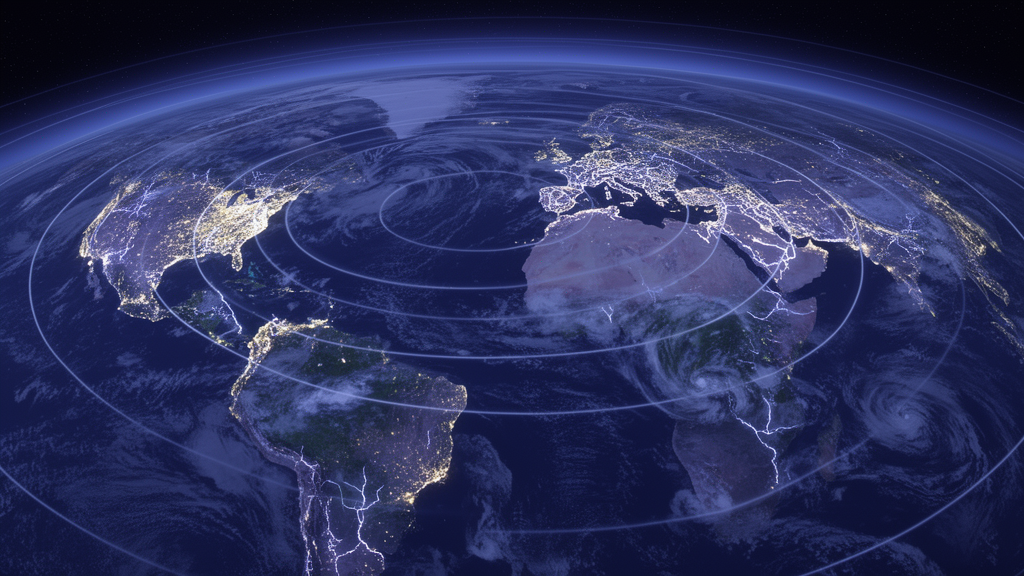
Every lightning stroke on Earth rings the planet like a bell. The discharges radiate electromagnetic energy into the thin dielectric shell of atmosphere trapped between the conducting ground and the ionosphere, and because attenuation at extremely low frequencies is remarkably weak, individual pulses can circle the globe several times before fading. The result is a set of persistent spectral peaks in the ELF band, near 8, 14 and 20 hertz, known as the Schumann resonances. For decades these resonances have been treated as a planetary seismograph of sorts, a way to sense the sum of all thunderstorm activity on Earth without ever leaving the laboratory. Now a team of researchers has shown that the resonances carry far more spatial information than anyone has been extracting from them, and they have published the formulas needed to unlock it.
Oleksandr Koloskov of the Institute of Radio Astronomy in Kharkiv, Masashi Hayakawa of the Hayakawa Institute of Seismo Electromagnetics in Tokyo, and Alexander P. Nickolaenko of the O.Ya. Usikov Institute for Radiophysics and Electronics have developed a new methodology, described in Annales Geophysicae, that allows a single observatory to deduce two key spatial characteristics of global thunderstorm activity at once: the effective distance from the observer to the center of worldwide lightning, and the effective size of the thunderstorm zone itself. Crucially, the technique works with either the vertical electric or the horizontal magnetic field component alone, which matters enormously in practice because most operational Schumann resonance observatories around the world record magnetic fields.
The underlying physics rests on a subtle but important distinction. The frequencies at which the power spectrum of the forced oscillations reaches its maximum, the peak frequencies that instruments actually measure, are not the same as the eigenfrequencies of the Earth-ionosphere cavity. Eigenfrequencies are controlled by the vertical profile of atmospheric conductivity and are independent of where lightning happens to be. Peak frequencies, by contrast, depend on the geometry between source and observer. Because the quality factor of the resonance modes typically ranges from four to ten, the spectral shape and the measured peak frequencies vary systematically with the source-to-observer distance, and it is precisely this dependence that the new method exploits.
To see how, the authors modeled a single lightning stroke as a vertical point dipole radiating inside a spherical cavity bounded below by a perfectly conducting Earth and above by an ionosphere whose conductivity profile follows published experimental parameterizations. They then computed the intensity of the resonant oscillations across the frequency-distance plane for the first two resonance modes and for both field components. The resulting maps reveal a striking asymmetry. For the first mode in the magnetic field and the second mode in the electric field, the intensity maximum sits near a source-observer distance of ten megameters and its peak frequency rises monotonically with distance, providing a direct ruler for measuring how far away the dominant thunderstorm center currently lies. For the first mode in the electric field and the second mode in the magnetic field, the opposite occurs: an inclined band of reduced intensity, the nodal zone, appears near ten megameters, where the resonant peak nearly vanishes.
The nodal zone is the key to the second half of the method. When a moving source crosses the nodal line, the peak frequency experiences a discontinuity, shifting from a convex to a concave distance dependence, a behavior that arises from the interference of adjacent resonance modes. Real global lightning, however, is not point-like. It is concentrated over a confined tropical region, so the point sources are distributed along the source-observer distance, and this spatial averaging smooths the discontinuity into a rapid but finite frequency change. The wider the region occupied by thunderstorms, the smaller the resulting frequency variation. In other words, the diurnal range of frequency variations, the difference between the daily maximum and minimum peak frequency, encodes the effective diameter of the global thunderstorm zone.
What makes the new work a genuine advance is the recognition that previous studies exploited only half of the available information. Long-term monitoring of the effective source width has been carried out using the diurnal frequency range of the first mode in the vertical electric field, while the source-observer distance has been tracked using the first mode frequency in the horizontal magnetic field. But no single station has routinely retrieved both quantities simultaneously. The authors demonstrate that this can be done in two ways: by recording the first mode frequency in both the electric and magnetic fields, or by recording the first and second mode frequencies in either field component alone. The second option is especially valuable for magnetic-field observatories, since the first magnetic mode yields the distance while the second magnetic mode yields the source size.
To turn these ideas into a practical tool, the team performed detailed computations for the Ukrainian Antarctic Station Akademik Vernadsky, located at 65.35 degrees south, which hosts one of the longest continuous series of Schumann resonance observations in the world and the longest in the polar regions. Using a full-wave solution of the resonance problem, solved via the Riccati equation with a realistic conductivity profile of the middle atmosphere, they generated calibration curves linking the measured quantities to the desired spatial parameters. The distance to the thunderstorm center follows from the first-mode magnetic peak frequency through a power-law relation, while the effective source width follows from the diurnal frequency range of the second magnetic mode through a third-degree polynomial fit with a determination coefficient of 0.9997. A complementary formula retrieves the distance from the second-mode electric peak frequency with a determination coefficient of 0.9994.
The modeling itself is a careful piece of geophysical engineering. The thunderstorm source is represented as an area centered on the equatorial point corresponding to 17:00 local time, sweeping around the globe as Universal Time advances, so that the distance from the Vernadsky observer to the source center oscillates daily between roughly 7.14 and 12.86 megameters. The finite extent of the source is accounted for by summing the field intensities of nineteen point sources distributed along the propagation arc with parabolic weights, and the peak frequency for each hour is computed using the classical Rice formula for the spectral centroid. The calculations confirm that the diurnal frequency range of the second magnetic mode decreases noticeably as the assumed size of the lightning zone grows, providing exactly the sensitivity needed to invert the measurement.
There are limitations worth noting. Using the second electric mode is complicated by secondary nodal zones at shorter and longer distances, where thunderstorm activity can perturb the observed peak frequencies. This complication is less severe for high-latitude stations like Akademik Vernadsky, where the distances to the main tropical thunderstorm centers mostly remain within the optimal seven to twelve megameter range. The authors also point out that the calibration curves are site-specific: the European mid-latitude Nagycenk Observatory in Hungary, a historic center of Schumann resonance research, would benefit from an updated site-specific calibration, and the analytical baseline derived from a uniform cavity model remains applicable to other latitudes as a first approximation.
The broader significance extends beyond technique. Global lightning activity is a sensitive indicator of tropical convection, climate variability and the electrical coupling between the atmosphere and the ionosphere, yet it is notoriously difficult to monitor continuously from space or from sparse ground networks. A method that lets any single magnetic-field observatory, using nothing more exotic than the frequencies of the planet’s electromagnetic hum, track both where the world’s thunderstorms are and how much territory they cover, turns a passive geophysical curiosity into a genuine remote-sensing instrument. As the authors conclude, the methodology is transferable to any Schumann resonance observatory worldwide, which means the planet’s own resonance cavity can now be read as a comprehensive, always-on monitor of its most violent weather.
Subject of Research: Retrieving the spatial distribution of global thunderstorm activity from observed Schumann resonance frequencies in the Earth-ionosphere cavity
Article Title: Deducing spatial characteristics of global thunderstorm activity using the observed Schumann resonance frequencies
Article References: Koloskov, O., Hayakawa, M., & Nickolaenko, A. P. (2026). Deducing spatial characteristics of global thunderstorm activity using the observed Schumann resonance frequencies. Annales Geophysicae, 44(2), 949-957. https://doi.org/10.5194/angeo-44-949-2026
Image Credits: AI Generated
DOI: 10.5194/angeo-44-949-2026
Keywords: Schumann resonances, global lightning activity, thunderstorms, Earth-ionosphere cavity, ELF electromagnetics, atmospheric electricity, ionosphere, remote sensing, Antarctic observatory, calibration curves, geophysics, Annales Geophysicae
Cite Scienmag News
Caitlin Barrett. (October 8, 2026). Lightning’s Planetary Hum: New Formulas Turn Schumann Resonances Into a Global Thunderstorm Radar. Scienmag. https://scienmag.com/lightnings-planetary-hum-new-formulas-turn-schumann-resonances-into-a-global-thunderstorm-radar/
Caitlin Barrett. "Lightning’s Planetary Hum: New Formulas Turn Schumann Resonances Into a Global Thunderstorm Radar." Scienmag, 8 October 2026, https://scienmag.com/lightnings-planetary-hum-new-formulas-turn-schumann-resonances-into-a-global-thunderstorm-radar/. Accessed 8 October 2026.
Caitlin Barrett. "Lightning’s Planetary Hum: New Formulas Turn Schumann Resonances Into a Global Thunderstorm Radar." Scienmag. October 8, 2026. https://scienmag.com/lightnings-planetary-hum-new-formulas-turn-schumann-resonances-into-a-global-thunderstorm-radar/


