


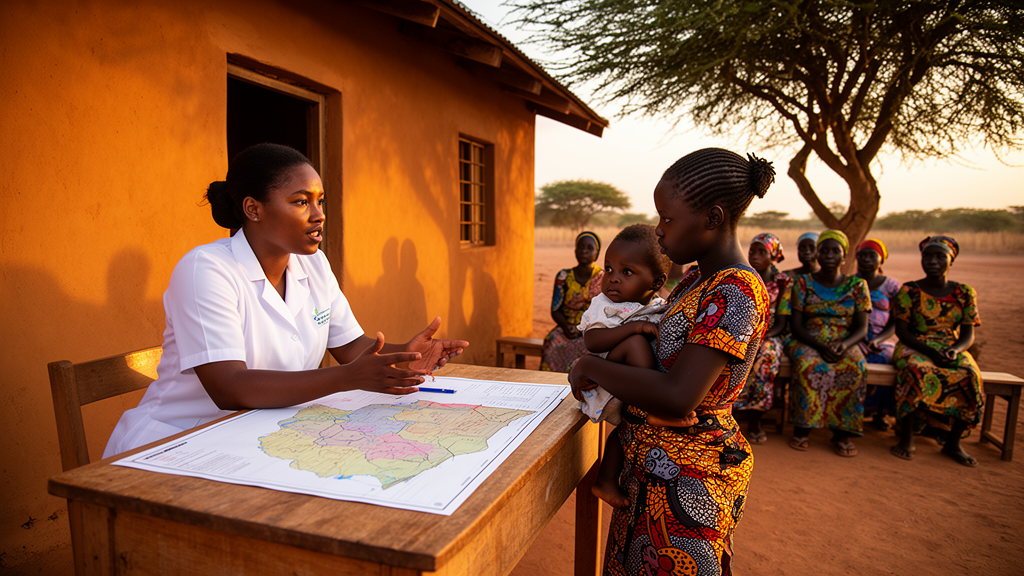
In one of the most detailed portraits yet of contraceptive service delivery in West Africa, researchers have linked a census of more than 3,000 health facilities in Burkina Faso with a nationally representative survey of nearly 7,000 women of reproductive age, and the picture that emerges is one of striking paradox. Family planning services are, on paper, almost everywhere: 82 percent of the 2,757 health facilities assessed reported offering some form of contraception, and short-acting and long-acting reversible methods were available in more than 98.6 percent of facilities. Yet fewer than one in a hundred facilities — just 0.7 percent — offered the full range of contraceptive possibilities. A woman may be able to obtain pills or injectables in her village clinic, but if she wants an intrauterine device or a contraceptive implant, the nearest facility that can reliably provide one may be far away, and the study shows that who gets to reach such a facility is shaped sharply by age, education and wealth.
The research, published in BMC Health Services Research, was led by Danielle Yugbaré Belemsaga of the Institut de Recherche en Sciences de la Santé in Ouagadougou, together with colleagues from the Université Joseph Ki-Zerbo and the Institut Africain de Santé Publique. The team took an unusual analytical approach for a low-income setting: rather than examining supply and demand separately, they fused two large cross-sectional datasets using geographic coordinates. The facility side came from the Harmonized Health Facility Assessment, a census covering 3,056 health facilities across the country, from rural health posts known as CSPS — Centres de Santé et de Promotion Sociale — up to regional and university hospitals. The population side came from the Performance Monitoring for Action survey, a nationally representative study of 6,947 women of reproductive age that recorded each respondent’s location with GPS precision.
The geospatial linkage is the technical heart of the study. Each woman in the survey was connected to her nearest health facility using Euclidean distance — the straight-line distance between two points on a map — and the researchers applied a five-kilometer threshold as the benchmark for geographic accessibility. This cutoff is widely used in health services research because walking five kilometers, particularly in hot climates or during pregnancy, represents a substantial burden of time and effort. By combining the facility census with the female survey, the analysts could ask not just whether clinics offer contraception, but whether the women who most need those services can actually reach them, and how the probability of access varies across social groups.
The indicators the team constructed covered three dimensions drawn from the World Health Organization’s service-availability and readiness framework: the offering of family planning services at all, the provision of short-acting methods such as oral contraceptives and injectables versus long-acting methods such as implants and intrauterine devices, and the accessibility of facilities offering any modern contraceptive method. On the first two dimensions, the news is largely encouraging. More than 98.6 percent of facilities stocked and provided both short- and long-term methods, a coverage figure that reflects years of investment by Burkina Faso’s Ministry of Health in integrating contraception into basic primary care. The near-universal availability of methods at facilities that offer family planning, however, sits uneasily beside the finding that only 0.7 percent of facilities offered every possibility — meaning the comprehensive, full-choice service that international guidelines envision remains vanishingly rare.
It is on the third dimension — who can physically reach a facility offering at least one modern contraceptive method within five kilometers — that the study’s most consequential findings appear. Geographic accessibility was significantly higher among women aged over 20, among those with higher education, and among women from wealthier households. In other words, the burden of distance falls disproportionately on the youngest women, the least educated, and the poorest — precisely the groups in whom unmet need for contraception tends to be highest and in whom unintended pregnancy carries the gravest consequences, including school interruption, unsafe abortion and maternal mortality.
The logistic regression models quantified these disparities with unusual clarity. Women aged 20 to 24 were 2.6 times more likely than adolescent girls aged 15 to 19 to have access to a health facility offering all contraceptive methods. Education produced a steep gradient: women with primary education were 1.3 times more likely to reach a facility providing short- and long-term methods than women with no schooling, while women with secondary education were 2.05 times more likely, both results statistically significant at the p < .01 level. Wealth amplified the pattern further — women from wealthier households were 3.7 times more likely to have such access, again with p < .01. These are associations from cross-sectional data, so the study cannot prove that distance itself causes lower contraceptive use among disadvantaged women, but the consistency of the gradient across age, education and wealth makes a compelling case that geography and social position compound each other.
The adolescent finding deserves particular attention. In Burkina Faso, as across much of the Sahel, teenage fertility remains among the highest in the world, and adolescent girls face formidable barriers to contraception that go beyond physical distance, including stigma, provider judgment and the fear of being seen entering a family planning clinic. The new data add a structural layer to that picture: even before social barriers come into play, a 15-to-19-year-old in Burkina Faso is markedly less likely than a woman in her early twenties to live within reach of a facility offering the full method mix. Any strategy that aims to reduce teenage pregnancy, the authors suggest, must therefore treat geographic inequity as a core problem rather than an afterthought.
Methodologically, the study demonstrates the power of linking routine facility censuses with population surveys through geospatial data — an approach that has become feasible as tools such as Open Data Kit for electronic data collection and GPS-enabled enumeration have spread through survey programs. The Burkina Faso analysis drew on the country’s health data warehouse, Endos-BF, and on the Performance Monitoring for Action platform, which is supported by the Bill & Melinda Gates Foundation and an anonymous donor. The facility component received ethical approval from the Ethics Committee for Health Research, while the household and female component was cleared both by the Johns Hopkins University Bloomberg School of Public Health and by Burkinabè authorities. The authors report no competing interests, and the article is published open access under a Creative Commons license.
The study’s limitations are those inherent to its design. Euclidean distance understates true travel time in a country where roads may be unpaved, seasonal flooding can cut off villages, and transport is scarce; a straight-line five kilometers may in practice mean an hour or more of travel. The facility census captures what is available, but readiness in the fuller WHO sense — trained staff on duty, equipment functioning, commodities in stock on the day of the visit — is harder to verify from a census alone, and the authors themselves flag gaps in service readiness alongside the geographic ones. Cross-sectional data also cannot capture movement over time, so the analysis is a snapshot rather than a trend line.
Even so, the implications for policy are concrete. Burkina Faso has already expanded the nominal availability of contraception to the vast majority of its health facilities; the remaining challenge, the authors conclude, is quality and equity — ensuring that facilities can offer the complete method mix, that commodities and trained providers are consistently present, and that the adolescents, the less educated and the poor are not systematically farther from comprehensive care. Strengthening service quality while deliberately targeting geographic and socioeconomic disparities, they argue, is the route to equitable access to modern contraception. For a country where family planning is among the most cost-effective interventions for maternal and child survival, the message of this facility-by-facility map is clear: the last mile of contraceptive access will not be closed by building clinics alone, but by deciding who those clinics are built to serve.
Subject of Research: Availability, readiness and geographic accessibility of family planning services in Burkina Faso
Article Title: Availability, readiness and accessibility of family planning services in Burkina Faso: analysis from health facilities and population cross-sectional data
Article References: Availability, readiness and accessibility of family planning services in Burkina Faso: analysis from health facilities and population cross-sectional data. (n.d.). https://doi.org/10.1186/s12913-026-15771-w
Image Credits: AI Generated
DOI: 10.1186/s12913-026-15771-w
Keywords: family planning, contraception, Burkina Faso, health facilities, geographic accessibility, health services research, service readiness, adolescent health, health equity, geospatial analysis, West Africa, reproductive health
Cite Scienmag News
Ophelia Keating. (October 8, 2026). Contraception Within Reach? Burkina Faso’s Family Planning Gap Mapped Facility by Facility. Scienmag. https://scienmag.com/contraception-within-reach-burkina-fasos-family-planning-gap-mapped-facility-by-facility/
Ophelia Keating. "Contraception Within Reach? Burkina Faso’s Family Planning Gap Mapped Facility by Facility." Scienmag, 8 October 2026, https://scienmag.com/contraception-within-reach-burkina-fasos-family-planning-gap-mapped-facility-by-facility/. Accessed 8 October 2026.
Ophelia Keating. "Contraception Within Reach? Burkina Faso’s Family Planning Gap Mapped Facility by Facility." Scienmag. October 8, 2026. https://scienmag.com/contraception-within-reach-burkina-fasos-family-planning-gap-mapped-facility-by-facility/


