


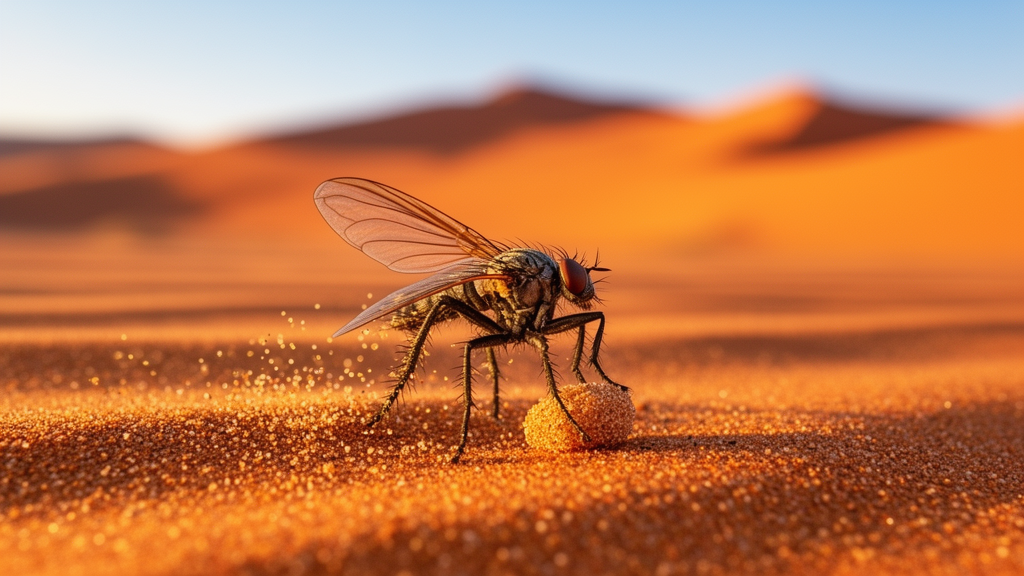
Deep in the southern Namib Desert, where fog drifts inland from the Atlantic and sand plains stretch toward the horizon, a small predatory fly has been hiding in plain sight. Entomologists Tayler Blee, Allan Cabrero and Torsten Dikow have published a comprehensive review of the assassin-fly genus Acnephalomyia in the journal African Invertebrates, describing one species new to science and reshuffling the known ranges of several others. The work, published on 31 October 2025, brings the recognised diversity of this genus in Namibia and South Africa to seven species, four of which are now confirmed from the southern Namib Desert alone.
Assassin flies belong to the family Asilidae, a group of predatory true flies renowned for their ambush tactics. Like their namesake, these insects are efficient hunters: adults perch on the ground or on vegetation and dart out to seize other insects mid-flight, piercing them with a stout, bristly proboscis and injecting paralyzing saliva. The subfamily Willistonininae, to which Acnephalomyia belongs, is a small and enigmatic lineage restricted largely to arid southern Africa, making its members valuable indicators of how desert biodiversity is organised at fine spatial scales.
The new species, formally named Acnephalomyia metallicoindica, was collected in the northern parts of the southern Namib Desert. Its name hints at a metallic sheen that distinguishes it from close relatives. In the course of the review, the authors also reassessed a single paratype specimen of Acnephalomyia iota that had been recorded from Namibia, and concluded that it actually belongs to the newly described species. That decision restricts A. iota to the Northern Cape Province of South Africa, a subtle but taxonomically significant correction that changes how conservationists and ecologists should interpret the ranges of both species.
Alongside the new species, the paper documents several additional collecting events for Acnephalomyia eremia, a species previously known from limited material. These records significantly extend the known geographic range of A. eremia within the southern Namib Desert, suggesting that the genus may be more widespread and locally abundant than museum drawers had implied. The other two species recorded in the region, Acnephalomyia andrenoides and Acnephalomyia platygaster, round out a four-species assemblage that now serves as a baseline for future monitoring.
To make this diversity accessible, the authors provide detailed diagnoses, high-resolution photographs, specimen occurrence data and an illustrated dichotomous identification key to all species of the genus. They also updated the key to the Asilidae genera of the Afrotropical Region so that it now accommodates every species of Acnephalomyia. Both keys are hosted online on the Lucid Keyserver, and all specimen images have been uploaded to a dedicated image repository, allowing researchers anywhere in the world to verify identifications without travelling to museum collections.
The study area is defined with unusual precision. The southern Namib Desert, as treated in the paper, is chiefly outlined by the Namib-Naukluft National Park and adjacent areas to the east, with nature reserves and road networks used to draw sharper boundaries than broad ecoregion maps allow. This matters because assassin flies are poor dispersers tied to specific soil and vegetation conditions, so even modest changes in the delimitation of the study area can alter which species are expected to occur where.
Beyond taxonomy, the paper situates the flies in their ecological and historical context. The authors discuss the distribution, biology and occurrence of each species within biodiversity hotspots as defined by Conservation International, and they analyse seasonal imago flight activity, the window of the year when adult flies are on the wing. Such phenological data are rare for desert insects and provide a practical guide for future collectors hoping to encounter these elusive predators during their brief adult lives.
The review also pays tribute to the human history of Namib Desert entomology. The knowledge of Diptera and other Asiloidea species is summarised alongside accounts of important early collectors of specimens and the museums that house their material, with particular attention to the Gobabeb Namib Research Institute. Founded in the heart of the desert, Gobabeb has served for decades as a staging point for researchers studying one of the oldest deserts on Earth, and many of the specimens underpinning this new species description were gathered during expeditions associated with that institution.
Why does a single new fly species from a remote desert merit international attention? The answer lies in what Acnephalomyia represents. Desert ecosystems are often assumed to be species-poor, yet each careful survey of the Namib reveals hidden diversity, much of it endemic and vulnerable to climate change, mining and infrastructure development. Predatory flies sit high in the arthropod food web, regulating populations of other insects, and their presence or absence can signal shifts in ecosystem health long before larger animals respond. Documenting their taxonomy is the first step toward tracking those signals.
The full study, including the species descriptions, keys and distribution maps, is published in African Invertebrates, volume 66, issue 2, pages 251 to 271, under the title Namib Desert Asiloidea (Diptera) 1. A review of the assassin-fly genus Acnephalomyia Londt, 2010 (Asilidae) with the description of a new species. With seven species now recognised across Namibia and South Africa and an updated identification toolkit freely available online, the genus Acnephalomyia stands as a model for how modern, digitally integrated taxonomy can transform our understanding of life in one of the planet’s harshest landscapes.
Subject of Research: Taxonomic review and new species description of assassin flies in the southern Namib Desert
Article Title: Namib Desert Asiloidea (Diptera) 1. A review of the assassin-fly genus Acnephalomyia Londt, 2010 (Asilidae) with the description of a new species
Article References: Namib Desert Asiloidea (Diptera) 1. A review of the assassin-fly genus Acnephalomyia Londt, 2010 (Asilidae) with the description of a new species. (n.d.). Original publication
Image Credits: AI Generated
DOI: Not provided
Keywords: Acnephalomyia, Asilidae, Namib Desert, new species, taxonomy, Diptera, entomology, biodiversity, African Invertebrates, identification key, Namib, Desert
Cite Scienmag News
Gavin Prescott. (October 16, 2026). New Assassin Fly Species Emerges from the Namib Desert’s Sand Dunes. Scienmag. https://scienmag.com/new-assassin-fly-species-emerges-from-the-namib-deserts-sand-dunes/
Gavin Prescott. "New Assassin Fly Species Emerges from the Namib Desert’s Sand Dunes." Scienmag, 16 October 2026, https://scienmag.com/new-assassin-fly-species-emerges-from-the-namib-deserts-sand-dunes/. Accessed 16 October 2026.
Gavin Prescott. "New Assassin Fly Species Emerges from the Namib Desert’s Sand Dunes." Scienmag. October 16, 2026. https://scienmag.com/new-assassin-fly-species-emerges-from-the-namib-deserts-sand-dunes/


