


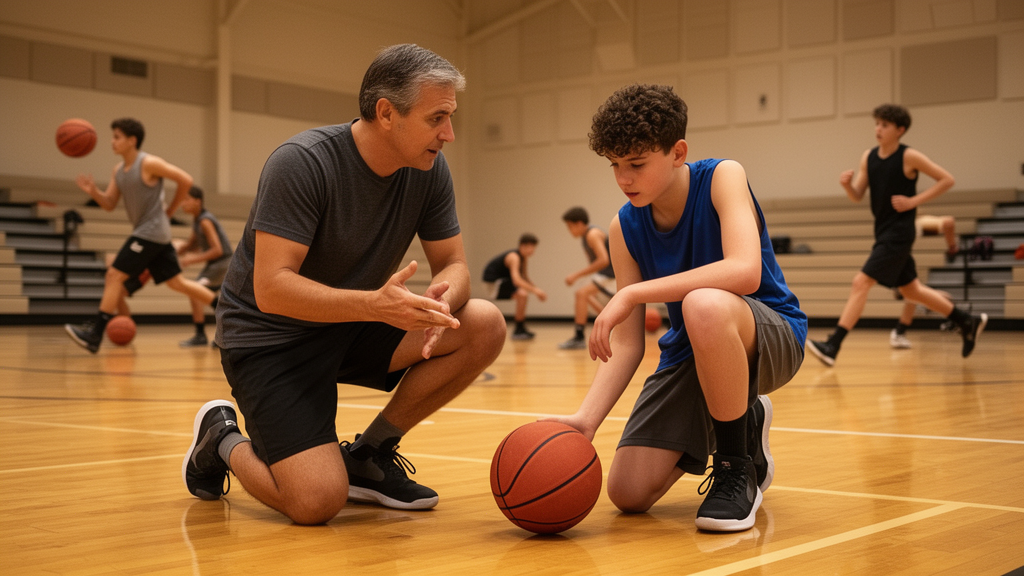
In basketball classes, a rushed shot or a pass to a marked teammate is more than a technical slip. It is a public event, witnessed by peers and the teacher, and how the instructor responds in the seconds afterward may shape how much students learn from it. A new randomized instructional study published in Frontiers in Psychology suggests that when teachers respond to tactical errors with a structured, positive routine, students in a game-centered basketball program make measurably better decisions on the court, and the gains persist for at least three weeks after instruction ends.
The research, conducted by Shen Fan of Anyang Vocational and Technical College in China, embedded a comparison of two post-error response styles within an otherwise identical Teaching Games for Understanding (TGfU) curriculum. TGfU is a well-established pedagogical model in which modified games and tactical problems come before or alongside focused skill practice, and guided questioning connects what students perceive, decide, and do during play. Rather than asking whether TGfU works, the study asked a subtler question: given the same curriculum, the same teacher, and the same tactical questions, does the way a teacher handles a visible tactical error change how students learn to decide?
Sixty college students without substantial competitive basketball experience were individually randomized within gender strata before two instructional classes were formed, each with thirty students. One class received TGfU combined with positive error-handling, or PEH; the other received the same curriculum with neutral error-handling, or NEH. In both conditions, the teacher used identical core prompts at every planned feedback episode: What did you see? What options were available? Why did you choose that action? Only when a predefined tactical error remained evident after those common questions did the condition-specific script begin.
The two scripts differed in a carefully specified way. In the PEH condition, the teacher acknowledged the error in neutral, learning-oriented language, kept the original learner’s turn and gave at least five seconds of additional wait time, used a cue to support self-correction rather than supplying the answer, invited one or two alternative solutions from peers, and explicitly framed the error as useful information while preventing ridicule. In the NEH condition, the teacher respectfully identified the less functional choice, explained the relevant cue, stated a preferred option, and offered a replay. Ridicule was prohibited in both conditions, making NEH an educationally credible active comparison rather than a neglectful baseline.
Tactical decision-making was assessed through standardized 3-on-3 half-court games at pretest, posttest, and a three-week retention test. Every eligible pass, dribble or drive, and shot was coded on a three-point scale using a focused adaptation of the Basketball Learning and Performance Assessment Instrument, with the decision context immediately preceding each action determining the rating. A technically missed but tactically justified open shot, for example, still counted as an adequate decision. Two blinded coders achieved strong agreement across more than 800 paired event ratings, with a linear weighted Cohen’s kappa of 0.779 and an intraclass correlation of 0.838.
The results showed a significant condition-by-time interaction for decision-making. The PEH class improved from a mean of 1.951 at baseline to 2.304 at posttest and 2.295 at retention, while the NEH class rose from 1.902 to 2.114 and then 2.087. Both groups learned, as expected from a genuine curriculum, but the PEH advantage was statistically significant at both posttest and retention. Action-specific analyses revealed significant interactions for passing and shooting but not for dribbling or driving, a pattern the author notes may partly reflect unequal decision opportunities during fixed-duration games.
Psychological safety, measured with a context-adapted version of Edmondson’s seven-item scale, also showed a significant condition-by-time interaction. Students in the PEH class gained 0.462 points on the five-point scale, a statistically significant increase, whereas the 0.129-point gain in the NEH class was not significant. An exploratory within-subject mediation analysis within the PEH condition estimated an indirect effect of 0.160, with a bootstrap confidence interval from 0.100 to 0.221, indicating that students who reported larger increases in perceived safety also tended to show larger improvements in tactical decision-making over the same eight-week interval.
The author is careful about what this mediation result does and does not establish. Because psychological safety and decision-making were assessed over the same pre-post interval, the analysis captures concurrent within-person covariation rather than temporal precedence or causal mediation. The design also carries a structural limitation: each condition was implemented in only one instructional class, so classroom-specific influences such as peer norms and shared interactions cannot be separated from the condition effect, and the inferential statistics were not adjusted for within-class dependence. The findings are therefore presented as exploratory at the student level, and the author calls for future studies with multiple classes per condition, cluster-randomized designs, and measurement of psychological safety before subsequent decision-making outcomes.
Why might the way errors are treated matter so much in a game-centered physical education setting? The theoretical argument rests on the public, embodied nature of basketball learning. Modified games make decisions visible, and a learner who expects embarrassment or status loss after a mistake may rationally avoid the ball, choose low-risk actions, or stay silent during tactical questioning. Such behavior undermines precisely the experimentation and explanation through which TGfU is expected to work. A teacher who pauses, invites revision, and blocks ridicule communicates that an imperfect action does not threaten belonging, which may allow students to verbalize uncertainty, compare their rule for action with alternatives, and re-enter play with a corrected decision.
The practical implications are deliberately modest. Teachers do not need to praise every mistake or suspend performance standards; a usable sequence is to pause, allow a few seconds for reconstruction, ask what information was noticed, compare one or two options, and replay. Distinguishing decision quality from technical outcome remains essential, since an open shot that misses can reflect good judgment while a contested shot that happens to score can remain a poor decision. If replicated across multiple classrooms and populations, this line of research suggests that the social treatment of errors may be a lever for improving tactical learning that costs little to implement but could meaningfully change how students engage with the hardest part of invasion games: deciding what to do next.
Subject of Research: Effects of positive error-handling within TGfU-based basketball instruction on tactical decision-making and perceived classroom psychological safety
Article Title: Positive error-handling in TGfU-based basketball instruction: effects on tactical decision-making and the role of perceived classroom psychological safety
Article References: Fan, S. (2026). Positive error-handling in TGfU-based basketball instruction: effects on tactical decision-making and the role of perceived classroom psychological safety. Frontiers in Psychology, 17, Article 1984425. https://doi.org/10.3389/fpsyg.2026.1984425
Image Credits: AI Generated
DOI: 10.3389/fpsyg.2026.1984425
Keywords: basketball, TGfU, error-handling, psychological safety, tactical decision-making, physical education, randomized trial, sport psychology, game-centered pedagogy, error climate, retention, teaching games for understanding
Cite Scienmag News
Glenn Wilkins. (October 16, 2026). How Teachers Handle Mistakes May Shape Basketball Students’ Tactical Decision-Making. Scienmag. https://scienmag.com/how-teachers-handle-mistakes-may-shape-basketball-students-tactical-decision-making/
Glenn Wilkins. "How Teachers Handle Mistakes May Shape Basketball Students’ Tactical Decision-Making." Scienmag, 16 October 2026, https://scienmag.com/how-teachers-handle-mistakes-may-shape-basketball-students-tactical-decision-making/. Accessed 16 October 2026.
Glenn Wilkins. "How Teachers Handle Mistakes May Shape Basketball Students’ Tactical Decision-Making." Scienmag. October 16, 2026. https://scienmag.com/how-teachers-handle-mistakes-may-shape-basketball-students-tactical-decision-making/


