


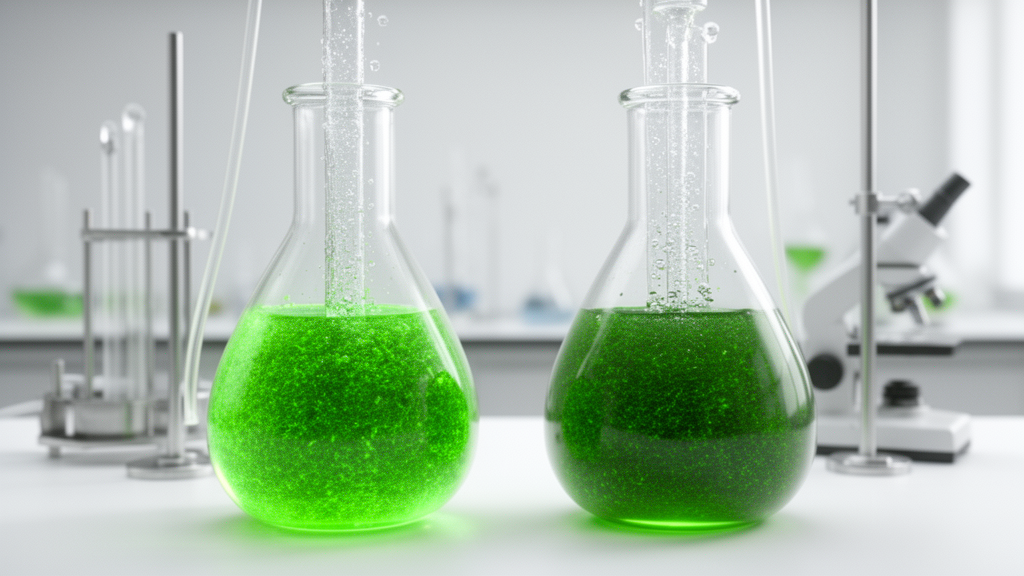
Every liter of ethanol distilled from sugarcane leaves behind roughly thirteen liters of vinasse, a dark, acidic, nutrient-loaded slurry that Brazil’s ethanol industry produces at a staggering scale. During the 2025/2026 harvest, the country generated about twenty-six billion liters of ethanol and nearly 340 billion liters of vinasse. Traditionally, this waste is sprayed onto cane fields as fertilizer, but repeated applications can salinize and acidify soils, alter microbial communities, and leach nutrients into groundwater and rivers. A new study published in Frontiers in Industrial Microbiology now shows that vinasse, once properly treated, can serve as a complete culture medium for microalgae at full strength—no dilution required—and that some species actually grow faster in this industrial waste than in a standard synthetic laboratory medium.
The research team, led by Vitória G. Navarrete of São Paulo State University and Ana T. Lombardi of the Federal University of São Carlos, set out to answer three questions: Can microalgae be cultivated in 100 percent vinasse? How does algal growth change vinasse’s organic composition? And can vinasse-grown cultures serve as inoculum for successive cultivation cycles? The answers carry real weight for the circular bioeconomy, because microalgae can simultaneously remediate wastewater and produce biomass for biofuels, pigments, and animal feed.
The vinasse came from Usina Santa Lucia in Araras, São Paulo, and was treated using a patented method (INPI BR 102015024100-3) that percolates the effluent sequentially through coarse sand, smectite clay, and activated carbon. This low-cost filtration retained particulate material, reduced turbidity, and adjusted the pH from 4.0 to about 7.0—converting the dark, opaque waste into a light, translucent liquid that allows light to penetrate, a prerequisite for photosynthetic growth. Crucially, the treatment preserved both inorganic and organic nutrients, and no sterilization was performed, so bacteria and yeasts remained in the effluent, forming a microbial consortium with the algae.
Nine microalgal species were first screened in 96-well microplates across vinasse concentrations from 50 to 100 percent. Three species—Chlorolobion braunii, Tetradesmus sp., and Haematococcus pluvialis—were selected for detailed testing in 6-well plates containing 12 milliliters of full-strength treated vinasse. The researchers compared three treatments: control cultures in BG11 synthetic medium, vinasse cultures inoculated from BG11-grown cells (V1), and vinasse cultures inoculated from cells already growing in vinasse (V2). Growth was monitored daily by cell counts under an optical microscope and by absorbance measurements.
The standout performer was C. braunii. In the V1 treatment it achieved a specific growth rate of 1.3 per day—nearly twice the 0.7 per day measured in its BG11 control, and roughly double the rates of Tetradesmus sp. (0.66 per day) and H. pluvialis (0.68 per day). Because C. braunii was the only species that grew faster in vinasse than in synthetic medium, the authors concluded it was performing mixotrophic growth, using dissolved organic carbon in the effluent as a supplementary energy source alongside photosynthesis. Mixotrophy makes irradiance less restrictive and enables algal growth in darker media, which matters industrially because organic substrates reduce dependence on light penetration.
Cell morphology told a more nuanced story. Using mixed-effects modeling on measurements of 30 cells per replicate, the team found that cell volume increased 1.6-fold in vinasse-grown C. braunii (208 cubic micrometers) and 6.3-fold in Tetradesmus sp. (250 cubic micrometers) compared with controls. H. pluvialis maintained its volume (5,575 cubic micrometers). The researchers interpret the enlarged cells as a stress response: increasing cell volume decreases the surface-area-to-volume ratio, reducing the uptake of nutrients and toxicants. Consistent with this, larger cells divided more slowly, reflected in lower growth rates—a pattern previously documented for microalgae exposed to toxic compounds such as copper and glyphosate.
The inoculum origin experiment revealed striking species-specific differences. When the inoculum came from vinasse-grown cells (V2), C. braunii’s growth rate dropped 3.2-fold to 0.4 per day and its cells became larger, reaching 1,073 cubic micrometers. Tetradesmus sp., by contrast, showed no variation in growth response—0.67 per day in V2 versus 0.66 per day in V1—though its cell volume ballooned 13.2-fold compared with the control. H. pluvialis responded to V2 by forming small cysts, a characteristic stress response of this species, and its maximum cell density fell about 60 percent below that of the control and V1 treatments.
Nuclear magnetic resonance (NMR) spectroscopy provided the chemical detective work. The ¹H NMR spectrum of raw vinasse showed signals of butyrate, isobutyrate, ethanol, acetate, succinate, isocitric acid, methanol, and 1,2-propanediol. After algal growth, acetate and butyrate signals dropped dramatically—acetate fell from 0.6754 to about 0.01 arbitrary units across all three species—indicating consumption by the microbial consortium. Acetate is a well-known inducer of mixotrophic metabolism in microalgae, while butyrate tolerance is species-dependent; previous screening of ten strains found nine experienced stress on butyrate. The vinasse’s indigenous bacteria, dominated by genera such as Lactobacillus, Megasphaera, and Bifidobacterium, can both produce and consume these volatile fatty acids, so the consortium’s metabolism likely shaped the effluent’s chemistry alongside the algae.
The most intriguing NMR finding was exclusive to H. pluvialis cultures: the appearance of cis-aconitate, a tricarboxylic acid cycle intermediate never detected in raw or treated vinasse, nor in the media of the other two species. Aconitic acid is naturally present in sugarcane vinasse but was removed during treatment. Literature shows that high light intensity, high salinity, or nitrogen starvation can drive H. pluvialis to excrete cis-aconitate to prevent mitochondrial imbalance and balance the cell’s redox state. Combined with its 60 percent growth reduction, the cis-aconitate release confirms that H. pluvialis cells were under physiological stress in vinasse. Meanwhile, citric acid present in treated vinasse was depleted after C. braunii and Tetradesmus sp. cultivation but persisted in the H. pluvialis medium, suggesting the former two assimilated it while the latter struggled at the aconitase step of the citric acid cycle.
The study’s conclusion is pragmatic: full-strength treated vinasse can serve as a viable culture medium for microalgae, but success hinges on species selection. C. braunii ranks as the most successful organism in the effluent, followed by Tetradesmus sp. and then H. pluvialis. Tetradesmus sp.’s indifference to inoculum origin makes it a robust candidate for industrial applications, since vinasse-grown cultures could seed successive cycles without synthetic medium, simplifying inoculum production and reducing operational costs. The authors caution that the microplate-scale systems used here still need verification at larger volumes, where dead zones and light variation differ from controlled laboratory conditions. Future work should focus on scaling up culture volumes to evaluate biomass and biomolecule productivity. If those hurdles are cleared, the ethanol industry could close a remarkable loop: turning its most troublesome waste stream into algae, and algae into fuel, feed, and pigment.
Subject of Research: Growing microalgae in treated vinasse: effects on cell morphology and growth rate
Article Title: Growing microalgae in treated vinasse: effects on cell morphology and growth rate
Article References: Navarrete, V. G., Ferreira, V. S., Venâncio, T., Pulgrossi, R. C., Branco, L. H. Z., & Lombardi, A. T. (2026). Growing microalgae in treated vinasse: effects on cell morphology and growth rate. Frontiers in Industrial Microbiology, 4, Article 1917607. https://doi.org/10.3389/finmi.2026.1917607
Image Credits: AI Generated
DOI: 10.3389/finmi.2026.1917607
Keywords: microalgae, vinasse, circular economy, bioremediation, mixotrophy, ethanol industry, Growing, treated, effects, cell, morphology, growth
Cite Scienmag News
Drew Townsend. (October 16, 2026). Treated Vinasse Grows Microalgae Faster Than Synthetic Medium. Scienmag. https://scienmag.com/treated-vinasse-grows-microalgae-faster-than-synthetic-medium/
Drew Townsend. "Treated Vinasse Grows Microalgae Faster Than Synthetic Medium." Scienmag, 16 October 2026, https://scienmag.com/treated-vinasse-grows-microalgae-faster-than-synthetic-medium/. Accessed 16 October 2026.
Drew Townsend. "Treated Vinasse Grows Microalgae Faster Than Synthetic Medium." Scienmag. October 16, 2026. https://scienmag.com/treated-vinasse-grows-microalgae-faster-than-synthetic-medium/


