


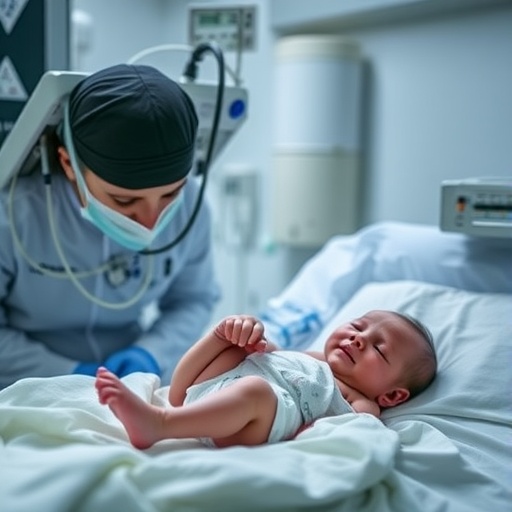
In an eye-opening exploration into the intricate nexus between social determinants of health (SDoH) and the survival of neonates undergoing extracorporeal membrane oxygenation (ECMO), recent research published in the Journal of Perinatology sheds new light on how socioeconomic and environmental factors interlace with cutting-edge medical interventions. Neonatal ECMO, a life-saving technology that oxygenates blood outside the infant’s body when their heart or lungs are critically compromised, has revolutionized care for the most vulnerable patients, yet disparities in outcomes have long puzzled clinicians. This study propels us beyond the clinical apparatus to confront the broader societal context shaping infant mortality in the most acute care settings.
ECMO functions as a formidable last-resort therapy when infants suffer from severe respiratory or cardiac failure. By cannulating the patient and diverting blood to an oxygenator, this technology temporarily replaces compromised lung and heart functions. The procedure, however, is complex and fraught with risks including bleeding, infection, and neurological injury. Previously, research has predominantly focused on physiological indicators predicting ECMO survival, but the new findings highlight a more nuanced reality: infants’ social environments deeply influence their chances of survival beyond what purely medical variables reveal.
The researchers rigorously analyzed a large cohort of infants receiving ECMO treatment, integrating comprehensive data on their social determinants, including parental income levels, education, neighborhood deprivation indices, and access to healthcare resources. Their approach uniquely combined high-resolution clinical data with granular sociodemographic metrics, applying sophisticated multivariate statistical models to isolate the effect of community and family factors on survival outcomes. This methodology marks a paradigm shift, recognizing health as a multidimensional phenomenon shaped by intersecting forces beyond the hospital walls.
One of the most striking revelations of the study was the persistent association between lower socioeconomic status and increased post-ECMO mortality. Infants born into lower-income families or residing in areas characterized by high social vulnerability experienced significantly worse survival rates despite receiving equivalent ECMO therapies. These disparities remained robust even after adjusting for confounding clinical variables such as gestational age, birth weight, and preexisting comorbidities, suggesting that the social environment exerts an independent influence on recovery trajectories during and after ECMO intervention.
The authors proposed several potential mechanisms underlying these disparities. Socioeconomic disadvantage may exacerbate pre-existing health conditions due to chronic exposure to environmental toxins, inadequate prenatal care, and maternal stress, which in turn compromises neonatal physiological reserve. Furthermore, post-discharge follow-up and rehabilitative care, essential for optimizing long-term outcomes after ECMO, are frequently less accessible to families facing structural barriers such as transportation challenges, financial constraints, and limited health literacy, potentially influencing survival and neurodevelopmental outcomes.
Intriguingly, differential access to specialized neonatal intensive care units (NICUs) was also implicated as a social determinant. The study highlighted that infants referred from under-resourced hospitals faced delays in ECMO initiation, reducing the likelihood of survival. This finding accentuates the critical role of healthcare system organization and regional disparities in shaping patient outcomes, calling for policy-level interventions to ensure equitable availability and coordination of ECMO services nationwide.
The research further delved into the impact of racial and ethnic disparities, uncovering that minority infants disproportionately suffered from adverse outcomes. This observation aligns with broader patterns of healthcare inequity documented extensively but importantly contextualizes it within the ultra-high-stakes domain of neonatal ECMO support. The study underscores the urgency of culturally tailored interventions and systemic reforms aimed at dismantling institutional biases predisposing vulnerable populations to poorer ECMO outcomes.
This comprehensive investigation also underscored the significance of parental education as a protective factor. Higher levels of caregiver education correlated with improved survival odds, potentially reflecting better health advocacy and navigation skills during the intensely complex neonatal ECMO journey. Education may enhance understanding of post-ECMO care requirements and facilitate more effective interactions with multidisciplinary care teams, thereby positively influencing infant recovery.
From a technical standpoint, the study employed cutting-edge survival analysis techniques, including Cox proportional hazards modeling adjusted for cluster effects inherent in multi-institutional data. The authors also utilized geospatial mapping to visualize the spatial distribution of social vulnerabilities juxtaposed against ECMO outcomes, providing a compelling visual analogue to statistical inferences. This integrative approach robustly captured the multilayered nature of health inequities in neonatal critical care.
The findings from this research resonate profoundly amid a global health landscape increasingly recognizing the interplay between social factors and advanced medical technologies. The study challenges narrow biomedical paradigms that attribute neonatal outcomes solely to individual physiologic states or treatment protocols, advocating instead for holistic frameworks encompassing social context as a determinant of survival. It propels a radical rethinking of how neonatal critical care units integrate social health assessments into clinical decision-making.
Looking forward, the authors call for prospective interventional studies focusing on ameliorating social disparities through targeted frameworks. Such initiatives could include enhanced community outreach programs, improved prenatal education targeting at-risk populations, streamlined referral pathways to ECMO-equipped centers, and policies fostering health equity in neonatal critical care. The imperative now is to translate these sobering insights into actionable strategies that neutralize the deleterious impact of social disadvantage on neonatal ECMO survival.
Moreover, the study’s implications extend into the realm of health policy, prompting critical examination of reimbursement models, resource allocation, and regionalized care networks. Creating equitable access to ECMO and related medical advances necessitates systemic commitments transcending the individual hospital level—underscoring the need for integrated public health and clinical strategies that address social determinants as non-negotiable components of neonatal care excellence.
This research is a clarion call for interdisciplinary collaboration, marrying neonatology, social science, and health services research. The complexity of disentangling social determinants’ impacts requires nuanced methodologies and cross-sector partnerships that bridge medicine, sociology, and policy-making. The Initiative embodies a forward-looking vision where neonatal survival metrics are augmented by social equity indices, driving both clinical innovation and social justice.
Perhaps most importantly, these findings humanize neonates treated with ECMO not merely as medical cases but as members of families and communities shaped by social realities. They compel healthcare providers to consider broader psychosocial dimensions throughout the continuum of ECMO care, embedding interventions that span medical, community, and societal spheres. This synthesis holds the promise not only of survival but of thriving beyond the neonatal intensive care unit.
Clinicians navigating the complexities of neonatal ECMO must now reckon with the sobering evidence that social determinants significantly color survival odds. Incorporating standardized assessments of socioeconomic status, family support structures, and environmental risk factors into ECMO protocols could facilitate earlier identification of at-risk infants and prompt more holistic care planning. This may include social work engagement, early multidisciplinary family-centered support, and linkage with community-based resources.
In sum, this seminal study dismantles the long-standing silos separating biomedical innovation from social realities. It advances the discourse on neonatal ECMO outcomes by illuminating the potent role social determinants of health play in shaping mortality. As ECMO technology continues to evolve, integrating social context into both research paradigms and clinical pathways emerges as an ethical imperative and a clinical necessity.
This landmark contribution not only enriches our scientific understanding but also galvanizes a collective commitment to equity in the most vulnerable frontiers of healthcare. It signals a future where neonatal ECMO success is measured not only in survival curves but in the dismantling of social barriers that disproportionately compromise infant lives. The science is clear: saving lives requires saving the social context in which those lives unfold.
Cite Scienmag News
Harold Sullivan. (April 29, 2026). Neonatal ECMO Outcomes Linked to Social Determinants. Scienmag. https://scienmag.com/neonatal-ecmo-outcomes-linked-to-social-determinants/
Harold Sullivan. "Neonatal ECMO Outcomes Linked to Social Determinants." Scienmag, 29 April 2026, https://scienmag.com/neonatal-ecmo-outcomes-linked-to-social-determinants/. Accessed 5 September 2026.
Harold Sullivan. "Neonatal ECMO Outcomes Linked to Social Determinants." Scienmag. April 29, 2026. https://scienmag.com/neonatal-ecmo-outcomes-linked-to-social-determinants/


