


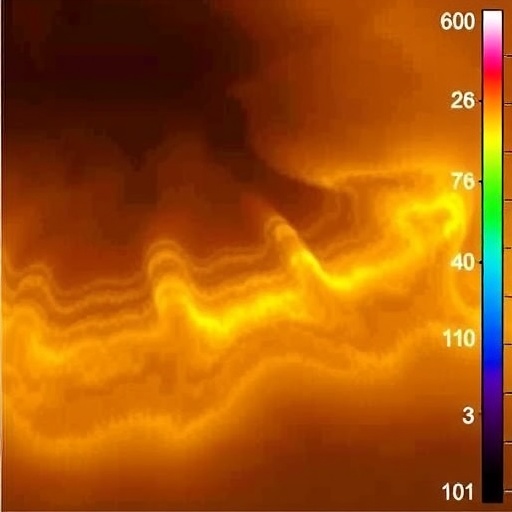
Deep within our planet lies a critical interface known as the core–mantle boundary (CMB), a region where extreme temperatures and dynamic processes converge to shape Earth’s thermal and magnetic evolution. Recent research has illuminated the intricate behaviors of heat flow at this boundary, revealing how variations here influence the geodynamo—the mechanism responsible for Earth’s magnetic field. A groundbreaking study now explores how distinctive structures in the lowermost mantle can actually reverse the expected direction of heat transfer, fundamentally altering our understanding of how the deep Earth operates.
The core’s heat output and the mantle’s behavior are intimately linked, but spatial and temporal variations in heat flux at the CMB complicate this relationship. Heat flow from the core into the mantle typically fuels convective currents in the liquid outer core, driving the geodynamo process that sustains Earth’s magnetic shield. However, recent sophisticated simulations suggest that beneath certain geological features in the mantle, heat might instead flow back toward the core, a phenomenon previously unconfirmed and challenging conventional geophysical assumptions.
Central to this discovery are large low-shear-wave-velocity provinces (LLSVPs), massive structures located at the base of the mantle. These provinces are identifiable by their diminished seismic wave speeds, which geophysicists interpret as reservoirs of anomalously hot, chemically distinct materials. The new study models these LLSVPs with enhanced thermal conductivity adjustments and accounts for excess internal heating, simulating how these features interact dynamically with heat flow near the CMB.
The simulations reveal a striking phenomenon: heat flux directly beneath LLSVPs can be locally negative. This means, counterintuitively, that heat is being transferred from the mantle back into the core. This unexpected reversal challenges prior models which generally assumed a consistent outward flow of heat from core to mantle. Such negative fluxes have profound implications not only for the thermal balance of the Earth’s interior but also for the longevity and variability of its magnetic field.
Moreover, the research underscores that throughout the base of the mantle piles associated with LLSVPs, the heat flux remains lower than the adiabatic heat flux of the core. This thermal configuration suggests a degree of regional stratification at the top of the core, potentially explaining discrepancies observed in seismic and geomagnetic data. In other words, the topmost layer of the core may be thermally segregated in ways that we had not confirmed previously.
Interestingly, the study also explores the impact of subducted slabs—denser fragments of oceanic lithosphere—that eventually reach the CMB. The arrival of these slabs triggers pronounced spikes in heat flux, dramatically increasing the heterogeneity of lateral heat flow along the core–mantle boundary. This dynamic enhances the complexity of heat exchange patterns and further influences the geodynamo’s behavior, potentially affecting geomagnetic activity on geological timescales.
A significant implication of these findings relates to so-called “superchrons,” intervals lasting tens of millions of years during which Earth’s magnetic field remains stable without reversals. The occurrence of locally negative heat flux beneath the LLSVPs might explain these long periods of geomagnetic quiescence. When heat flows reversely into the core, it can alter convection patterns in ways that suppress the typical polarity flip mechanism, shedding new light on the origin and cessation of superchrons.
The study’s approach involved advanced mantle thermochemical convection modeling that incorporates temperature-dependent thermal conductivity and internal radiogenic heating within dense mantle piles. This methodological innovation provides a more realistic representation of the mantle’s behavior at extreme conditions than previous models, enabling researchers to capture subtle but critical feedbacks influencing heat fluxes at depth.
By reconciling seismic data, which reveals complex structures in the lowermost mantle, with geomagnetic observations that hint at temporal variability in the geodynamo, this research bridges a vital gap in Earth sciences. The correspondence between the spatial extents of LLSVPs and anomalies in the geomagnetic field suggests a coupling mechanism mediated through heat flux variations being directly tied to mantle dynamics.
The nuanced understanding of heat flow gleaned from this work also carries implications for the planet’s thermal evolution over geologic time. How heat migrates across the CMB influences the cooling rate of the core, the crystallization of the solid inner core, and consequently the lifecycle of the geodynamo. The discovery that heat transfer is not unidirectional, but can locally reverse in space and time, necessitates revisiting models of Earth’s deep thermal history and magnetic field generation.
This revelation also lays groundwork for interpreting seismic tomography results with a new lens, appreciating that chemical and thermal heterogeneity in LLSVPs exerts a tangible impact on core processes. The presence of chemically distinct reservoirs affects not only the mantle’s physical properties but also its thermal gradient with direct knock-on effects for core convection patterns and magnetic field intensity.
Such interconnectedness across Earth’s deep interior underscores the planetary-scale complexity of thermal and compositional interactions driving Earth’s long-term stability. The core-mantle boundary emerges not simply as a static physical barrier but as a dynamic interface where thermal regimes, chemical signatures, and fluid motion all coalesce to modulate our planet’s magnetic heartbeat.
Future research building on these findings may sharpen our forecasts for geomagnetic field behavior, including its reversals and excursions, by incorporating the interplay of mantle structures and heat flux heterogeneity shown in this study. Understanding these processes is not merely academic; Earth’s magnetic field shields life on the surface from charged solar particles, making geomagnetic stability crucial for habitability.
In conclusion, the discovery of negative heat flux beneath LLSVPs represents a paradigm shift in understanding Earth’s deep thermal dynamics. It opens fresh avenues into interpreting Earth’s magnetic field history and its deep interior’s energy budget, challenging geoscientists to refine their models of the planet’s evolving mantle and core mechanisms. The study invites a reconsideration of how internal heat governs the interplay between mantle convection and geomagnetic phenomena, securing a pivotal advance in the geophysical sciences.
As our planet continues its ceaseless churn beneath the crust, these findings remind us that Earth’s interior is a realm of profound complexity and subtle interactions. The dance of heat and composition at the core-mantle boundary not only choreographs magnetic field generation but ultimately shapes the environment that sustains life above ground. Unlocking its secrets brings us closer to comprehending the planet’s past, present, and future in extraordinary detail.
Cite Scienmag News
Violet Maxwell. (June 17, 2026). Negative Heat Flux Under Low-Shear-Wave-Velocity Zones. Scienmag. https://scienmag.com/negative-heat-flux-under-low-shear-wave-velocity-zones/
Violet Maxwell. "Negative Heat Flux Under Low-Shear-Wave-Velocity Zones." Scienmag, 17 June 2026, https://scienmag.com/negative-heat-flux-under-low-shear-wave-velocity-zones/. Accessed 4 September 2026.
Violet Maxwell. "Negative Heat Flux Under Low-Shear-Wave-Velocity Zones." Scienmag. June 17, 2026. https://scienmag.com/negative-heat-flux-under-low-shear-wave-velocity-zones/


