


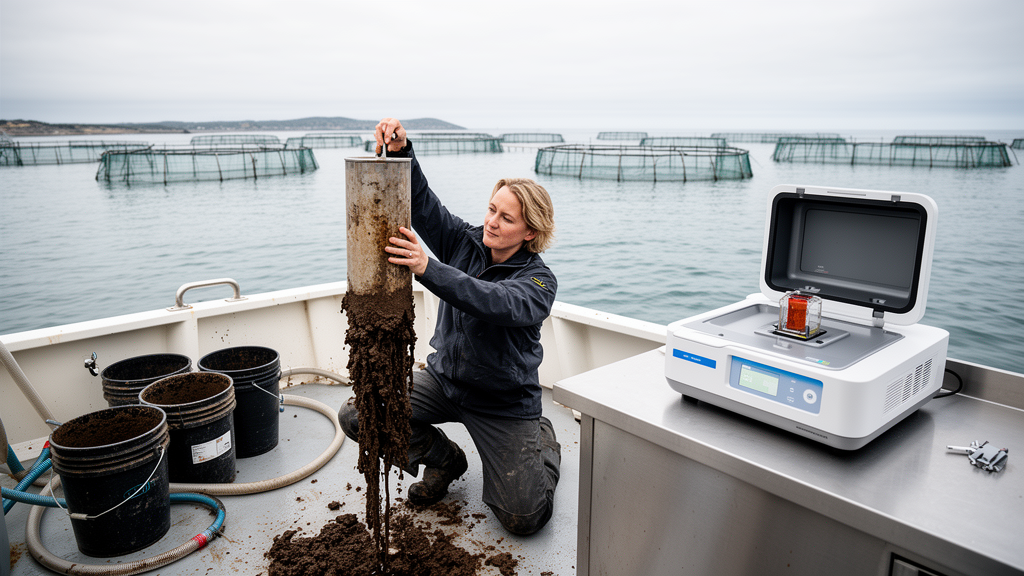
Environmental DNA (eDNA) monitoring has quietly transformed how scientists assess the health of marine ecosystems, replacing laborious manual counts of seafloor invertebrates with rapid genetic analysis of sediment samples. Now, a new pilot study from researchers working on Scottish salmon farms suggests that the technology underpinning this revolution may be on the verge of another leap forward. By testing Oxford Nanopore Technologies’ latest duplex sequencing chemistry against the industry-standard Illumina MiSeq platform, the team found that the long-read approach can reproduce the same ecological patterns as short-read sequencing while offering far richer taxonomic detail.
The study, published in the journal Metabarcoding and Metagenomics, focused on bacterial communities living in sediments around two Atlantic salmon (Salmo salar) aquaculture installations in Scotland, one located near Oban and the other in Loch Linnhe. Fish farms deposit feed and faeces on the seabed, creating a gradient of organic enrichment that radiates outward from the cage edges. Bacteria respond quickly and predictably to this enrichment, making them powerful bioindicators of environmental impact. Regulators increasingly rely on DNA-based analysis of these communities to assess whether farms are operating within permitted environmental limits.
Traditionally, such monitoring has depended on Illumina sequencing, a second-generation technology prized for its accuracy, with a median error rate of roughly 0.5 percent. But Illumina’s short reads, capped at around 500 base pairs, capture only fragments of the bacterial 16S ribosomal RNA gene, the standard taxonomic marker. These short fragments typically cannot be assigned reliably to genus or species level, which limits the ecological information that can be extracted. In contrast, Nanopore sequencers can read entire genes in a single pass, but until recently their error rates, sometimes reaching 6 to 15 percent on older flow cells, made them unsuitable for the precision demands of compliance monitoring.
The breakthrough tested in this study is duplex sequencing, a strategy in which both strands of a DNA molecule are read sequentially through the same nanopore. Because errors in one strand can be cross-checked against its complementary partner, the approach dramatically improves base-calling accuracy. Oxford Nanopore reports accuracy above 99.9 percent (a Phred score of 30 or higher) when duplex reads are combined with super-accuracy base-calling models. The research team applied this chemistry, using the new R10.4.1 flow cell and the Dorado duplex base-caller, to full-length 16S rRNA gene amplicons generated from the same DNA extracts that had been sequenced on the Illumina platform.
The results were striking. Of the high-quality Nanopore amplicon reads retained for analysis, 36 percent were duplex reads with a Phred score of at least 30, a proportion notably higher than the duplex rates of roughly 6 to 7 percent reported in previous bacterial genome-sequencing studies using the same chemistry. The authors speculate that shorter DNA fragments, such as the roughly 1,500-base-pair 16S rRNA gene, may have a higher likelihood of forming duplex molecules at the pore than the much longer fragments typical of whole-genome sequencing, though they caution that this hypothesis requires further testing.
To compare the two platforms fairly, the researchers sampled sediment along transects running from each farm’s outer cage edge, through an intermediate Allowable Zone of Effect, to a distant reference site chosen to lie beyond the influence of farm deposits. Both sequencing approaches told the same ecological story. When diversity patterns were calculated from Illumina amplicon sequence variants (ASVs) and Nanopore operational taxonomic units (OTUs), both datasets split the samples into two clear clusters: a high-impact group comprising the cage-edge samples and the more affected Allowable Zone of Effect at one farm, and a low-impact group containing both reference sites and the less affected zone at the other farm. These patterns matched independent macroinvertebrate-based assessments, which rated the cage edge of one farm as heavily disturbed while the corresponding zone at the other farm remained in good ecological condition.
Notably, the Nanopore data appeared even more sensitive than the Illumina data in distinguishing between samples. Bray-Curtis distances between bacterial communities were larger in the Nanopore dataset, and differences in Shannon diversity between sites were more pronounced. For biomonitoring, where the goal is to detect subtle environmental change before it becomes severe, this heightened sensitivity could prove a genuine advantage.
The most consequential differences emerged at the taxonomic level. On average, 86 percent of high-quality Nanopore reads could be assigned to bacterial family and 82 percent to genus, compared with only 52 percent and 50 percent respectively for Illumina reads. At the species rank the gap widened dramatically: roughly 65 percent of Nanopore reads returned a species-level identification, against a mere 15 percent of Illumina reads, and more than 99 percent of the species-level Illumina assignments belonged to rare sequence variants. When the researchers collapsed their data to family level, the two platforms agreed well, with seven of the ten most abundant families shared between datasets, dominated by sulfur-cycling bacteria typical of organically enriched sediments. But at the genus level, agreement deteriorated for the Illumina data, and the taxonomy-based clustering of samples shifted slightly, a direct consequence of short reads lacking the sequence information needed to discriminate between closely related genera.
Some discrepancies between the platforms are attributable to the different PCR primer pairs used to amplify the short V3-V4 region for Illumina and the full-length gene for Nanopore sequencing. Both primer sets are known to miss certain bacterial groups, and the stochastic nature of PCR amplification can distort relative abundance estimates. The researchers acknowledge these limitations, noting that only PCR-independent metagenome sequencing could fully eliminate such biases, though that approach remains too expensive for routine monitoring.
The practical implications are considerable. Nanopore’s MinION device is compact and comparatively affordable, which would allow individual laboratories to run their own sequencing rather than outsourcing to commercial providers, shortening turnaround times and enabling protocol optimisation for specific sample types. The full-length 16S sequences also provide more material for designing indicator-specific primers for fast, sequencing-free quantitative PCR assays. The authors conclude that eDNA-based monitoring of aquaculture impacts could be conducted equally well with improved Nanopore duplex sequencing, and they propose the logical next step: a full validation against macroinvertebrate-derived biotic indices across numerous compliance-monitoring samples, mirroring the process that established Illumina sequencing as a trusted tool for regulators.
Subject of Research: Comparing Nanopore duplex sequencing and Illumina MiSeq for eDNA-based bacterial biomonitoring of salmon aquaculture impacts
Article Title: Nanopore duplex sequencing as an alternative to Illumina MiSeq sequencing for eDNA-based biomonitoring of coastal aquaculture impacts
Article References: Stoeck, T., Katzenmeier, S. N., Breiner, H.-W., & Rubel, V. (2024). Nanopore duplex sequencing as an alternative to Illumina MiSeq sequencing for eDNA-based biomonitoring of coastal aquaculture impacts. Metabarcoding and Metagenomics, 8, Article e121817. https://doi.org/10.3897/mbmg.8.121817
Image Credits: AI Generated
Keywords: environmental DNA, Nanopore sequencing, Illumina MiSeq, duplex sequencing, 16S rRNA, aquaculture, salmon farming, biomonitoring, bacterial communities, marine sediments, metabarcoding, Scotland
Cite Scienmag News
Alan Morgan. (October 19, 2026). Nanopore Duplex Sequencing Emerges as a Rival to Illumina for Monitoring Fish Farm Impacts on the Seafloor. Scienmag. https://scienmag.com/nanopore-duplex-sequencing-emerges-as-a-rival-to-illumina-for-monitoring-fish-farm-impacts-on-the-seafloor/
Alan Morgan. "Nanopore Duplex Sequencing Emerges as a Rival to Illumina for Monitoring Fish Farm Impacts on the Seafloor." Scienmag, 19 October 2026, https://scienmag.com/nanopore-duplex-sequencing-emerges-as-a-rival-to-illumina-for-monitoring-fish-farm-impacts-on-the-seafloor/. Accessed 19 October 2026.
Alan Morgan. "Nanopore Duplex Sequencing Emerges as a Rival to Illumina for Monitoring Fish Farm Impacts on the Seafloor." Scienmag. October 19, 2026. https://scienmag.com/nanopore-duplex-sequencing-emerges-as-a-rival-to-illumina-for-monitoring-fish-farm-impacts-on-the-seafloor/


