


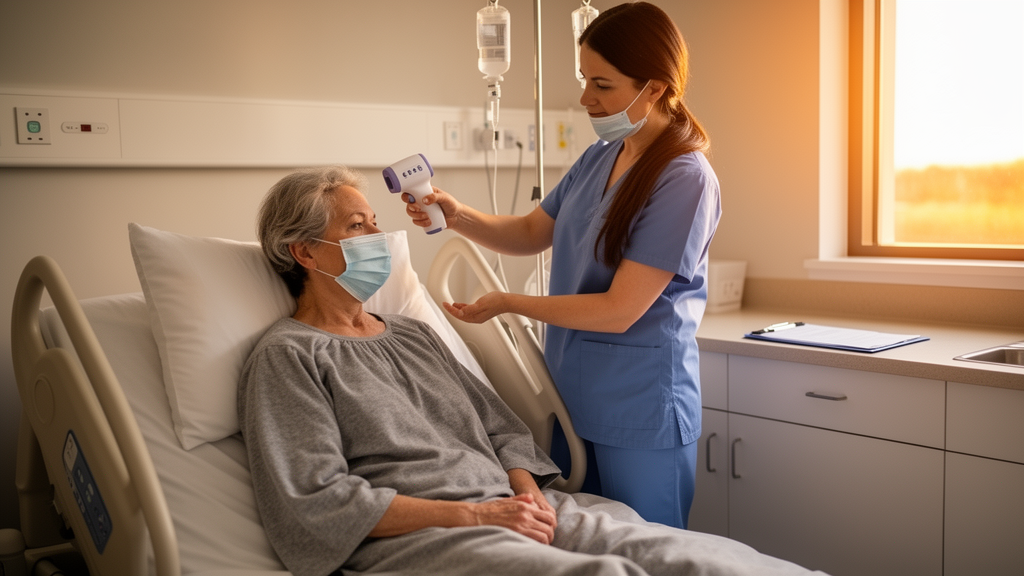
Patients recovering from autologous haematopoietic stem cell transplantation experience the dangerous stretch of severe neutropenia not as a series of isolated complaints but as shifting constellations of symptoms, and the way those constellations evolve over time determines whether they pick up the call button or wait it out in silence. That is the central finding of a qualitative study conducted in a haematopoietic stem cell transplantation unit in Wuxi, China, published in PLOS One. The research, led by Lili Jiang and colleagues including Jingfen Zhou, offers one of the most granular pictures to date of how patients appraise their own bodies during the most immunologically vulnerable phase of a transplant admission, and it carries direct implications for how oncology nurses structure monitoring and communication during protective isolation.
Autologous haematopoietic stem cell transplantation, in which a patient’s own stem cells are harvested and reinfused after high-dose chemotherapy, is a mainstay of treatment for multiple myeloma, relapsed lymphoma, and certain other haematological malignancies. The procedure works because the chemotherapy ablates the bone marrow and the reinfused cells rebuild it, but the interval between ablation and recovery leaves patients profoundly neutropenic, with absolute neutrophil counts low enough that even ordinary bacterial flora can become life-threatening. During this window, typically one to two weeks post-infusion, patients are nursed in protective isolation, monitored for fever, and managed with broad supportive care. Clinical guidelines define the danger signs clearly, yet the patients living through the window experience it from the inside, and the study set out to understand how they interpret what is happening to them.
The researchers employed a qualitative descriptive design, purposively sampling adults aged eighteen years or older who had undergone autologous transplantation and were currently neutropenic as inpatients in the transplantation unit. The sampling strategy deliberately sought variation across age, diagnosis, and treatment experience so that the findings would not reflect a narrow slice of the transplant population. Data collection consisted of semi-structured interviews, audio-recorded with consent and transcribed verbatim, conducted with twenty-two participants between post-transplant day plus five and day plus eighteen, precisely the period when neutrophil counts bottom out and begin to recover. The transcripts were then analysed using reflexive thematic analysis, an approach in which the researchers explicitly acknowledge and interrogate their own role in shaping the themes that emerge from the data rather than treating themes as if they were simply discovered.
The first major finding concerns how patients conceptualised their symptoms. Rather than reporting discrete problems such as nausea, fatigue, mucositis, or fever as separate items on a checklist, participants described them as interlocking constellations, clusters that rose and fell together and that could only be understood in relation to one another. A bout of diarrhoea paired with a new wave of fatigue carried a different meaning than either symptom alone, and the combination of oral pain with difficulty swallowing was appraised differently from oral pain in isolation. This cluster-based perception aligns with a growing body of symptom science showing that patients experience toxicity burdens holistically, but the study adds a temporal dimension that is often missing from cross-sectional symptom assessments.
That temporal dimension proved to be the hinge of the entire study. Participants did not merely catalogue what they felt; they tracked trajectories, comparing today’s symptoms with yesterday’s and using the direction of change as their primary signal. Worsening intensity, the appearance of new symptom combinations, or symptoms that simply felt different from the previous day prompted a re-appraisal of the situation from expected treatment toxicity to possible deterioration. In contrast, symptoms that followed a familiar course and matched what patients had been told to expect were often interpreted as the ordinary price of the transplant and tolerated without alarm. Fever-related patterns stood apart from this calculus: fever, or the constellation of sensations surrounding it, usually triggered immediate escalation and prompt reporting to staff, reflecting the consistent messaging patients receive about infection risk during neutropenia.
The second major finding concerns the behavioural consequences of these appraisals. Help-seeking during the neutropenic window was not uniform. The researchers identified a spectrum ranging from prompt reporting, in which patients escalated concerns to nursing staff as soon as they noticed a troubling trajectory, to watchful waiting, in which patients monitored symptoms over time before deciding whether to speak up. Some participants practised self-management first, attempting to control a symptom on their own and only reporting if their measures failed, while others withheld information altogether, choosing not to mention certain symptoms unless directly asked. These strategies were not random; they reflected deliberate calculations made under conditions of considerable uncertainty.
Three forces shaped those calculations. The first was uncertainty itself: patients often could not tell whether a symptom belonged to the expected toxicity profile or signalled something dangerous, and that ambiguity made them hesitant to act. The second was perceived legitimacy, the sense that a concern was serious enough to warrant staff attention; patients who judged their symptoms as minor or as things they should be able to endure felt reluctant to raise them. The third was a distinctly relational barrier, a reluctance to bother staff during protective isolation, where nursing contact is already frequent and patients are acutely aware of the workload their care demands. Together, these forces explain why a patient with a genuinely concerning trajectory might wait hours or a full day before mentioning it, a delay that matters enormously when the underlying risk is overwhelming sepsis in a person with essentially no neutrophil reserve.
The clinical implications follow directly from the mechanism the study describes. If patients appraise urgency by tracking symptom clusters and trajectories, then assessment tools that capture symptoms only as static lists will miss the signal patients are actually monitoring. The authors argue for cluster-informed assessment, in which nursing evaluations explicitly ask about combinations of symptoms and how they are changing from day to day, mirroring the cognitive framework patients already use. They also propose escalation coaching, structured conversations in which patients are taught which trajectories warrant immediate reporting, which symptoms can be self-managed with a defined threshold for escalation, and crucially, that reporting a concern is never a burden on staff. Such coaching could convert the watchful waiting and withholding behaviours documented in the study into earlier, safer escalation.
The study’s qualitative design means its findings describe the experiences of twenty-two patients in a single Chinese transplantation unit rather than establishing prevalence across transplant populations, and the authors are careful about the scope of their claims. Nevertheless, the mechanistic insight, that urgency appraisal is built from symptom constellations and their trajectories, is likely to generalise, because it reflects how patients anywhere must reason about their bodies when they cannot rely on laboratory values they cannot see. The work also fills a gap in the supportive care literature, which has extensively quantified symptom burden after transplantation but far less often asked patients how they decide what those symptoms mean.
For oncology nursing, the study arrives at a moment when transplantation volumes are rising globally and supportive care is increasingly delivered through protocols that assume patients will report problems promptly. The Wuxi findings suggest that assumption is fragile, and that the fix is not simply to tell patients to report everything, which ignores the legitimacy calculus and the reluctance to bother staff that the interviews revealed. Instead, the researchers point toward a partnership model in which nurses teach patients the trajectory language of danger, validate the reporting of ambiguous symptoms, and design assessment rounds that ask about clusters and change rather than isolated complaints. In a setting where a single day of delayed recognition can separate a manageable infection from a catastrophic one, teaching patients to read their own symptom constellations may prove to be one of the most cost-effective safety interventions in transplant care.
Subject of Research: Patient symptom appraisal and help-seeking behaviour during neutropenia after autologous haematopoietic stem cell transplantation
Article Title: Symptom clusters and help-seeking behaviours during neutropenia after autologous haematopoietic stem cell transplantation: A qualitative study to inform oncology nursing support
Article References: Jiang, L., Hua, J., Teng, F., Xu, T., Cao, H., & Zhou, J. (2026). Symptom clusters and help-seeking behaviours during neutropenia after autologous haematopoietic stem cell transplantation: A qualitative study to inform oncology nursing support. PLOS One, 21(10), e0361023. https://doi.org/10.1371/journal.pone.0361023
Image Credits: AI Generated
DOI: 10.1371/journal.pone.0361023
Keywords: neutropenia, autologous stem cell transplantation, symptom clusters, help-seeking behaviour, oncology nursing, qualitative research, protective isolation, fever, patient safety, supportive care, thematic analysis, haematological malignancy
Cite Scienmag News
Drew Townsend. (October 19, 2026). Symptom Clusters Drive Help-Seeking During Neutropenia After Stem Cell Transplantation. Scienmag. https://scienmag.com/symptom-clusters-drive-help-seeking-during-neutropenia-after-stem-cell-transplantation/
Drew Townsend. "Symptom Clusters Drive Help-Seeking During Neutropenia After Stem Cell Transplantation." Scienmag, 19 October 2026, https://scienmag.com/symptom-clusters-drive-help-seeking-during-neutropenia-after-stem-cell-transplantation/. Accessed 19 October 2026.
Drew Townsend. "Symptom Clusters Drive Help-Seeking During Neutropenia After Stem Cell Transplantation." Scienmag. October 19, 2026. https://scienmag.com/symptom-clusters-drive-help-seeking-during-neutropenia-after-stem-cell-transplantation/


