


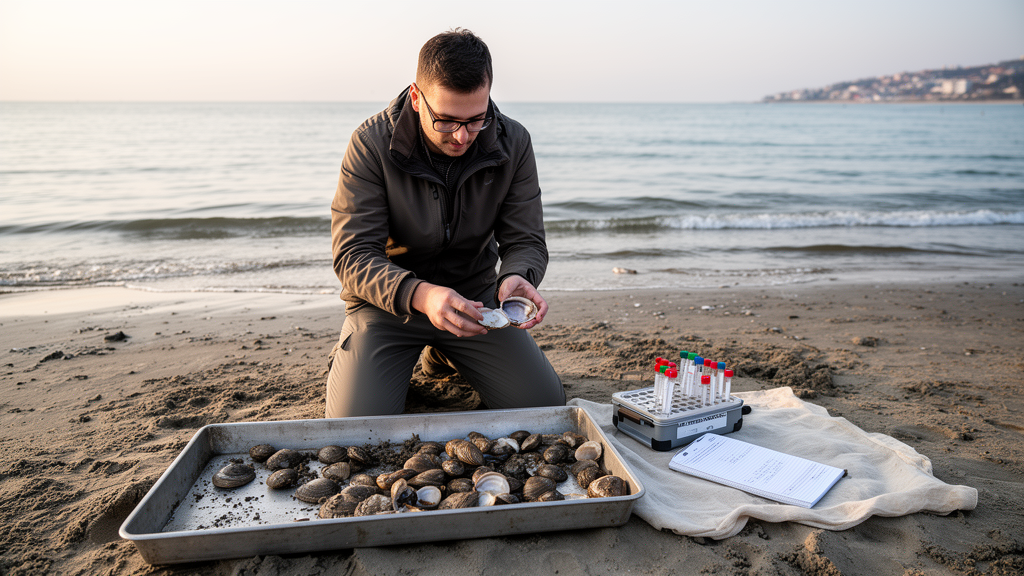
On the sandy beaches of the Bulgarian Black Sea coast, a small burrowing bivalve is quietly keeping score of human activity. The wedge clam Donax trunculus, a filter feeder barely a few centimetres long, spends its life sifting seawater and suspended particles, and in doing so it accumulates whatever trace metals drift through its habitat. A new study has now used this humble clam as a biological probe, revealing for the first time how metal contamination is distributed along Bulgaria’s coastal sandy habitats and pointing to a clear divide between the country’s northern and southern shores.
The research, published in the journal BioRisk, set out to carry out an initial screening of trace metal bioaccumulation in the soft tissues of wedge clams collected from different localities of the Bulgarian Black Sea coastal area, and to evaluate whether the species could serve as a bioindicator of metal pollution. Trace metals constitute a significant proportion of the pollutants in the Black Sea, where the highest concentrations are typically locked in marine sediments from which they can be released back into the water column. Because metals are persistent and bioaccumulative, their discharge into the Black Sea can have profound effects on the entire marine environment, and unlike many other pollutants they remain in soils and waters for hundreds to thousands of years.
Bivalves are particularly well suited to pollution monitoring because they are filter feeders and primary consumers in the Black Sea food chain, accumulating metals and other contaminants in their tissues and shells. Mussels of the species Mytilus galloprovincialis have traditionally been used as biomonitors of Black Sea metal pollution, but data on the spatial and temporal distribution of metal accumulation in benthic clam species from the Bulgarian coast has been quite scarce. Although the spatial variation of metal concentrations in sediments of the Bulgarian Black Sea coastal areas is well documented, no comprehensive studies on bioaccumulation of metal elements in clams from these habitats had been carried out before, despite the growing economic importance of clams for Bulgaria.
To fill this gap, the researchers collected wedge clams measuring 23 to 35 millimetres in length, either manually or from commercial providers, from sublittoral sandy habitats at representative localities along the Bulgarian coast. Sampling took place in June and September 2020, before and after the intensive touristic season, allowing the team to compare conditions on either side of the summer influx of visitors. The soft tissues of individual clams were digested with nitric acid and then analysed by Inductively Coupled Plasma Optical Emission Spectrometry, a technique known as ICP-OES, for the determination of seven elements: cadmium, chromium, copper, iron, nickel, lead and zinc. The measurements were carried out in the certified chemical laboratory at the Department of Chemistry of the Medical University-Varna, and differences between sites were tested statistically while patterns of similarity were explored with cluster analysis.
The results revealed that the content of trace metals in the wedge clams differed significantly amongst localities. Higher metal loads were present in clams from Sveti Vlas, Shkorpilovtsi, Slanchev Bryag, Ahtopol and Kranevo, several of them popular resort beaches. The highest values of lead, at 2.51 milligrams per kilogram wet weight, and cadmium, at 0.32 milligrams per kilogram, were found in samples from Sveti Vlas, together with high concentrations of chromium and copper. The highest concentration of copper, 34.12 milligrams per kilogram, along with the peak values of iron at 269.52 milligrams per kilogram and nickel at 0.32 milligrams per kilogram, were detected in wedge clams from Shkorpilovtsi. Maximum chromium content, 0.58 milligrams per kilogram, was present in samples from Slanchev Bryag, accompanied by high iron values, while the highest zinc concentration, 18.04 milligrams per kilogram, together with elevated chromium and iron, was measured in clams from Irakli. Varna Bay clams, meanwhile, recorded the highest June zinc value of 15.98 milligrams per kilogram among the tabulated sites.
Cluster analysis using Euclidean distance as a measure grouped the localities into two main clusters based on the similarity of metal concentrations in the clams. The first cluster comprised localities in the northern coastal area, namely Shkorpilovtsi, Sveti Vlas, Kranevo and Slanchev Bryag, with Shkorpilovtsi and Sveti Vlas showing the highest similarity, evidently due to the high accumulated levels of lead, cadmium and copper in clams sampled there. The second cluster included Primorsko, Arkutino, Sozopol and Ahtopol from the southern coastal area, with Varna Bay grouping together with Ahtopol because of the similarity of metal concentrations between them. As a whole, the levels of metal bioaccumulation in wedge clams from the northern localities were significantly higher than in clams from the southern localities, indicating different metal pollution levels in the northern and southern Bulgarian Black Sea coastal areas. Amongst the southern sites, Primorsko and Arkutino were most similar, and Ahtopol stood out as an exception, showing relatively higher values of copper, cadmium and nickel that linked it to Varna Bay instead.
The seasonal comparison, based on four localities sampled in both June and September 2020, found little variation overall. In wedge clams from Kranevo, however, the concentrations of copper, chromium and iron were significantly lower in September samples compared to June, and the content of chromium in clams from Varna Bay and Primorsko was also significantly lower in September. The researchers suggest that the observed seasonal variations were probably connected with local changes in the hydrological parameters of the ecosystems rather than with tourism alone, although the sampling design, spanning the period before and after the intensive touristic season, was chosen precisely to capture such pressures.
The study’s conclusions carry a double significance. On one hand, the wedge clams from localities known to have higher coastal inflows and touristic pressures, namely Varna Bay, Shkorpilovtsi, Sveti Vlas, Slanchev Bryag and Ahtopol, accumulated significantly higher metal elements in their tissues, confirming that the species registers the human footprint along the coast. On the other hand, the data showed that concentrations of accumulated metals in wedge clams from the studied localities were, as a whole, below the maximum residual levels prescribed by local and international regulations for seafood. Recent studies on commercial wedge clams from the Bulgarian Black Sea coast had already indicated that the species is generally safe for human consumption, and the new findings broadly support that assessment.
There was one notable exception. The high concentration of lead, 2.51 milligrams per kilogram, in wedge clams from Sveti Vlas in June significantly exceeded the national and European regulations for seafood, which set a limit of 1.5 milligrams per kilogram. This single exceedance at a busy resort beach underscores how localised metal contamination can be, and how a sentinel species can flag a problem that might otherwise go unnoticed in routine water or sediment sampling. Lead is among the trace metals of greatest toxicological concern, and its persistence in the marine environment makes such a signal particularly worth following up.
Taken together, the study establishes the wedge clam Donax trunculus as a suitable bioindicator for the assessment and monitoring of metal pollution in the Bulgarian Black Sea environment. As a filter feeder that plays a significant role in maintaining the functionality of marine ecosystems, the species can accumulate considerable amounts of trace metals while remaining abundant and accessible along sandy shores. For a coastline facing growing tourism and development pressure, the small clam buried in the sand may prove to be one of the most informative witnesses to the state of the Black Sea environment, turning every handful of beach sediment into a record of the metals that flow through it.
Subject of Research: Trace metal bioaccumulation in wedge clams as a bioindicator of pollution on the Bulgarian Black Sea coast
Article Title: Trace metal accumulation in tissues of wedge clams from sandy habitats of the Bulgarian Black Sea coast
Article References: Bachvarova, D., Stancheva, M., Ignatova-Ivanova, T., Ibryamova, S., Chipev, N., & Alexandrova, A. (2022). Trace metal accumulation in tissues of wedge clams from sandy habitats of the Bulgarian Black Sea coast. BioRisk, 17, 73-81. https://doi.org/10.3897/biorisk.17.77290
Image Credits: AI Generated
Keywords: wedge clam, Donax trunculus, trace metals, Black Sea, bioindicator, metal pollution, Bulgaria, ICP-OES, marine monitoring, bioaccumulation, Trace, metal
Cite Scienmag News
Reese Ellison. (October 19, 2026). Wedge Clams Reveal Metal Pollution Hotspots on Bulgaria’s Black Sea Coast. Scienmag. https://scienmag.com/wedge-clams-reveal-metal-pollution-hotspots-on-bulgarias-black-sea-coast/
Reese Ellison. "Wedge Clams Reveal Metal Pollution Hotspots on Bulgaria’s Black Sea Coast." Scienmag, 19 October 2026, https://scienmag.com/wedge-clams-reveal-metal-pollution-hotspots-on-bulgarias-black-sea-coast/. Accessed 19 October 2026.
Reese Ellison. "Wedge Clams Reveal Metal Pollution Hotspots on Bulgaria’s Black Sea Coast." Scienmag. October 19, 2026. https://scienmag.com/wedge-clams-reveal-metal-pollution-hotspots-on-bulgarias-black-sea-coast/


