

Monday, October 26, 2026
Science
No Result
View All Result
  • Login
  • HOME
  • SCIENCE NEWS
  • CONTACT US
  • HOME
  • SCIENCE NEWS
  • CONTACT US
No Result
View All Result
Scienmag
No Result
View All Result
Home Science News Technology and Engineering

Nanoparticle-Infused Cutting Fluids Cut Heat and Force in Stainless Steel Turning

October 26, 2026
in Technology and Engineering
Denise Maddox
By Denise Maddox Scienmag Editorial Profile - Mechanical Engineering
Reading Time: 2 mins read
0
Nanoparticle-Infused Cutting Fluids Cut Heat and Force in Stainless Steel Turning

Nanoparticle-Infused Cutting Fluids Cut Heat and Force in Stainless Steel Turning

65
SHARES
587
VIEWS
Share on FacebookShare on Twitter
ADVERTISEMENT

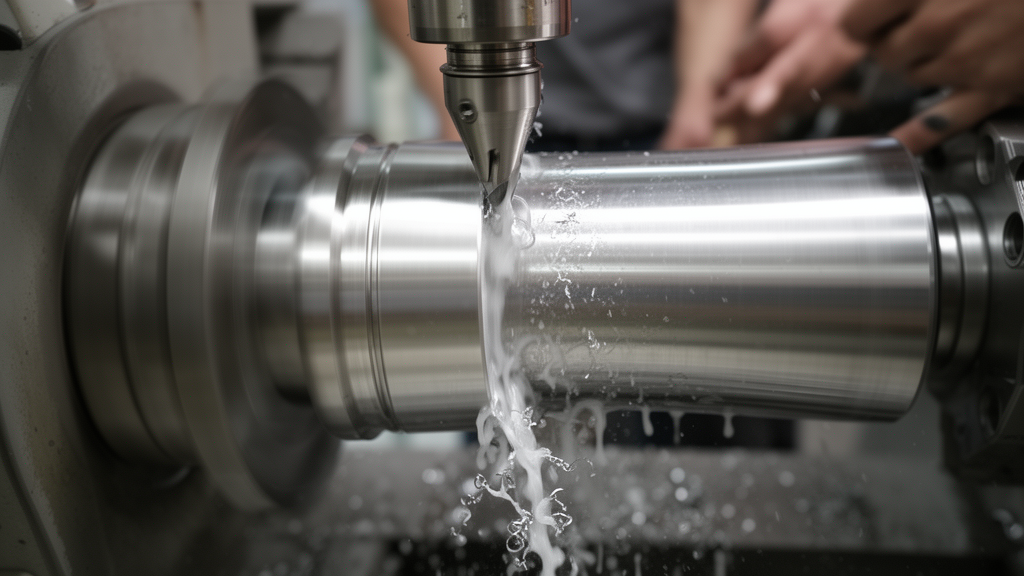
Turning AISI 304 stainless steel generates intense heat at the point where the cutting tool meets the workpiece, a problem that can shorten tool life and degrade the finished surface. A new experimental study in Scientific Reports examines whether adding metal oxide nanoparticles to a conventional cutting fluid can ease that thermal and mechanical burden. Researchers dispersed titanium dioxide (TiO₂) and zinc oxide (ZnO) nanoparticles into SAE30 emulsifier oil, testing concentrations of 1.5% and an optimized 2.25% by weight, and evaluated how each mixture altered the thermal and tribological behavior of the base fluid during precision turning operations.

The experiments were carried out on a production-grade CNC lathe using a DCMT-120,404 cutting insert. Two measurement systems quantified machining performance: a lathe tool dynamometer recorded the cutting forces acting on the tool, while a pyrometer monitored the temperature at the tool-workpiece interface. This combination allowed the team to compare how each nanoparticle-infused fluid affected both the mechanical load on the tool and the heat generated during cutting.

Among the fluids tested, the formulation containing 2.25% by weight of TiO₂ and ZnO nanoparticles delivered the strongest results, significantly reducing both cutting force and interface temperature relative to the other mixtures. The authors attribute this improvement to enhanced heat dissipation and lubrication within the cutting zone. In their interpretation, the nanoparticle-laden fluid reduces frictional interaction at the tool-chip interface, which in turn is expected to yield better surface roughness characteristics on the machined steel.

The study frames nanoparticle-dispersed cutting fluids as a means of improving machining quality in precision turning of AISI 304 stainless steel, linking the observed force and temperature reductions to the fluid’s modified thermal and tribological behavior. The reported benefits are tied to the specific formulations evaluated, with the 2.25% by weight concentration outperforming the 1.5% mixtures for both nanoparticle types.

As with any controlled machining study, the reported gains apply to the conditions tested: defined nanoparticle concentrations, a single insert geometry, and turning of one stainless steel grade on a CNC lathe. The published version is an accepted, peer-reviewed article released early for faster access, and it remains subject to further editorial edits before the final Version of Record replaces it. Readers should therefore treat the reported force and temperature reductions as experimental results tied to this particular setup rather than as universal performance figures for all cutting fluids or steel grades.

Subject of Research: Experimental analysis of TiO₂ and ZnO nanoparticle-infused cutting fluids in CNC turning of AISI 304 stainless steel

Article Title: Experimental analysis of AISI 304 stainless steel machinability utilizing TiO₂ and ZnO nanoparticle-infused emulsifier oil-based cutting fluids

Article References: Shanmugam, T., Kandasamy, V. K., Janakiraman, R., & Subramanian, R. (2026). Experimental analysis of AISI 304 stainless steel machinability utilizing TiO₂ and ZnO nanoparticle-infused emulsifier oil-based cutting fluids. Scientific Reports. https://doi.org/10.1038/s41598-026-71116-x

Image Credits: AI Generated

DOI: 10.1038/s41598-026-71116-x

Keywords: AISI 304 stainless steel, cutting fluids, nanoparticles, TiO2, ZnO, machining, CNC turning, cutting force, interface temperature, surface roughness, Experimental, analysis

Cite Scienmag News

Denise Maddox. (October 26, 2026). Nanoparticle-Infused Cutting Fluids Cut Heat and Force in Stainless Steel Turning. Scienmag. https://scienmag.com/nanoparticle-infused-cutting-fluids-cut-heat-and-force-in-stainless-steel-turning/


Denise Maddox. "Nanoparticle-Infused Cutting Fluids Cut Heat and Force in Stainless Steel Turning." Scienmag, 26 October 2026, https://scienmag.com/nanoparticle-infused-cutting-fluids-cut-heat-and-force-in-stainless-steel-turning/. Accessed 26 October 2026.

Denise Maddox. "Nanoparticle-Infused Cutting Fluids Cut Heat and Force in Stainless Steel Turning." Scienmag. October 26, 2026. https://scienmag.com/nanoparticle-infused-cutting-fluids-cut-heat-and-force-in-stainless-steel-turning/

Tags: AISI 304 stainless steelanalysisCNC lathe machining optimizationCNC turningcutting fluidscutting forcecutting force reduction techniquesExperimentalexperimental study on nanoparticle-enhanced lubricantsheat reduction in stainless steel turninginterface temperaturemachiningnanoparticle concentration effects on machining performanceNanoparticle-infused cutting fluidsnanoparticlesnanotechnology in manufacturingsurface finish improvement in stainless steel turningsurface roughnessthermal management in metal cuttingTiO2titanium dioxide nanoparticles in machiningtribological behavior of nanoparticle lubricantszinc oxide nanoparticles in cutting fluidsZnO
Share26Tweet16
Previous Post

Foam pad outperforms gauze at stripping wound biofilms in pig-skin model

Next Post

Hypomagnetic Fields Extend Lifespan but Impair Mobility in Parkinson’s Fruit Fly Model

Related Posts

Foam pad outperforms gauze at stripping wound biofilms in pig-skin model
Technology and Engineering

Foam pad outperforms gauze at stripping wound biofilms in pig-skin model

October 26, 2026
Titanium Dioxide Microsphere Scattering Layer Boosts Dye-Sensitized Solar Cell Efficiency
Technology and Engineering

Titanium Dioxide Microsphere Scattering Layer Boosts Dye-Sensitized Solar Cell Efficiency

October 26, 2026
Edible capacitive tilt sensor tracks continuous tilt for sustainable soft robotics
Technology and Engineering

Edible capacitive tilt sensor tracks continuous tilt for sustainable soft robotics

October 26, 2026
Waste powders cut concrete’s carbon footprint while boosting strength and durability
Technology and Engineering

Waste powders cut concrete’s carbon footprint while boosting strength and durability

October 26, 2026
EPICCAD benchmark gives AI the rules behind editable engineering designs
Technology and Engineering

EPICCAD benchmark gives AI the rules behind editable engineering designs

October 26, 2026
Physics-guided neural networks outperform data-only models on fractional LCR circuit
Technology and Engineering

Physics-guided neural networks outperform data-only models on fractional LCR circuit

October 26, 2026
Next Post
Hypomagnetic Fields Extend Lifespan but Impair Mobility in Parkinson’s Fruit Fly Model

Hypomagnetic Fields Extend Lifespan but Impair Mobility in Parkinson's Fruit Fly Model

  • Mothers who receive childcare support from maternal grandparents show more optimized

    Mothers who receive childcare support from maternal grandparents show more parental warmth, finds NTU Singapore study

    27656 shares
    Share 11059 Tweet 6912
  • University of Seville Breaks 120-Year-Old Mystery, Revises a Key Einstein Concept

    1061 shares
    Share 424 Tweet 265
  • Bee body mass, pathogens and local climate influence heat tolerance

    682 shares
    Share 273 Tweet 171
  • Researchers record first-ever images and data of a shark experiencing a boat strike

    546 shares
    Share 218 Tweet 137
  • Groundbreaking Clinical Trial Reveals Lubiprostone Enhances Kidney Function

    531 shares
    Share 212 Tweet 133
Science

Embark on a thrilling journey of discovery with Scienmag.com—your ultimate source for cutting-edge breakthroughs. Immerse yourself in a world where curiosity knows no limits and tomorrow’s possibilities become today’s reality!

RECENT NEWS

  • Mapping How Landscape Shapes the Hidden Side of Ethnic Heritage in Guizhou
  • Community Nurses Reveal What Makes Austrian Towns Hard Places to Grow Old In
  • Review maps five ethical domains for AI in medical education
  • Hypomagnetic Fields Extend Lifespan but Impair Mobility in Parkinson’s Fruit Fly Model

Categories

  • Agriculture
  • Anthropology
  • Archaeology
  • Athmospheric
  • Biology
  • Biotechnology
  • Blog
  • Bussines
  • Cancer
  • Chemistry
  • Climate
  • Earth Science
  • Editorial Policy
  • Marine
  • Mathematics
  • Medicine
  • Pediatry
  • Policy
  • Psychology & Psychiatry
  • Science Education
  • Science News
  • Social Science
  • Space
  • Technology and Engineering

Subscribe to Blog via Email

Enter your email address to subscribe to this blog and receive notifications of new posts by email.

Join 5,151 other subscribers

© 2025 Scienmag - Science Magazine

Welcome Back!

Login to your account below

Forgotten Password?

Retrieve your password

Please enter your username or email address to reset your password.

Log In
No Result
View All Result
  • HOME
  • SCIENCE NEWS
  • CONTACT US

© 2025 Scienmag - Science Magazine

Discover more from Science

Subscribe now to keep reading and get access to the full archive.

Continue reading