


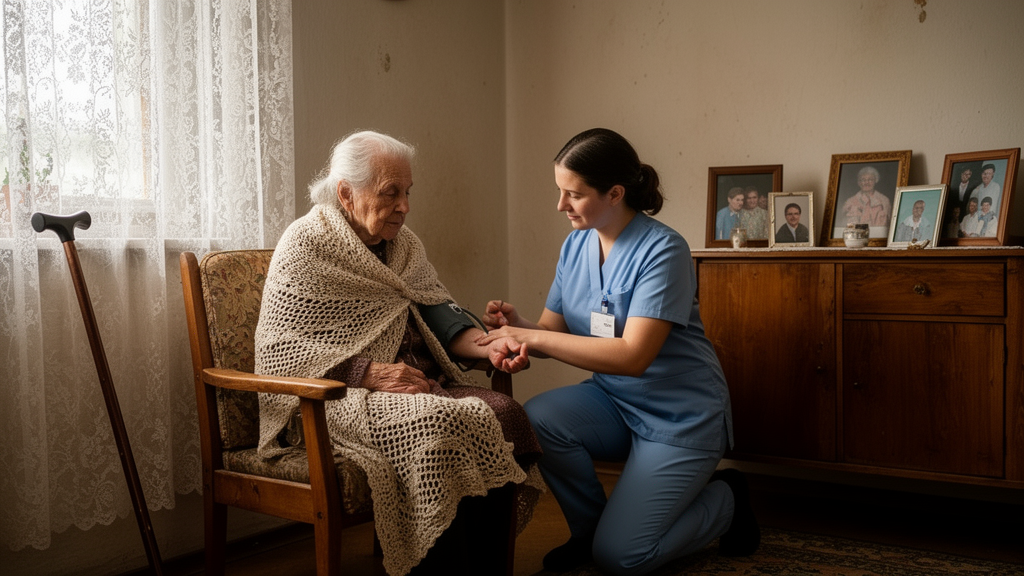
Community nurses in Austria see, house by house and street by street, what it actually takes for an older person to keep living at home. A new exploratory survey of these frontline health workers suggests that the barriers to aging in place look strikingly different in cities than in the countryside: rural nurses point first to gaps in infrastructure and transport, while their urban colleagues flag the erosion of social and community structures as the main obstacle to a decent old age in place.
The study, published in Frontiers in Public Health, was led by Tatjana Fischer of BOKU University in Vienna together with Anita Sackl of the Austrian National Public Health Institute and statistician Karl Moder, also of BOKU University. The team conducted a standardized online survey between November and December 2024, deliberately timed for the closing phase of Austria’s Community Nursing pilot project, a program funded from 2022 to 2024 through the EU GenerationNext initiative that deployed nurses to 242 of the country’s 2,092 municipalities, organized into 117 pilot projects, to offer preventive, advisory and coordinating services directly to residents.
The motivation for the study emerged in June 2023, when a community nurse attending a lecture series on quality of life in old age described the challenges in her municipality and explicitly asked to discuss the age-friendliness of municipalities with spatial planners. Because Austria’s population is aging rapidly, with 1.9 million people aged 65 and over, roughly 21 percent of the total population as of February 2026, and because spatial disparities exist in both double aging and the provision of social infrastructure, the authors saw community nurses as an untapped source of place-based knowledge for planners and public health experts alike.
Of the 273 community nurses registered in Austria at the time of the survey, 41 opened the questionnaire, 31 named their municipalities, 24 answered at least the first half of the questions, and 23 identified older adults as their clients. Those 23 records formed the analytical dataset: 10 responses came from nurses working in urban municipalities and 13 from nurses in rural ones, representing roughly one in four urban pilot projects and one in seven rural ones. Because the sample is small and riddled with missing values, the authors present their results descriptively and stress that nothing here is representative of Austria or of different municipal types.
To organize what the nurses said, the researchers used a questionnaire of 22 predominantly open-ended questions in six thematic sections, covering everyday observations, future trends, impressions of and wishes for the municipality, communication with local stakeholders, and involvement in local planning. The open-ended answers were coded using the health determinants model of Dahlgren and Whitehead, which links individual characteristics and lifestyle to housing conditions, social and community networks, and broader socio-economic, cultural and environmental conditions. The team added accessible infrastructure, a priority of the World Health Organization’s Age-Friendly Cities framework, as an extra dimension. Statistical testing relied on Fisher’s exact test, appropriate for small contingency tables, with Cohen’s Kappa used to check how consistently nurses from the same municipality answered; three cases showed moderate-to-substantial agreement, with Kappa values of 0.6099, 0.7249 and 0.6477.
A clear pattern concerned how vulnerable older adults appear relative to other client groups. Twelve of the 23 respondents said older people, including the very old, were particularly vulnerable, and ten of those twelve worked in rural municipalities. The association between municipality type and this perception yielded a p-value of 0.0123, while the converse view, that older adults are merely one vulnerable group among many, was reported more often by urban nurses, with a p-value of 0.0034. The authors caution that with 63 uncorrected hypothesis tests on a tiny sample, these p-values serve only as exploratory description, not confirmatory evidence, and that neither working experience nor level of employment was associated with how respondents recognized vulnerable groups.
When asked what hampers their day-to-day work, the nurses most often cited unsuitable living and housing situations for aging, named by 16 respondents, followed by car dependency and the lack of caring or caregiving relatives, each named by 12. Weather conditions were mentioned three times. Notably, nurses working 20 or more hours a week reported the absence of caregiving relatives as a challenge more often than part-time colleagues, with a p-value of 0.0361, suggesting that the erosion of family care capacity weighs heaviest on those carrying the fullest caseloads. No association emerged between these challenges and the urban or rural character of the municipality.
Looking ahead, the nurses judged demographic change or aging, named by 21 respondents, and poverty in old age, also named by 21, to be the future trends that would most seriously affect their work, with climate change and natural hazards close behind at 20. The authors interpret this convergence of demographic aging with climate-related threats as a compounding problem: overlapping risks increase the complexity of care planning, the burden on care staff, and the demands on preventive measures and crisis management, particularly in rural alpine regions where long distances, deficient public transport and extreme weather already complicate care delivery.
Perhaps the most policy-relevant finding concerns the nurses’ role in local decision-making. Fifteen respondents said they talk with local politicians such as mayors, 13 with public authorities, and only five with clubs and associations including the Church. Yet just six of the 23 nurses had ever been involved in local planning, five of them rural, and six more said they would like to be, four of them urban. Seven nurses said they would like to share their place-based observations, particularly on accessibility, with public authorities or spatial planners. The study found no link between where a nurse’s office was located and whether they communicated with stakeholders, and it could not determine why local decision-makers show little interest in the nurses’ spatial knowledge.
The authors argue that this untapped knowledge matters because community nurses are outreach workers who make preventive home visits and know their clients’ living arrangements and social spaces, giving them an unvarnished view of the space-health-care nexus that spatial planners rarely access. They suggest that linking illness trajectories with housing situations in health impact assessments could show decision-makers the real-life circumstances of older adults, and that nurses’ insights could feed tools for assessing the age-friendliness of settlement structures, from mixed-use development at the local scale to infrastructure provision and location planning at the regional scale.
The study is, according to its authors, the first attempt in the German-speaking countries to capture local aging-in-place conditions from the community nursing perspective while considering urban-rural differences. Its limitations are substantial: the survey ran during a period of organizational uncertainty and survey fatigue, the response chain through pilot project contacts means the number of nurses who actually received the invitation cannot be verified, and the absence of population data on Austrian community nurses makes selection and self-selection bias impossible to rule out. Coding was performed by a single author without independent double coding, and no triangulation or mixed-methods validation was performed. Still, the findings align with international literature and with the WHO’s Age-Friendly Cities framework and the Sustainable Development Goals on health and sustainable communities, and they point to a cautious conclusion: for single older adults, those with reduced mobility, and those at risk of poverty, aging in place may become steadily harder, whether in low-density rural municipalities or in cities, unless housing, mobility, infrastructure and social networks are addressed together.
Subject of Research: Community nurses' perspectives on aging in place and age-friendliness of urban and rural Austrian municipalities
Article Title: Aging in place in urban and rural contexts—Voices of community nurses from Austria
Article References: Fischer, T., Sackl, A., & Moder, K. (2026). Aging in place in urban and rural contexts—Voices of community nurses from Austria. Frontiers in Public Health, 14, Article 1869649. https://doi.org/10.3389/fpubh.2026.1869649
Image Credits: AI Generated
DOI: 10.3389/fpubh.2026.1869649
Keywords: aging in place, community nursing, Austria, rural-urban differences, health determinants, age-friendly municipalities, spatial planning, long-term care, demographic change, online survey, public health, housing
Cite Scienmag News
Phoebe Ingram. (October 26, 2026). Community Nurses Reveal What Makes Austrian Towns Hard Places to Grow Old In. Scienmag. https://scienmag.com/community-nurses-reveal-what-makes-austrian-towns-hard-places-to-grow-old-in/
Phoebe Ingram. "Community Nurses Reveal What Makes Austrian Towns Hard Places to Grow Old In." Scienmag, 26 October 2026, https://scienmag.com/community-nurses-reveal-what-makes-austrian-towns-hard-places-to-grow-old-in/. Accessed 26 October 2026.
Phoebe Ingram. "Community Nurses Reveal What Makes Austrian Towns Hard Places to Grow Old In." Scienmag. October 26, 2026. https://scienmag.com/community-nurses-reveal-what-makes-austrian-towns-hard-places-to-grow-old-in/


