


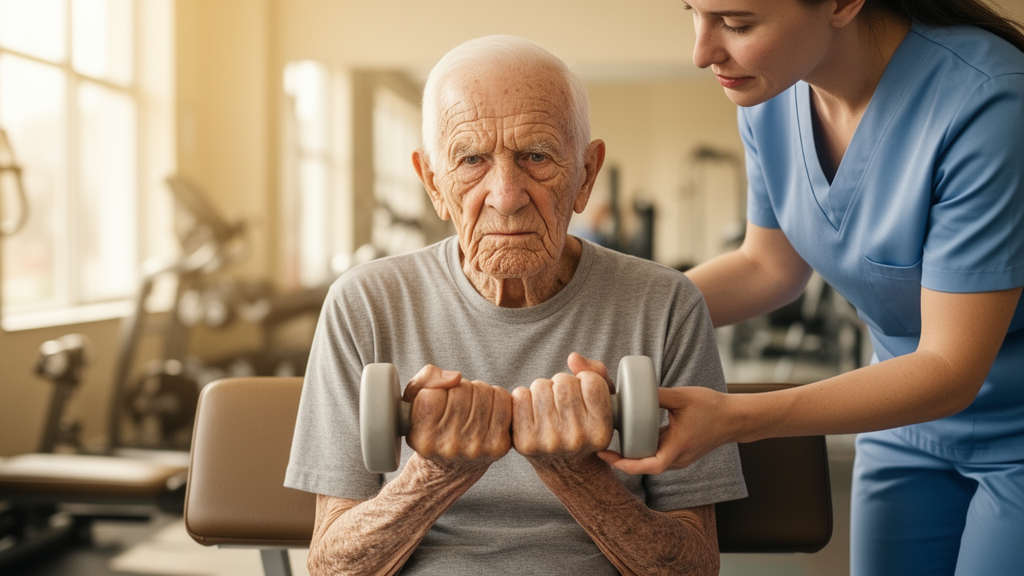
Resistance training may strengthen the thighs of frail and pre-frail older adults, but the evidence that it improves broader physical function or frailty itself remains far weaker, according to a systematic review and meta-analysis of randomized controlled trials published in Frontiers in Public Health. Pooling data from nine trials involving 566 participants aged 60 and older, all explicitly diagnosed as frail or pre-frail using validated assessment tools, the review found low-certainty evidence that structured resistance training may improve knee extensor strength, with a standardized mean difference of 1.30 (95% confidence interval 0.48 to 2.13). Possible benefits for handgrip strength and gait speed were supported only by very-low-certainty evidence, while the effects on Timed Up and Go performance, Short Physical Performance Battery score, and frailty score remained uncertain.
Frailty is a common clinical syndrome in geriatric medicine characterized by a decline in multisystem physiological reserve and reduced tolerance to stressors. Unlike chronological aging alone, it represents an identifiable high-risk state closely associated with falls, hospitalization, admission to long-term care, mortality, reduced quality of life, and increased healthcare resource use. Crucially, frailty is not a fixed condition: individuals may transition among robust, pre-frail, and frail states. That plasticity is what makes early intervention attractive, because identifying and treating pre-frail or early frail older adults before substantial functional decline occurs is considered an important strategy for delaying deterioration and reducing adverse outcomes. Exercise is among the most commonly recommended non-pharmacological strategies, and current clinical practice guidelines recommend that frail older adults receive multicomponent physical activity that includes progressive resistance training.
The review’s authors, Xiaodong Qian, Wei Huang, and Lingzi Yao, argue that previous syntheses have muddied the picture by mixing populations. Earlier systematic reviews often combined older adults identified with frailty assessment tools together with populations selected on the basis of sarcopenia, reduced muscle strength, or impaired physical performance. That overlap is understandable, since weakness and slow gait speed are core diagnostic criteria in the widely used Fried physical frailty phenotype, but sarcopenia mainly represents the muscle-related dimension of frailty and does not define frailty as a whole, which also includes constructs such as cognitive frailty. When populations defined by validated frailty tools are not distinguished from those selected only by subdimensions of frailty, the effects of resistance training in truly frail or pre-frail older adults become difficult to interpret.
To sharpen that focus, the team searched seven electronic information sources from database inception to August 2026 with no language restrictions, covering PubMed, Embase, the Cochrane Central Register of Controlled Trials, Web of Science, China National Knowledge Infrastructure, ClinicalTrials.gov, and ProQuest. The review was registered in PROSPERO and conducted according to the PRISMA 2020 reporting guidelines. From 2,889 identified records, after removing 594 duplicates and screening 2,295 by title and abstract, the reviewers assessed 31 full-text reports and excluded 22 for ineligible design, population, intervention, or duplicate publication. The final synthesis included nine randomized controlled trials comprising 27 study arms and 566 participants with a pooled mean age of 75.9 years.
Most studies diagnosed frailty or pre-frailty using the Fried or Cardiovascular Health Study frailty phenotype, in which meeting one to two criteria defined pre-frailty and three or more defined frailty. One study used the Tilburg Frailty Indicator alongside the FRAIL scale. The trials were conducted in China, Portugal, Brazil, the United Kingdom, Turkey, and South Korea, in settings ranging from communities and hospitals to residential care homes and long-term care facilities. All interventions centered on resistance or strength training, including elastic band and TheraBand programs, machine-based pneumatic resistance, ankle-weight and dumbbell training, and chair-based exercise. Intervention duration ranged from 6 to 28 weeks, with a mean of roughly 14.9 weeks, and most programs ran two to three times per week in sessions of 25 to 60 minutes.
The headline result concerned the quadriceps. Across six comparisons from five trials involving 340 participants, resistance training was associated with improved knee extensor strength, with a standardized mean difference of 1.30, an effect the authors classify as very large on their scale, though rated only low certainty by the GRADE framework. Handgrip strength, pooled from seven comparisons involving 353 participants, showed a mean difference of 4.15 kilograms (95% CI 0.81 to 7.48) with very-low-certainty evidence. Gait speed, pooled from six comparisons involving 305 participants, improved by 0.13 meters per second (95% CI 0.00 to 0.26), also at very low certainty. Yet between-study heterogeneity was substantial to considerable for these outcomes, with I-squared values of 77.2 percent for knee extensor strength, 85.6 percent for handgrip strength, and 78.0 percent for gait speed, and the 95% prediction intervals crossed the null in every case.
The picture for broader function was even murkier. Timed Up and Go performance, pooled from four comparisons involving 296 participants, showed a mean difference of minus 0.14 seconds with a confidence interval spanning 3.14 seconds lower to 2.85 seconds higher. The Short Physical Performance Battery, from only three comparisons involving 102 participants, yielded a mean difference of 2.30 points (95% CI minus 2.39 to 6.99) with very high heterogeneity of 94.5 percent. Frailty scores, from four comparisons involving 190 participants, showed a standardized mean difference of minus 0.70 (95% CI minus 1.76 to 0.35). For handgrip strength, gait speed, TUG, and SPPB, clinical importance remained uncertain because each confidence interval encompassed the corresponding reference threshold for clinical importance, and the certainty of evidence for all these outcomes was very low.
Subgroup analyses did not identify consistent effect modifiers. For handgrip strength, effects did not differ significantly by intervention duration, frailty status, training intensity above or below 70 percent of one-repetition maximum, or session duration. For gait speed, however, the subgroup difference by frailty status was statistically significant: the pooled effect was positive in studies enrolling pre-frail participants (0.20 meters per second) and in mixed frail and pre-frail populations (0.06 meters per second), while the estimate from the single study enrolling frail participants alone was not significant. The authors stress this pattern is hypothesis-generating rather than evidence of a differential effect, since the frail-only subgroup rested on one comparison. Sensitivity analyses, including leave-one-out analyses and alternative correlation assumptions, broadly supported the robustness of the pooled estimates.
The authors offer a physiological explanation for the outcome-specific pattern. Many resistance-training programs directly load the lower-limb extensor musculature, making knee extensor strength a relatively direct measure of training-related adaptation. By contrast, TUG and SPPB depend on the integration of multiple functional abilities beyond muscle strength, including balance, gait, chair-rise performance, turning, and task coordination, so improvements may require not only increased strength but also balance, walking, and task-specific practice. The contrast with an earlier review by Nagata and colleagues, which reported a significant SPPB improvement using broader frailty eligibility criteria, may partly reflect differences in population definition, baseline functional status, and intervention characteristics, underscoring how strongly conclusions depend on how frailty is defined.
Methodological quality was mixed: four of the nine studies were rated overall low risk of bias and five overall high risk, with concerns concentrated on outcome data not included in analysis, allocation concealment, and blinding of outcome assessors. The review also carries limitations the authors acknowledge: few trials and small samples, varied training protocols, diverse recruitment settings, inconsistent reporting of training prescriptions and safety outcomes, and reference thresholds for clinical importance that were derived from other populations, including community-dwelling older adults, stroke survivors, and lumbar surgery patients. Reporting of adverse events was sparse, though four reports stated no intervention-attributable adverse effects occurred. The authors conclude that resistance training may be most useful for targeting strength- and mobility-related limitations, while broader goals such as improving composite physical function, quality of life, independence, or fall risk may require combining it with balance training, walking practice, nutritional support, or multicomponent geriatric care. Adequately powered trials with standardized, progressive training prescriptions and longer-term follow-up are needed before firm recommendations can be made.
Subject of Research: Effects of resistance training on muscle strength, physical function, and frailty scores in frail and pre-frail older adults
Article Title: Effects of resistance training on frailty-related outcomes in frail and pre-frail older adults: a systematic review and meta-analysis of randomized controlled trials
Article References: Qian, X., Huang, W., & Yao, L. (2026). Effects of resistance training on frailty-related outcomes in frail and pre-frail older adults: a systematic review and meta-analysis of randomized controlled trials. Frontiers in Public Health, 14, Article 1896512. https://doi.org/10.3389/fpubh.2026.1896512
Image Credits: AI Generated
DOI: 10.3389/fpubh.2026.1896512
Keywords: frailty, resistance training, older adults, meta-analysis, muscle strength, gait speed, handgrip strength, randomized controlled trials, physical function, healthy aging, GRADE certainty, sarcopenia
Cite Scienmag News
Beatrice Stafford. (October 26, 2026). Resistance Training May Strengthen Frail Older Adults, but Evidence Remains Shaky. Scienmag. https://scienmag.com/resistance-training-may-strengthen-frail-older-adults-but-evidence-remains-shaky/
Beatrice Stafford. "Resistance Training May Strengthen Frail Older Adults, but Evidence Remains Shaky." Scienmag, 26 October 2026, https://scienmag.com/resistance-training-may-strengthen-frail-older-adults-but-evidence-remains-shaky/. Accessed 26 October 2026.
Beatrice Stafford. "Resistance Training May Strengthen Frail Older Adults, but Evidence Remains Shaky." Scienmag. October 26, 2026. https://scienmag.com/resistance-training-may-strengthen-frail-older-adults-but-evidence-remains-shaky/


