

Monday, October 26, 2026
Science
No Result
View All Result
  • Login
  • HOME
  • SCIENCE NEWS
  • CONTACT US
  • HOME
  • SCIENCE NEWS
  • CONTACT US
No Result
View All Result
Scienmag
No Result
View All Result
Home Science News Technology and Engineering

Edible capacitive tilt sensor tracks continuous tilt for sustainable soft robotics

October 26, 2026
in Technology and Engineering
Denise Maddox
By Denise Maddox Scienmag Editorial Profile - Mechanical Engineering
Reading Time: 3 mins read
0
Edible capacitive tilt sensor tracks continuous tilt for sustainable soft robotics

Edible capacitive tilt sensor tracks continuous tilt for sustainable soft robotics

65
SHARES
587
VIEWS
Share on FacebookShare on Twitter
ADVERTISEMENT

Researchers have unveiled the first fully edible tilt sensor capable of reporting a continuous range of inclination angles, a step toward robots that can be eaten, digested and metabolized after completing their mission. The device, described in an open-access paper in Scientific Reports, replaces the binary on-off response of the only previously reported edible tilt sensor with an analog signal that tracks how far the sensor has tipped, from 0 degrees all the way to 80 degrees.

The sensor relies on capacitance rather than resistance, a choice the authors say is central to its performance. Resistive sensing, used in the earlier edible device, is strongly affected by heat and humidity, which limits its usefulness in wet environments such as inside the human body. Capacitive measurements are, by principle, far less sensitive to temperature and moisture, making the new sensor better suited to the damp, warm conditions that edible robots are ultimately meant to operate in.

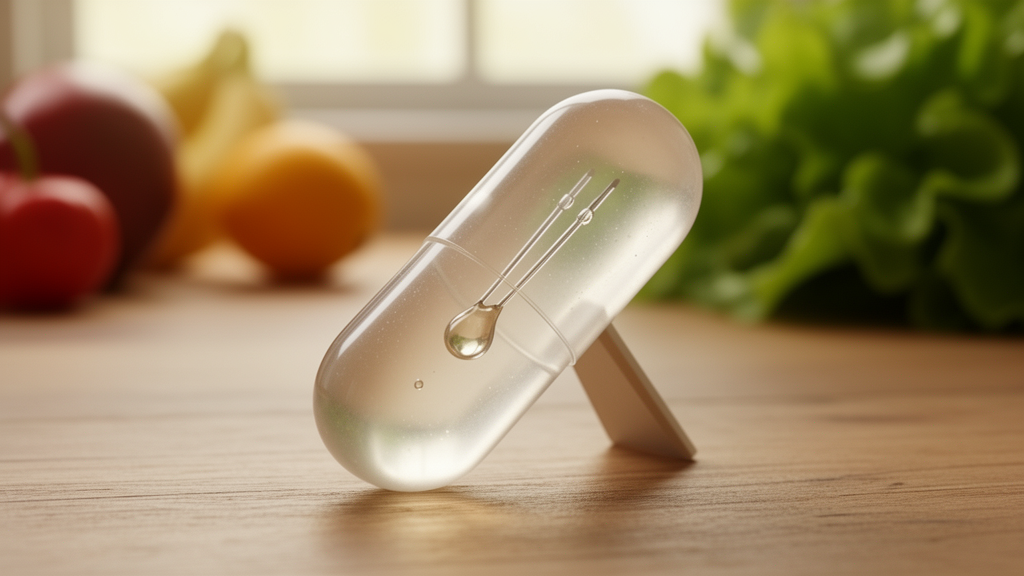
Structurally, the device is simple and entirely food-based. A compartment made of gelatine is coated with wax, graphite provides the electrodes, and an edible dielectric liquid serves as the sensing medium. Reading the capacitance variance as the sensor tilts gives a measure of the tilt angle, allowing the sensor to monitor the self state of a robot, including its orientation and inclination, continuously rather than in discrete steps.

In characterization tests, the team reports a large working range spanning 0 to 80 degrees, a sensitivity of 2.34 percent per degree, and good repeatability across measurements. Those figures describe a laboratory prototype, and the authors present the concept, design, fabrication and characterization of the sensor in detail, providing a basis for other groups to reproduce and refine the approach.

Beyond the bench, the researchers demonstrated the sensor’s application in robotic control, showing that its continuous tilt readout can feed into the guidance of a robotic system. That capability matters because tilt sensing is a key technology for autonomous robotic control: a robot navigating on its own needs to know its own orientation. For edible transient robots, which are designed to dissolve or be metabolized after use, every component, including the sensors, must be built from materials that are safe to swallow and break down naturally.

The work addresses a specific gap in the edible robotics literature. Until now, the only fully edible tilt sensor reported produced a binary output, meaning it could signal whether a threshold had been crossed but not how far the device had tilted, and its resistive principle made it vulnerable to the very heat and humidity that edible robots would encounter. By combining a continuous capacitive readout with food-grade materials, the new sensor extends what edible devices can sense and how reliably they can sense it.

The authors position the device as paving the way for sustainable, autonomously navigable edible soft robotics, in which robots made of consumable materials could perform tasks and then simply disappear. The paper was published on 23 October 2026 and is being shared early as a peer-reviewed, accepted manuscript that carries a permanent DOI, with a final version of record to follow. As with any early-release article, the published version remains subject to further edits.

Subject of Research: Edible capacitive tilt sensors for sustainable autonomous soft robotics

Article Title: An edible capacitive tilt sensor towards sustainable autonomous robotics

Article References: Qi, Q., Kumaresan, Y., Keller, A., Garrad, M., & Rossiter, J. (2026). An edible capacitive tilt sensor towards sustainable autonomous robotics. Scientific Reports. https://doi.org/10.1038/s41598-026-70258-2

Image Credits: AI Generated

DOI: 10.1038/s41598-026-70258-2

Keywords: edible robotics, tilt sensor, capacitive sensing, gelatine, soft robotics, sustainable technology, transient devices, autonomous navigation, Scientific Reports, edible, capacitive, tilt

Cite Scienmag News

Denise Maddox. (October 26, 2026). Edible capacitive tilt sensor tracks continuous tilt for sustainable soft robotics. Scienmag. https://scienmag.com/edible-capacitive-tilt-sensor-tracks-continuous-tilt-for-sustainable-soft-robotics/


Denise Maddox. "Edible capacitive tilt sensor tracks continuous tilt for sustainable soft robotics." Scienmag, 26 October 2026, https://scienmag.com/edible-capacitive-tilt-sensor-tracks-continuous-tilt-for-sustainable-soft-robotics/. Accessed 26 October 2026.

Denise Maddox. "Edible capacitive tilt sensor tracks continuous tilt for sustainable soft robotics." Scienmag. October 26, 2026. https://scienmag.com/edible-capacitive-tilt-sensor-tracks-continuous-tilt-for-sustainable-soft-robotics/

Tags: autonomous navigationbiocompatible soft robotic sensorscapacitance versus resistance sensingcapacitivecapacitive sensingcontinuous inclination measurementdielectric liquid as sensing mediumedibleEdible capacitive tilt sensoredible roboticsfood-based sensor designgelatinegelatine and wax components in edible sensorsgraphite electrodes in food electronicsmoisture and temperature resilience in edible devicesopen-access research on edible sensorsScientific Reportssoft roboticssoft robotics applicationssustainable edible roboticsSustainable Technologytilttilt sensortransient devices
Share26Tweet16
Previous Post

Exercise Is Linked to Less Procrastination in Students, But Only When They Sleep Well

Next Post

Behaviour-Change Nursing Package Tied to Better Diet Adherence in Non-Dialysis Kidney Patients

Related Posts

Titanium Dioxide Microsphere Scattering Layer Boosts Dye-Sensitized Solar Cell Efficiency
Technology and Engineering

Titanium Dioxide Microsphere Scattering Layer Boosts Dye-Sensitized Solar Cell Efficiency

October 26, 2026
Waste powders cut concrete’s carbon footprint while boosting strength and durability
Technology and Engineering

Waste powders cut concrete’s carbon footprint while boosting strength and durability

October 26, 2026
EPICCAD benchmark gives AI the rules behind editable engineering designs
Technology and Engineering

EPICCAD benchmark gives AI the rules behind editable engineering designs

October 26, 2026
Physics-guided neural networks outperform data-only models on fractional LCR circuit
Technology and Engineering

Physics-guided neural networks outperform data-only models on fractional LCR circuit

October 26, 2026
AI System Pairs Transformer Memory With Reinforcement Learning to Personalize Digital Psychological Support
Technology and Engineering

AI System Pairs Transformer Memory With Reinforcement Learning to Personalize Digital Psychological Support

October 26, 2026
University of Michigan Wins $5.66 Million to Build Crash-Preventing Smart Intersections
Technology and Engineering

University of Michigan Wins $5.66 Million to Build Crash-Preventing Smart Intersections

October 26, 2026
Next Post
Behaviour-Change Nursing Package Tied to Better Diet Adherence in Non-Dialysis Kidney Patients

Behaviour-Change Nursing Package Tied to Better Diet Adherence in Non-Dialysis Kidney Patients

  • Mothers who receive childcare support from maternal grandparents show more optimized

    Mothers who receive childcare support from maternal grandparents show more parental warmth, finds NTU Singapore study

    27656 shares
    Share 11059 Tweet 6912
  • University of Seville Breaks 120-Year-Old Mystery, Revises a Key Einstein Concept

    1061 shares
    Share 424 Tweet 265
  • Bee body mass, pathogens and local climate influence heat tolerance

    682 shares
    Share 273 Tweet 171
  • Researchers record first-ever images and data of a shark experiencing a boat strike

    546 shares
    Share 218 Tweet 137
  • Groundbreaking Clinical Trial Reveals Lubiprostone Enhances Kidney Function

    531 shares
    Share 212 Tweet 133
Science

Embark on a thrilling journey of discovery with Scienmag.com—your ultimate source for cutting-edge breakthroughs. Immerse yourself in a world where curiosity knows no limits and tomorrow’s possibilities become today’s reality!

RECENT NEWS

  • Titanium Dioxide Microsphere Scattering Layer Boosts Dye-Sensitized Solar Cell Efficiency
  • Behaviour-Change Nursing Package Tied to Better Diet Adherence in Non-Dialysis Kidney Patients
  • Edible capacitive tilt sensor tracks continuous tilt for sustainable soft robotics
  • Exercise Is Linked to Less Procrastination in Students, But Only When They Sleep Well

Categories

  • Agriculture
  • Anthropology
  • Archaeology
  • Athmospheric
  • Biology
  • Biotechnology
  • Blog
  • Bussines
  • Cancer
  • Chemistry
  • Climate
  • Earth Science
  • Editorial Policy
  • Marine
  • Mathematics
  • Medicine
  • Pediatry
  • Policy
  • Psychology & Psychiatry
  • Science Education
  • Science News
  • Social Science
  • Space
  • Technology and Engineering

Subscribe to Blog via Email

Enter your email address to subscribe to this blog and receive notifications of new posts by email.

Join 5,151 other subscribers

© 2025 Scienmag - Science Magazine

Welcome Back!

Login to your account below

Forgotten Password?

Retrieve your password

Please enter your username or email address to reset your password.

Log In
No Result
View All Result
  • HOME
  • SCIENCE NEWS
  • CONTACT US

© 2025 Scienmag - Science Magazine

Discover more from Science

Subscribe now to keep reading and get access to the full archive.

Continue reading